On this day: the Americans with Disabilities Act is signed
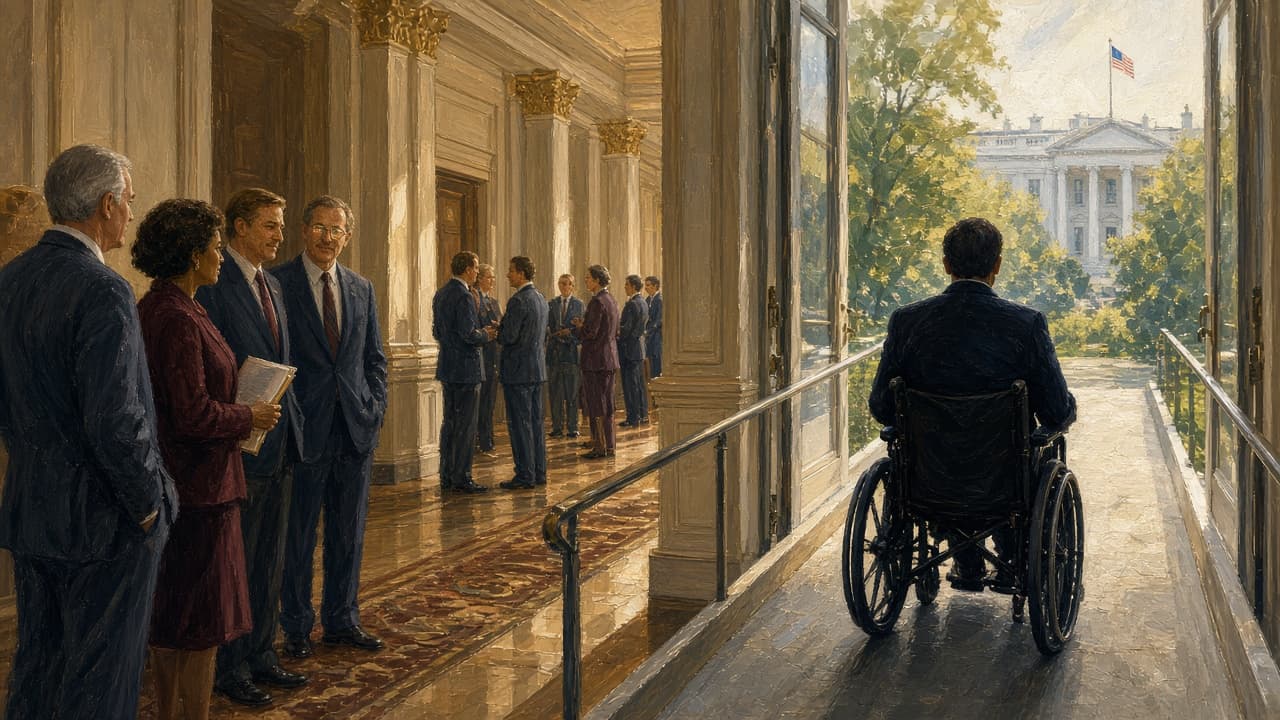
On 26 July 1990, President George H. W. Bush signed the Americans with Disabilities Act on the South Lawn of the White House. The law banned disability discrimination in employment, public services, transport and business, and it changed the built environment.
On 26 July 1990, in front of around three thousand people on the South Lawn of the White House, George H. W. Bush signed the Americans with Disabilities Act. He ended his remarks with a line aimed at the physical and legal barriers the law targeted: "Let the shameful wall of exclusion finally come tumbling down." It remains the broadest civil rights statute for disabled people anywhere, and it applies to roughly one in four American adults.

Before the ADA, the legal position was patchy. Section 504 of the Rehabilitation Act of 1973 barred disability discrimination, but only by entities receiving federal money. A private restaurant, shop, cinema or office was free to refuse service or employment. Buses and trains had no obligation to be usable. Many disabled Americans could not physically reach a polling place, a courtroom or a job interview, and that exclusion was entirely lawful.
The law came out of decades of organizing by disabled people themselves, not from a sympathetic committee. The independent living movement, which began around Ed Roberts and the Center for Independent Living in Berkeley in the early 1970s, argued that disability is produced by inaccessible environments rather than by bodies alone. Deaf students shut down Gallaudet University in 1988 in the Deaf President Now protest and won. Those campaigns built the political capacity to push a broad federal bill.
The most direct action came four months before the signing. In March 1990, with the bill stalled in the House, more than sixty disabled protesters left their wheelchairs and mobility aids at the bottom of the Capitol steps and climbed the eighty-three stone steps with their arms. Among them was eight-year-old Jennifer Keelan-Chaffins. The Capitol Crawl gave the campaign an image that was impossible to argue with, and the bill moved.
The statute is organized in five titles and it is worth knowing what each does. Title I covers employment: employers with 15 or more workers cannot discriminate and must provide reasonable accommodation unless it causes undue hardship. Title II covers state and local government, including schools, courts, voting and public transport. Title III covers private businesses open to the public, from shops to doctors' offices. Title IV requires telephone relay services. Title V handles miscellaneous provisions including protection against retaliation.
Two phrases carry most of the weight in practice. Reasonable accommodation means a change to a job or setting that lets a qualified person do the work: a modified schedule, screen-reading software, a desk at a different height, permission to sit. Undue hardship is the employer's defence, measured against the size and resources of the business. Courts have spent thirty-five years working out where the line falls, and those two terms are where most ADA litigation lives.
The effects most people see are architectural. Curb cuts at intersections, ramps beside steps, accessible toilet stalls, lifts, lever handles instead of round knobs, wide doorways, audible pedestrian signals, kneeling buses and reserved parking spaces all follow ADA accessibility guidelines. Many of these help people who do not identify as disabled at all: parents with strollers, delivery workers, travellers with suitcases, older people with sore knees. Designers call this the curb cut effect.
The law did not arrive finished. Supreme Court rulings in the late 1990s and early 2000s read the definition of disability narrowly, excluding people whose conditions were controlled by medication or devices. Congress responded with the ADA Amendments Act of 2008, which restored a broad reading and instructed courts to focus on whether discrimination occurred rather than on whether the plaintiff qualified. That correction is a necessary part of the story.
Enforcement also remains uneven. The ADA relies heavily on private lawsuits, which means compliance often depends on somebody being willing to sue. Employment outcomes have improved less than access to buildings: the employment rate for disabled Americans remains far below that of non-disabled Americans. Web accessibility became a major contested area after 1990 because the statute was written before the commercial internet, and courts have divided on how far Title III reaches online.
Internationally the ADA became a template. Australia passed its Disability Discrimination Act in 1992, the United Kingdom in 1995, and the United Nations Convention on the Rights of Persons with Disabilities opened for signature in 2007 with drafting influenced by the American model. Accessibility requirements in building codes across dozens of countries now resemble the standards set in 1990 and 1991.
Eagle Frame's takeaway: 26 July 1990 is the day the United States made disability discrimination illegal across employment, government services and public business. The ramps and curb cuts are the visible half. The harder half is employment, where the law's promise of reasonable accommodation is still argued case by case thirty-five years on.