On this day: the Andrea Doria sinks after a collision
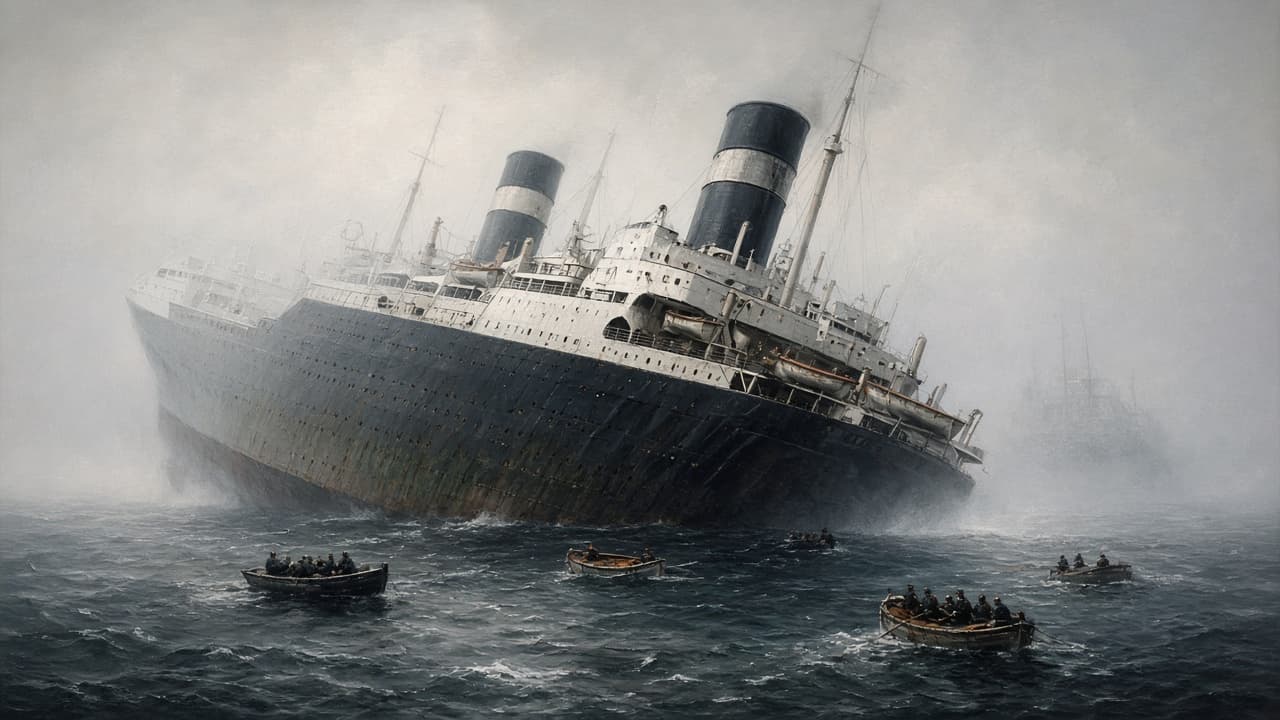
On 25 July 1956, the Italian liner Andrea Doria and the Swedish ship Stockholm collided in fog off Nantucket. Forty-six people aboard the Andrea Doria died, about 1,660 were rescued and the liner rolled under the next morning.
At about 23:10 on the night of 25 July 1956, in dense fog roughly 45 nautical miles south of Nantucket, the reinforced bow of the Swedish liner Stockholm cut into the starboard side of the Italian liner Andrea Doria. Both ships had radar. Both crews had been watching each other approach for close to 20 minutes. The Andrea Doria took on water immediately, listed further and further to starboard through the night, and rolled over and sank at 10:09 the following morning. The wreck was photographed from the air, and the pictures of a modern liner lying on her side became some of the most reproduced maritime images of the century.
The Andrea Doria was the pride of the Italian Line and of postwar Italy. She was launched in 1951 and entered service in January 1953, measured 29,100 gross tons and 700 feet, carried murals and mosaics commissioned from Italian artists and had three outdoor swimming pools, one for each class. On this crossing she was nine days out of Genoa with 1,134 passengers and 572 crew, due at her New York pier the next morning. Many passengers had already packed and left their cabin doors open for early disembarkation.
The Stockholm was a different kind of ship. She belonged to the Swedish American Line, displaced about 12,600 tons and was less than half the Italian ship's size, but she had been built in 1948 with a heavily strengthened bow for winter service in ice. She had left New York that afternoon with 534 passengers, heading east on the same crowded corridor that funnelled almost all North Atlantic traffic past the Nantucket lightship.
How two radar-equipped ships hit each other in open water is the whole point of the story. The Andrea Doria had been in fog since the afternoon, sounding her whistle and running with watertight doors closed, but she had barely slowed, holding about 21.8 knots out of a possible 23 because she was trying to arrive on schedule. The Stockholm was in clear air, making about 18 knots, and was running north of the recommended eastbound track to shorten her passage. Each ship saw the other on radar from around 17 miles out. Each then formed a picture of the meeting that the other did not share. The Andrea Doria expected to pass starboard to starboard and turned to port to widen the gap. The Stockholm read a conventional port to port meeting and turned to starboard. The two turns aimed them at each other.
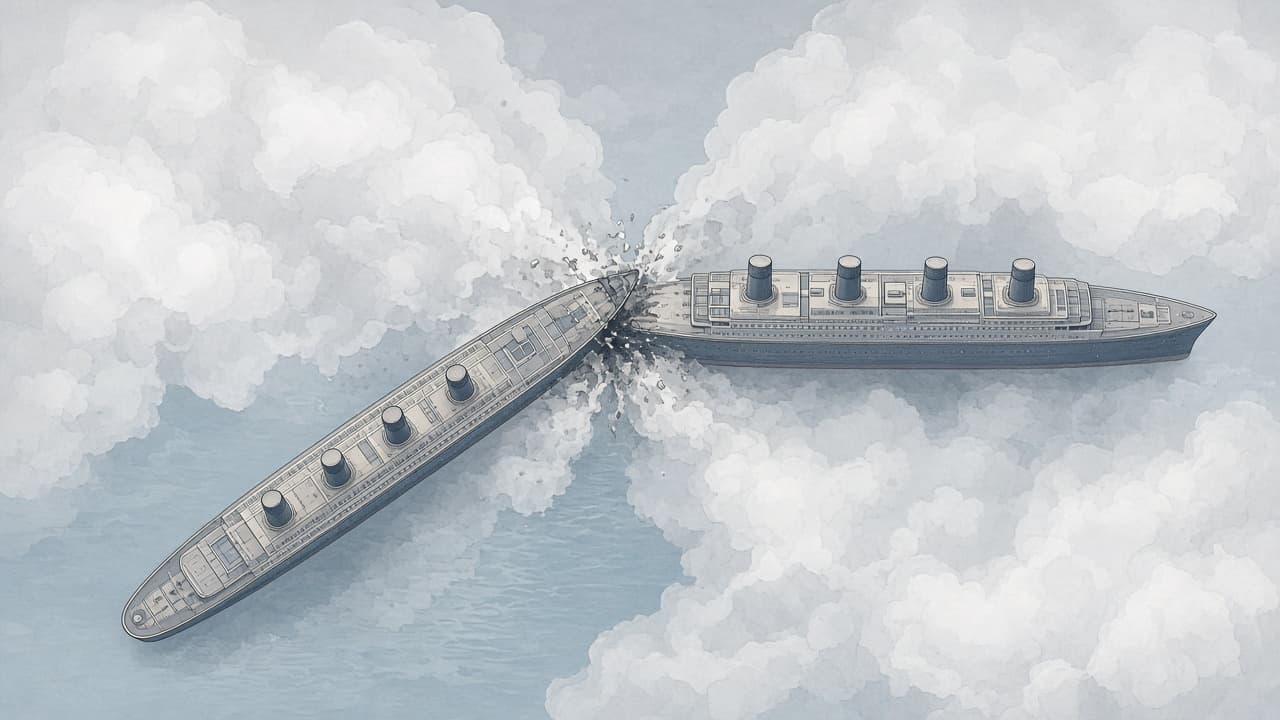
The impact drove the Stockholm's bow about 40 feet into the Andrea Doria just aft of the bridge, slicing through several passenger decks. Most of the deaths happened in that instant, in cabins that were simply cut open. The Stockholm lost roughly 75 feet of her bow and stayed afloat with her forward bulkheads holding. The Andrea Doria did not have that margin.
Her fate was decided by stability rather than by the size of the hole. She had been designed to survive flooding while listing no more than about 15 degrees, the angle beyond which lifeboats on the high side can no longer be swung out. Empty fuel and ballast tanks on her starboard side had not been refilled with seawater as they emptied during the crossing, a common cost-saving practice because clean tanks are easier to service, and water flooding those spaces plus a flooded generator room pushed her past 20 degrees within minutes. The list kept growing. The eight lifeboats on the port side hung inboard over the deck and could never be launched. That left seats for roughly half the people on board.
The rescue is why the death toll stayed low. The radio operator's distress call brought ships from a wide area. The Stockholm, damaged but stable, stayed alongside and took survivors aboard. The freighter Cape Ann, the military transport Private William H. Thomas and United States Coast Guard cutters closed in. The French liner Ile de France, already 44 miles past, turned around, lit every deck light she had as a beacon and took on 753 people. By dawn about 1,660 survivors had been recovered. Forty-six people aboard the Andrea Doria were killed and five crew on the Stockholm died, a combined total usually given as 51, with small variations between sources.
One survivor became famous by accident. Linda Morgan, 14, was asleep in a cabin on the Andrea Doria and was found alive on the wrecked bow of the Stockholm, scooped up by the intruding steel and carried across. Newspapers called her the miracle girl. Her half sister, asleep in the same cabin, was killed. Stories like hers dominated coverage, helped by the fact that reporters and photographers could reach the scene by aircraft and that television news was ready to use the footage.
The legal reckoning was quieter than expected. Hearings opened in New York with both lines blaming each other, and in January 1957 they settled out of court and split the costs, which meant no court ever formally apportioned fault. The technical lessons stuck harder. The phrase radar-assisted collision entered the maritime vocabulary to describe exactly this failure, where equipment works and interpretation does not. Radar plotting training became standard, the 1960 SOLAS conference tightened rules on subdivision and lifeboats, traffic separation schemes were introduced to keep opposing streams of ships apart, and the 1972 collision regulations spelled out obligations on safe speed and proper use of radar in restricted visibility.
The wreck lies about 240 feet down and has earned a grim nickname among divers, who call it the Everest of wreck diving because of the depth, the currents and the cold. More than 20 divers have died there since the 1980s. The hull has been collapsing for years, and the promenade decks that photographers captured in 1956 have largely fallen in.
Eagle Frame's takeaway: 25 July 1956 is the case study for trusting instruments without checking your assumptions. Two crews watched each other on radar for 20 minutes, each decided which way the other would pass, and the ship that sank did so mainly because her empty tanks were dry and her lifeboats could not be launched from a list nobody expected.