
On this day: Anne Frank and her family are captured
On 4 August 1944, after 761 days hidden in rooms behind an Amsterdam canal house, Anne Frank, her family and four others were arrested. Only her father survived the camps. The notebooks left on the floor became the most widely read personal account of the Holocaust.
On the morning of 4 August 1944, a car stopped outside Prinsengracht 263 in Amsterdam. An Austrian SS sergeant of the security service, Karl Josef Silberbauer, went up into the offices of the Opekta company with several Dutch police collaborators, ordered the staff aside and was led to a bookcase standing on a landing. The bookcase swung out. Behind it a door opened onto a set of rooms where eight people had been living for just over two years. All eight were taken away, along with two of the employees who had been hiding them, Victor Kugler and Johannes Kleiman. One of the eight was 15 years old and had spent the previous two months writing about what she would do after the war.
Annelies Marie Frank was born in Frankfurt on 12 June 1929. Her father Otto was a businessman who had served as an officer in the German army in the First World War. Her mother, Edith Hollander, came from a merchant family in Aachen. Her sister Margot was three years older. After the Nazis took power in 1933 the family left Germany, and Otto set up a Dutch branch of Opekta selling pectin for home jam making, later adding a spice business called Pectacon. Anne grew up in the Rivierenbuurt district of Amsterdam, went to a Montessori school and spoke Dutch with her friends. The Netherlands felt safe. Her parents tried for years to obtain American visas and the paperwork never came through.
Germany invaded on 10 May 1940 and the Dutch army surrendered in five days. The measures then came in order, each one small enough to absorb. Jews had to register in January 1941. They were removed from public office, then from universities and professions. Jewish-owned businesses were transferred to non-Jewish owners, so Otto put his firms in his colleagues' names while continuing to run them from a back office. From September 1941 Jewish children had to attend separate schools, and Anne and Margot moved to the Jewish Lyceum. From May 1942 everyone had to wear a yellow star. In July 1942 deportations began from the transit camp at Westerbork in the north-east of the country.
Anne was given a red and white checked autograph book for her 13th birthday on 12 June 1942 and started using it as a diary. On 5 July, Margot received a written order to report for a labour camp in Germany. The family left the house the next morning in the rain, wearing several layers of clothes because suitcases would have drawn attention, and moved into the rooms Otto had already been quietly preparing above and behind his business premises. The van Pels family, Hermann, Auguste and their son Peter, joined them on 13 July. A dentist, Fritz Pfeffer, arrived on 16 November 1942. Eight people in about 46 square metres.
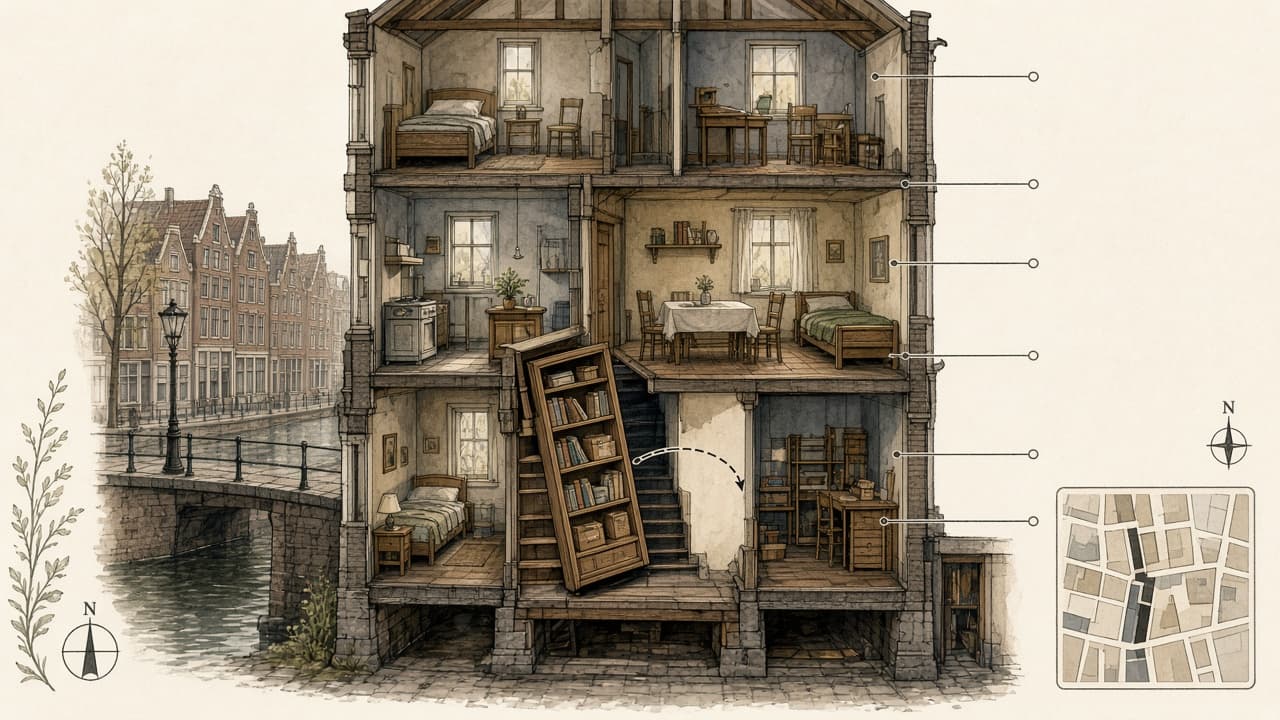
The mechanics of hiding are worth spelling out, because the diary is often read without them. The annex was the rear section of a narrow canal building, two floors plus an attic, reached by a staircase concealed behind a bookcase built by the warehouse manager Johan Voskuijl. Between roughly half past eight in the morning and six in the evening nobody could run a tap, flush a toilet, cough loudly or walk in shoes, because warehouse workers on the ground floor did not know they were there. Windows were blacked out or curtained in daylight. Four helpers kept them alive: Miep Gies, Bep Voskuijl, Kugler and Kleiman, who bought food using ration coupons obtained illegally, carried library books up the stairs and brought news. A radio in the private office let them hear Radio Oranje broadcasting from London, which is how they learned about the Normandy landings on 6 June 1944 and started to believe they would get out.
Anne wrote roughly 300 entries in two years. From spring 1944, after hearing a Dutch minister in exile broadcast an appeal for ordinary people to preserve records of the occupation, she began rewriting the diary on loose sheets with publication in mind, cutting some passages and sharpening others. She wrote about her irritation with Pfeffer and with her mother, her closeness to her father, her reading, her body, her fear of the doorbell, her feelings for Peter and her plan to be a writer or a journalist. The tone shifts from a schoolgirl's notebook to something deliberate. The final entry is dated 1 August 1944, three days before the raid.
After the arrest they were taken to the security service headquarters, then to a prison on the Weteringschans, then on 8 August to Westerbork. Because they had been caught in hiding they were classed as punishment cases and set to breaking up old batteries by hand. On 3 September 1944 they were loaded onto the last transport ever to leave Westerbork for Auschwitz, arriving on the night of 5 September into 6 September. Men and women were separated on the platform. Hermann van Pels was killed in the gas chambers within weeks of arrival. Edith Frank died in the women's camp on 6 January 1945 of hunger and exhaustion.
At the end of October 1944 Anne and Margot were put on a transport to Bergen-Belsen in northern Germany. Belsen had no gas chambers. It had no adequate food, water, shelter or sanitation either, and the population it received that winter was far beyond anything the camp was organized for. A typhus epidemic spread through it, carried by lice. Both sisters caught it and both died, most probably in February 1945, some weeks before British troops reached the camp on 15 April. Research published by the Anne Frank House in 2015 moved the likely date of death earlier than the March figure recorded after the war. Anne was 15. Peter van Pels died at Mauthausen on 10 May 1945, days after liberation. Auguste van Pels died in transit in the spring of 1945 and Fritz Pfeffer at Neuengamme on 20 December 1944. Of the eight, only Otto Frank came home. The Red Army reached Auschwitz on 27 January 1945 and he was still in the camp infirmary.
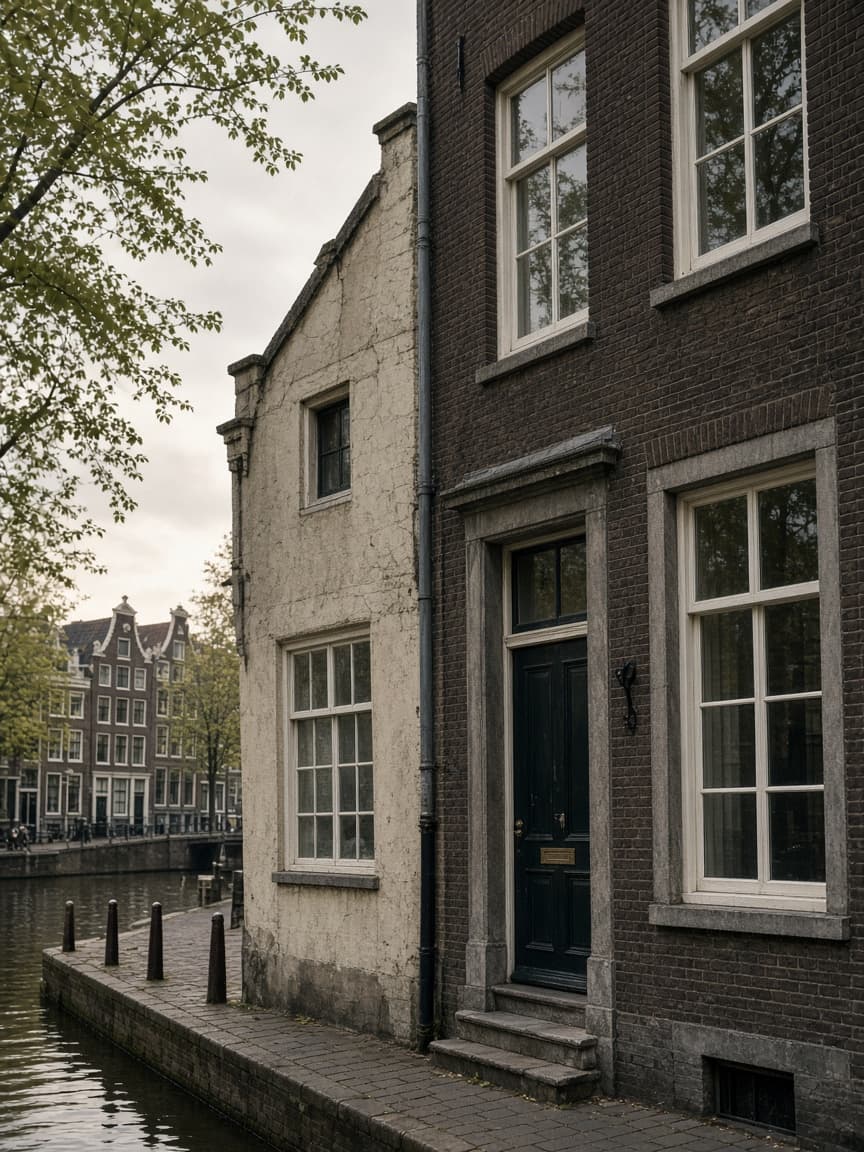
The papers survived by minutes. After the arresting party left with the people, Miep Gies and Bep Voskuijl went up into the ransacked rooms and gathered the notebooks and loose sheets from the floor, where they had been tipped out of a briefcase the officers wanted for valuables. Gies put them in her desk drawer and did not read them. She handed them to Otto Frank in the summer of 1945, once the Red Cross had confirmed that both daughters were dead. He typed a version, combining Anne's original diary with her own revision and cutting passages he found too private. Several Dutch publishers turned it down. Het Achterhuis was published on 25 June 1947 in a run of about 1,500 copies.
It has since been translated into more than 70 languages. A Broadway play opened in 1955 and a film followed in 1959, both of which softened the ending and drew criticism for making the story universal at the expense of the specific fact that Anne Frank was murdered for being Jewish. The museum at Prinsengracht 263 opened on 3 May 1960 and now receives over a million visitors a year. Because deniers attacked the text's authenticity, the Netherlands State Institute for War Documentation published a critical edition in 1986 that printed every version side by side, alongside forensic handwriting, ink and paper analysis confirming Anne wrote it.
Who gave them away has never been established. Dutch police investigated in 1947 and 1948 and again in 1963 and 1964 without result. Silberbauer, traced to Vienna in 1963 where he was working as a policeman, said he had been sent out on an anonymous telephone tip and knew nothing more. A 2016 study by the Anne Frank House raised the possibility that the raid grew out of an inquiry into ration coupon fraud at that address rather than a denunciation of Jews in hiding, which would mean nobody betrayed them at all. A 2022 book naming a Jewish notary as the informant was rejected by Dutch historians as unsupported by evidence. The question is likely to stay open.
One number puts the diary in proportion. About 107,000 Jews were deported from the Netherlands and roughly 5,000 came back, one of the lowest survival rates in occupied Western Europe. Anne Frank is a single voice out of that, and out of the roughly 1.5 million Jewish children killed across Europe. She is read because she wrote well and because she was recognizably a teenager, not because her fate was unusual. Her father spent the rest of his life saying that most of the others had no notebook.
Eagle Frame's takeaway: 4 August 1944 ended 761 days of silence maintained by eight people in hiding and four colleagues who risked their lives to feed them. Read the diary for the writing, but hold the arithmetic beside it, because Anne Frank is the one voice we happen to have from a Dutch Jewish community that was almost entirely destroyed, and nobody has ever established who made the phone call.