On this day: Apollo 11 splashes down safely
On 24 July 1969, the Apollo 11 command module hit the Pacific and Neil Armstrong, Buzz Aldrin and Michael Collins were pulled from the water. Coming home was the part of the Moon landing that could still have killed them.
At 16:50 universal time on 24 July 1969, which was just before 13:00 on the American east coast, the Apollo 11 command module Columbia struck the Pacific Ocean about 900 miles southwest of Honolulu. The mission had lasted 8 days, 3 hours and 18 minutes. The aircraft carrier USS Hornet was waiting 13 miles away with President Richard Nixon on the bridge. Neil Armstrong, Buzz Aldrin and Michael Collins were alive, the flight was over, and the promise John F. Kennedy had made to Congress in May 1961 was complete. That promise was landing a man on the Moon and returning him safely to the Earth, and the second half is what the splashdown settled.

Getting home was a physics problem with a very narrow answer. A spacecraft returning from the Moon arrives at about 24,800 mph, roughly 40 per cent faster than one coming back from Earth orbit, and it carries an enormous amount of energy that has to be removed before it reaches the sea. Rockets cannot do that, because slowing down with engines would need almost as much fuel as leaving. The energy is dumped into the atmosphere as heat instead, which is why the shape of the capsule and the material on its base mattered more than anything else on the return trip.
The corridor was thin. Enter too steeply and the deceleration and heating rise beyond what the structure and the crew can take. Enter too shallow and the capsule skips back out of the atmosphere on a long orbit with no way home. The acceptable entry angle was about two degrees wide. Fifteen minutes before hitting the atmosphere, Columbia separated from the service module that had carried its engine, fuel, oxygen and power for the whole flight, and turned blunt end forward.
What follows is worth describing step by step. At around 400,000 feet the capsule met measurable air. The blunt base pushed a shock wave ahead of itself, so most of the heat stayed in a layer of superheated gas rather than in the metal, and temperatures in that layer reached several thousand degrees. The base was covered in an ablative heat shield, an epoxy resin packed into a honeycomb of glass fibre, which is designed to char and flake away and carry heat off with the debris. Around the capsule the air ionised and blocked radio contact for about three minutes. The crew felt roughly 6.5 times their body weight. The command module's centre of mass was deliberately offset so it flew at a slight angle and produced a little lift, which let the guidance computer steer, stretch out the deceleration and control where it came down.
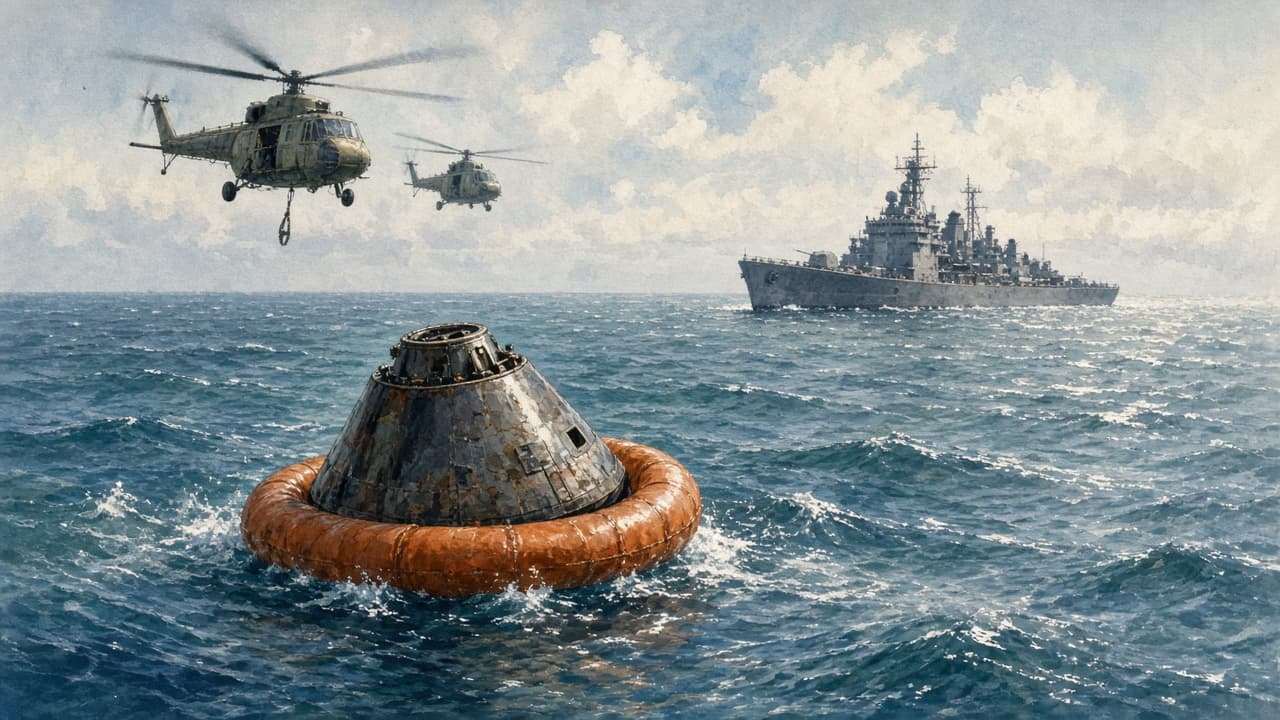
The target had moved. Forecasters expected thunderstorms in the planned recovery zone, so the landing point was shifted about 215 nautical miles downrange and the Hornet steamed to the new position. Columbia came down close to the mark, flipped nose down in the swell into the attitude engineers called stable two, and righted itself within minutes when three inflatable bags on the nose filled with air. Helicopters were overhead almost immediately.
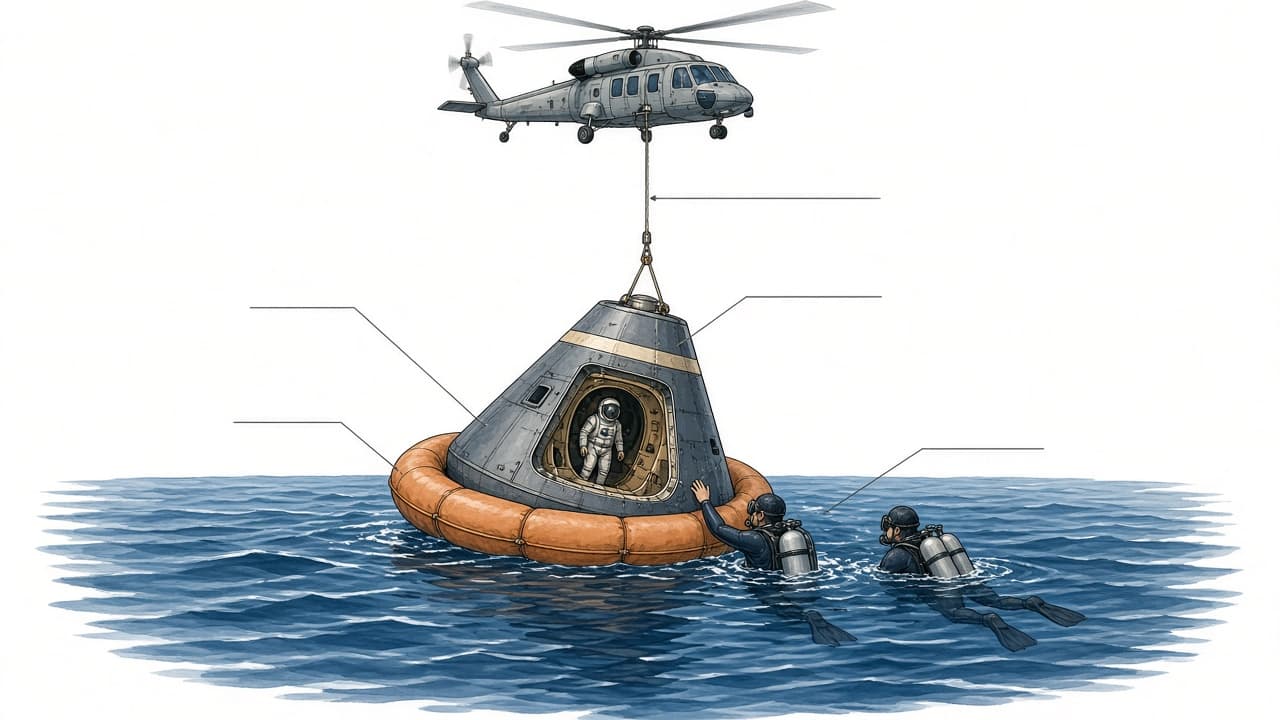
Then came a precaution that now looks strange and made sense at the time. Nobody could prove there was no biological hazard in lunar dust, so NASA planned for the possibility of back contamination. A Navy swimmer, Lieutenant Clancy Hatleberg, dropped into the water, passed three biological isolation garments through a partly opened hatch, scrubbed the hatch and the suits with disinfectant and sank the contaminated gear. The crew were winched up in the hooded suits, walked across the Hornet's deck and stepped straight into a converted Airstream trailer known as the Mobile Quarantine Facility. Nixon greeted them through its window and told them it had been the greatest week since the creation.
The quarantine ran 21 days from the last contact with lunar material, ending on 10 August at the Lunar Receiving Laboratory in Houston, where the crew, the capsule and the samples were held together. Mice were exposed to lunar dust to look for any effect. Nothing biological was found, and after Apollo 14 the requirement was dropped. The cargo justified the caution in a different way: 21.5 kg, about 47.5 pounds, of rock and soil, the first material any mission had brought back from another world. Some of it has been analysed continuously since 1969 and some was deliberately sealed and left unopened for decades so that future instruments could examine it.
The rest of the mission had gone almost too smoothly to remember properly. Saturn V lifted off from Florida on 16 July. The lunar module Eagle landed in the Sea of Tranquillity on 20 July at 20:17 universal time with about 25 seconds of usable fuel left after Armstrong flew past a boulder field. The crew spent about 21 and a half hours on the surface and roughly two and a half hours outside. Eagle lifted off on 21 July, docked with Collins in lunar orbit, and the engine burn that sent them home worked on the first attempt, which it had to, because there was no backup.
The pieces are still around. Columbia is on display in the Smithsonian's National Air and Space Museum, the Hornet is a museum ship at Alameda in California, and the quarantine trailer survives in the Smithsonian collection. Only ten more people walked on the Moon and the last left in December 1972. Every crewed return since has used the same physics, including NASA's Orion capsule on Artemis I in 2022, which came home faster and used a skip through the upper atmosphere to spread the heating out before its final descent.
Eagle Frame's takeaway: the famous date is 20 July, and 24 July is the one that closed the mission. Read the splashdown as the reminder that Apollo 11's hardest engineering was not the landing but the 2,700 degree slide back through the atmosphere with no engine, no second attempt and a two degree margin for error.