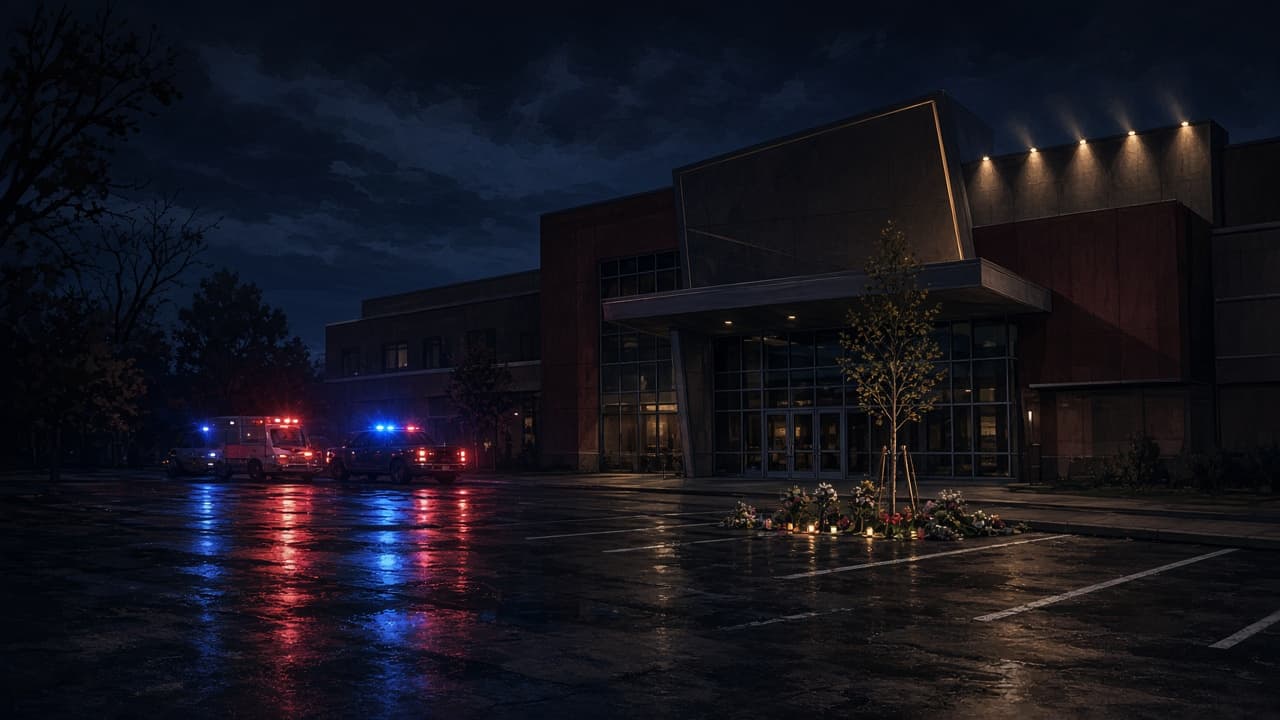
On this day: a mass shooting strikes an Aurora cinema
On 20 July 2012, a gunman attacked a midnight screening in Aurora, Colorado. Twelve people were killed and seventy were injured. The case ran through a long trial, a debate about mental illness and criminal responsibility and another round of argument about gun laws.
Shortly after midnight on 20 July 2012, at the Century 16 cinema in Aurora, Colorado, a gunman entered a packed midnight screening of The Dark Knight Rises and opened fire. Twelve people were killed and seventy were injured. The youngest person killed was six years old. Police arrested the attacker behind the building within minutes. This account gives no detail of the attack itself beyond what is needed to understand the case and its aftermath.
The twelve who died were Jonathan Blunk, Alexander J. Boik, Jesse Childress, Gordon Cowden, Jessica Ghawi, John Larimer, Matt McQuinn, Micayla Medek, Veronica Moser-Sullivan, Alex Sullivan, Alexander C. Teves and Rebecca Wingo. Several were killed shielding other people. Alex Sullivan was at the cinema celebrating his twenty-seventh birthday. Naming them matters, because coverage of attacks like this tends to remember the person who caused them and forget everyone else.
The attacker was James Holmes, 24, a doctoral student in neuroscience at the University of Colorado who had recently failed an oral examination and withdrawn from the programme. He had been seeing a university psychiatrist, who had become concerned enough to mention him to a campus threat assessment team weeks before the attack. He was no longer a student by then, which limited what the university believed it could do. That gap between clinical concern and available action became a central issue afterward.
The weapons and the ammunition had been bought legally over the preceding two months from Colorado gun shops, along with thousands of rounds ordered online, body armour and tear gas canisters. He passed the required background checks each time because he had no criminal record and no disqualifying mental health adjudication. He had also booby-trapped his apartment with explosives and incendiaries before leaving, which police spent two days making safe. Nobody was hurt there.
The trial took three years to reach a jury and then ran for three months in 2015. Holmes pleaded not guilty by reason of insanity, which under Colorado law shifted the burden to the prosecution to prove he was sane beyond reasonable doubt. Two court-appointed psychiatrists examined him and both concluded that he suffered from serious mental illness and was nonetheless legally sane, because he knew what he was doing and knew it was wrong. That is the legal test, and it is narrower than the public usually assumes.
The jury convicted him on all counts in July 2015 and then deadlocked at the sentencing stage, with at least one juror unwilling to impose death. He received twelve consecutive life sentences without parole plus 3,318 years for the attempted murders and the explosives. The outcome disappointed some of the families and relieved others. Colorado abolished the death penalty entirely in 2020.
The legal aftermath ran in several directions. Survivors and families sued Cinemark, the cinema operator, arguing it should have had better security. A federal jury found for the company in 2016 and a related state case ended with the plaintiffs facing a substantial costs claim, which many found a bitter result. A separate suit against online ammunition retailers was dismissed under a federal law that shields firearms and ammunition sellers from most liability for the criminal misuse of their products.
Colorado did change its gun laws. In 2013 the legislature passed universal background checks for private sales and a limit of fifteen rounds on magazine capacity. The response was intense: two state senators were recalled from office later that year and a third resigned to avoid a recall, in what became a national demonstration of the political cost of gun legislation. The state added a red flag law in 2019, allowing courts to remove firearms temporarily from people found to pose a risk to themselves or others.
Aurora also sits inside a specifically Colorado sequence that residents feel sharply. Columbine High School is about 25 kilometres away and was attacked in 1999. The Planned Parenthood clinic shooting in Colorado Springs followed in 2015, the STEM School Highlands Ranch attack in 2019 and the Boulder supermarket attack in 2021. Emergency planning across the state's hospitals and police departments has been rebuilt repeatedly around those events.
Practical changes did come out of the medical response. The number of casualties arriving at hospitals within minutes, many transported in police cars rather than ambulances because there were not enough, prompted revisions to mass casualty protocols in the region and contributed to the national Stop the Bleed programme, which trains civilians to apply tourniquets and pressure. Those methods, developed in military medicine, are now standard in American public buildings.
The Century 16 reopened in January 2013 after renovation, a decision that divided victims' families, some of whom boycotted the event. A permanent memorial, the Ascentiate sculpture surrounded by thirteen cranes, was dedicated in Aurora in 2018. Several survivors and relatives went into advocacy, on gun policy and on victim services, and others have spoken about wanting nothing to do with the public argument at all.
Eagle Frame's takeaway: 20 July 2012 is the night twelve people were killed at a midnight screening in Aurora. The case produced a rare full insanity trial that clarified how narrow the legal test is, a set of Colorado gun laws that cost legislators their seats and a lasting question about what a university or a clinician can actually do when concern about a person is real and the legal threshold for acting is not met.