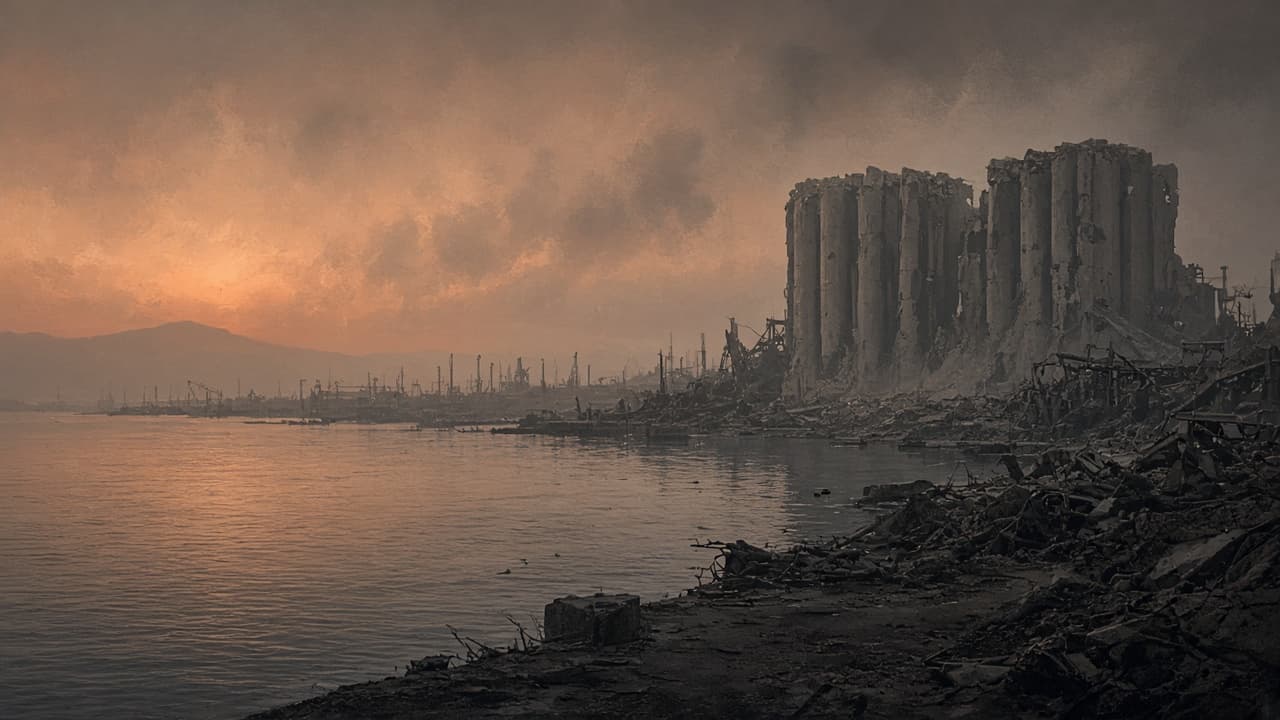
On this day: the Beirut port explosion
On 4 August 2020, about 2,750 tonnes of ammonium nitrate that had sat in a Beirut port warehouse for six years caught fire and detonated. More than 200 people were killed, thousands were injured and large parts of the city were wrecked. No senior official has stood trial.
At 6:07 in the evening on 4 August 2020, a fire burning inside Hangar 12 at the port of Beirut reached a stockpile of about 2,750 tonnes of ammonium nitrate. There was a smaller blast first, then the main detonation. Video from across the city caught a white dome expanding outward faster than the sound, which was water vapour in the air condensing as the shock wave passed, followed by a red-brown cloud of nitrogen oxides. Windows broke kilometres inland. The bang was heard in Cyprus, roughly 240 kilometres away, and seismometers recorded the event at around magnitude 3.3. At least 218 people were killed, more than 6,000 were injured and around 300,000 were left without a habitable home.
Ammonium nitrate is not exotic. Written NH4NO3, it is a white crystalline salt and the most widely used nitrogen fertilizer on earth, produced and shipped in tens of millions of tonnes a year. Farmers handle it routinely. It is also the base of most commercial mining explosives, because of one structural fact: the nitrate part of the molecule is rich in oxygen, so the compound carries its own oxidizer and does not need air to react. In a sealed bag at ambient temperature it sits there indefinitely. That combination, ordinary and energetic, is exactly what makes bulk storage a regulated activity.
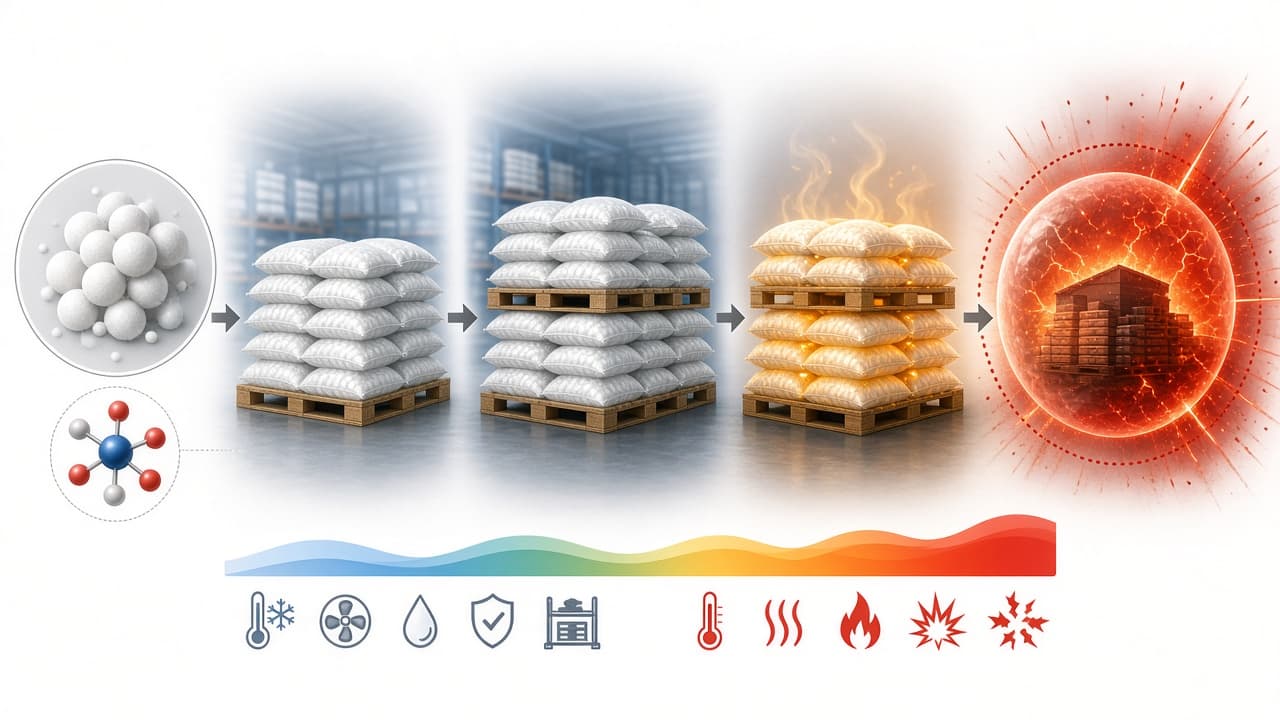
The step from fertilizer to explosion runs like this. Heat begins to break the compound down, releasing gas and more heat. In a large confined pile the heat cannot escape to the air, so the temperature in the middle climbs and decomposition speeds up. Pressure builds. If a strong enough shock forms, it travels through the material faster than the speed of sound in that material, and each layer it passes through reacts and pushes the wave forward. What was a slow chemical fire becomes a detonation that converts the whole stock into hot gas almost instantly. Contamination with oil, fuel or packaging lowers the threshold. Mass and confinement matter more than anything else, which is why safety codes cap the quantity in one building, demand separation from fuels and flammables, require ventilation and specify non-combustible construction.
None of that chemistry was new in 2020. A fertilizer silo at Oppau in Germany exploded in 1921 and killed more than 500 people. In 1947 the SS Grandcamp, loaded with ammonium nitrate, caught fire in Texas City and killed at least 581. The AZF plant in Toulouse exploded in 2001, killing 31. A fertilizer depot in West, Texas exploded in 2013 and killed 15 people, most of them firefighters who had gone in to fight the fire. Tianjin in China followed in 2015. The pattern repeats: a large stored quantity, a fire nearby and a delay in getting the material out.
How the cargo came to Beirut is a maritime paperwork story. The MV Rhosus, a Moldovan-flagged freighter, left Batumi in Georgia in 2013 carrying 2,750 tonnes of ammonium nitrate ordered by an explosives manufacturer in Mozambique. The ship put into Beirut in November 2013 with mechanical trouble and unpaid bills, was inspected, was declared unseaworthy and was detained. Its owner walked away. The crew was stranded aboard for about a year. In 2014 the cargo was unloaded into Hangar 12 at the port, a shed a few hundred metres from residential streets, and the ship eventually sank at its mooring. The material stayed in the shed for six years.
The warnings exist in writing, which is why the case is not a mystery. Customs officials wrote to Beirut judges at least six times between 2014 and 2017 asking for permission to re-export the cargo, sell it or hand it to the Lebanese army, and received no decision. Port authorities, customs, army intelligence, state security and the judiciary all touched the file at some point. A state security report in July 2020, a few weeks before the blast, recorded that the hangar was insecure and that the contents could destroy the city. Repair work on a hangar door, reportedly including welding, was carried out on the afternoon of 4 August. Fireworks were stored in the same building.

Geography decided much of the toll. Beirut's port is not isolated infrastructure on a distant spit of land but an industrial zone pressed against old residential quarters, so the districts of Karantina, Mar Mikhael and Gemmayzeh received the pressure wave at nearly full strength. Hospitals lost windows, doors and power at the moment the injured arrived, and at least three were put out of service during a Covid-19 wave. The 48 metre concrete grain silos on the quay took the force on one flank and shielded parts of the city to the west, while the country's main grain reserve was destroyed with them. The World Bank later put physical damage at $3.8bn to $4.6bn.
The explosion also landed on a state that had already broken down. Lebanon had been in financial collapse since 2019, with the currency down more than 90 per cent against the dollar, banks refusing depositors their own savings, electricity rationed to a few hours a day and a protest movement in the streets since October 2019 against the sectarian political class. To most people in Beirut the blast was not a freak industrial accident but the same negligence they had already been living with, arriving all at once. Volunteers, not the state, swept the glass out of the affected districts in the following weeks.
Accountability has gone nowhere. The cabinet of Prime Minister Hassan Diab resigned on 10 August 2020. The first investigating judge, Fadi Sawan, charged Diab and three former ministers and was removed from the case in February 2021. His successor, Tarek Bitar, sought to question senior politicians, former ministers, security service heads and port officials, and was repeatedly suspended by legal complaints filed by the very people he was trying to summon. Parliament has not lifted the immunity of sitting members. Lebanon's government has refused calls for an international inquiry. Human Rights Watch concluded in a 2021 report that officials at multiple levels knew of the risk and may bear criminal responsibility. Families of the dead march at the port on the fourth of each month.
Some technical questions remain open and the honest answer is that they may stay that way. An FBI assessment concluded that roughly 550 tonnes actually detonated, far less than the stockpile on the manifest, raising the question of where the rest went. Estimates of the yield range from a few hundred tonnes of TNT equivalent to about a kilotonne, which would place it among the largest accidental non-nuclear explosions ever recorded. Photographs from before the blast showed torn bags and material spilled on the floor of the hangar. The chemistry was understood, the hazard was documented and the paperwork was filed. What failed was the decision to move it.
Eagle Frame's takeaway: 4 August 2020 was not a scientific surprise. Ammonium nitrate has behaved the same way at Oppau, Texas City, Toulouse and West, and Lebanese officials had it in writing that 2,750 tonnes of it sat in a shed beside a residential city. More than 200 people were killed by six years of nobody signing a form, and six years later the case still has no trial.