On this day: East Germany begins building the Berlin Wall
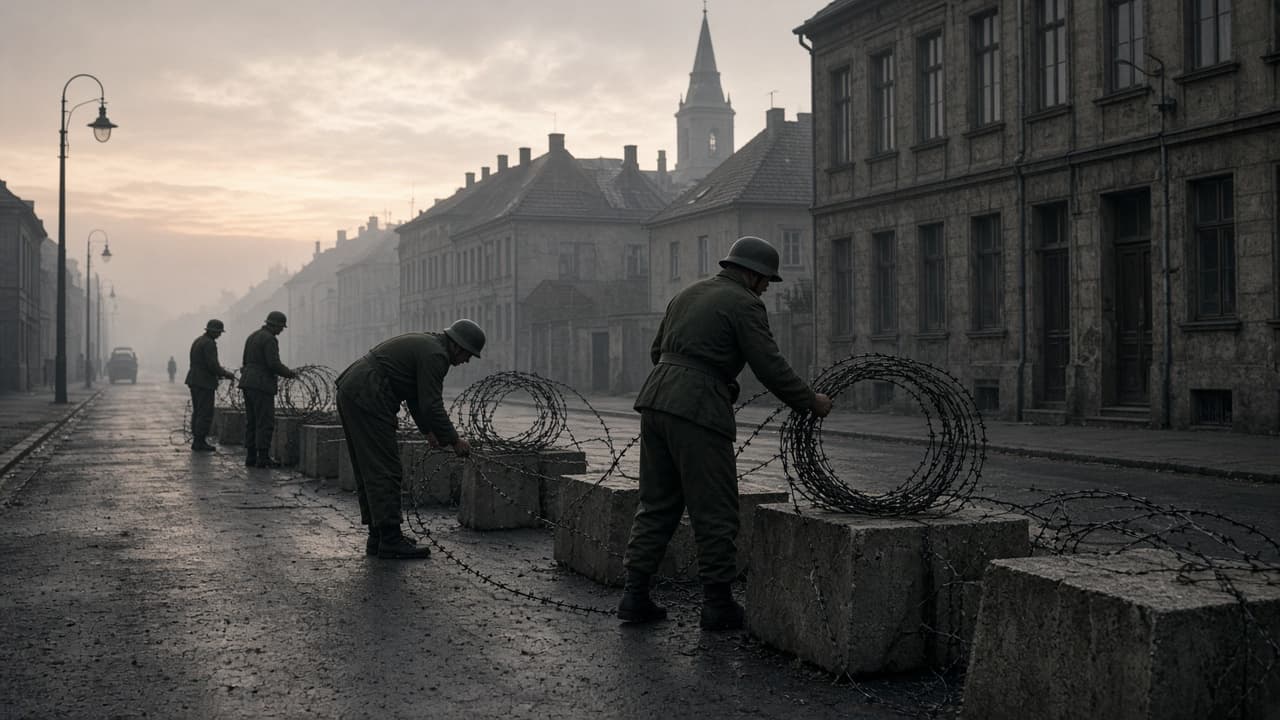
On 13 August 1961, East German forces sealed the border with barbed wire and barriers. Overnight, Berlin was divided and families found themselves cut apart.
On 13 August 1961, the German Democratic Republic began sealing West Berlin off from East Berlin and the surrounding East German territory. Overnight, troops, police and construction crews unrolled barbed wire, tore up streets and blocked crossing points. What started as a wire barrier hardened within days and months into concrete, watchtowers and a death strip. The world came to call it the Berlin Wall. For Berliners it was first a shock at dawn: the S-Bahn stopped, the streetcar ended and relatives on the other side of town suddenly lived behind a frontier.
Why did East Germany do it? Through the 1950s, millions of East Germans had fled west, many through open Berlin. Doctors, engineers and young workers left, draining the socialist state's labor and prestige. West Berlin sat as an island of the Federal Republic deep inside East German territory, a loophole in the Iron Curtain. Walter Ulbricht's government, backed by the Soviet Union under Nikita Khrushchev, chose to close the loophole rather than liberalize. Officials called it an antifascist protective rampart. Ordinary speech called it what it was: a wall to keep people in.
Overnight on 13 August 1961, East German forces sealed the border that cut through Berlin, first with wire and then with concrete. A map of the divided city shows western sectors surrounded by eastern territory, with the wall as a ring and a scar. Families found themselves on opposite sides of checkpoints. Workers who had crossed daily for jobs suddenly faced armed barriers. The construction answered years of emigration west through Berlin, which East Germany treated as an existential drain of skilled people.
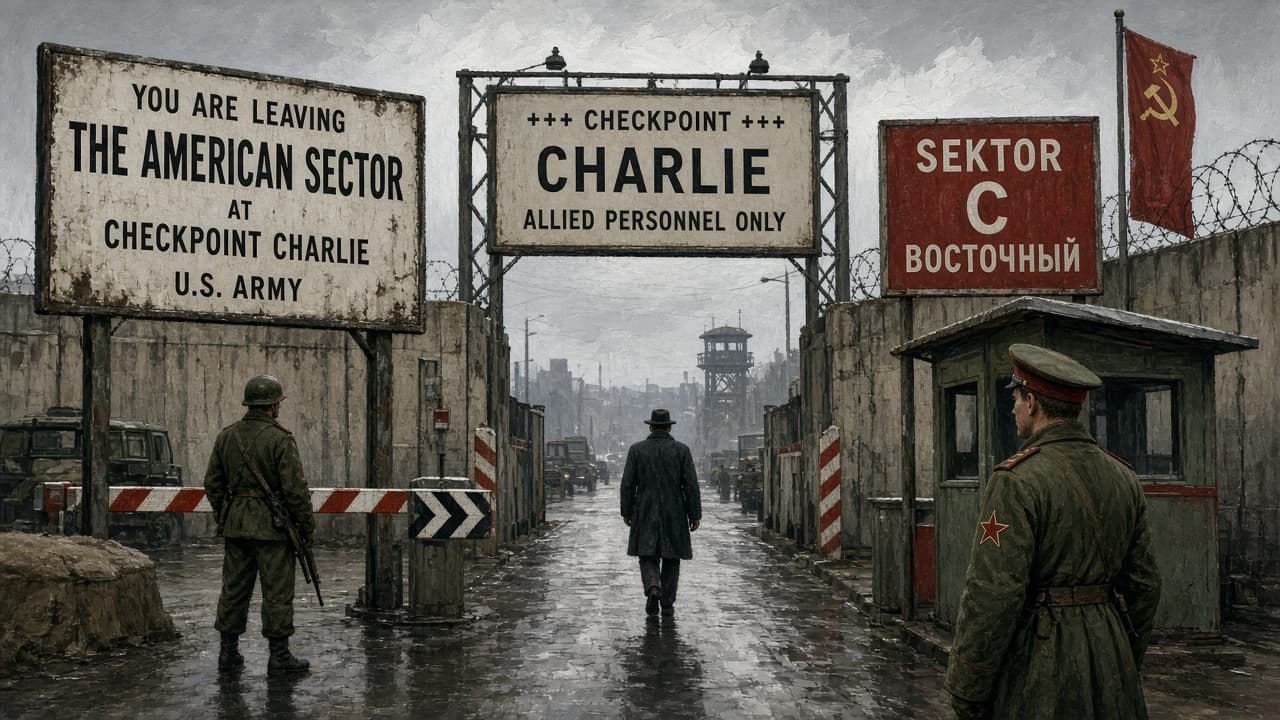
Checkpoint Charlie became the most photographed crossing between the American and Soviet sectors, a stage for tank standoffs and spy-novel mythology. For Berliners it was paperwork, fear and occasional tragedy when people tried to climb or tunnel. The wall's later graffiti-covered western face and lethal eastern death strip taught two different visual languages of the same barrier. When the wall opened in 1989, those checkpoints turned into museums of a border that had once decided marriages, careers and whether a city felt whole.
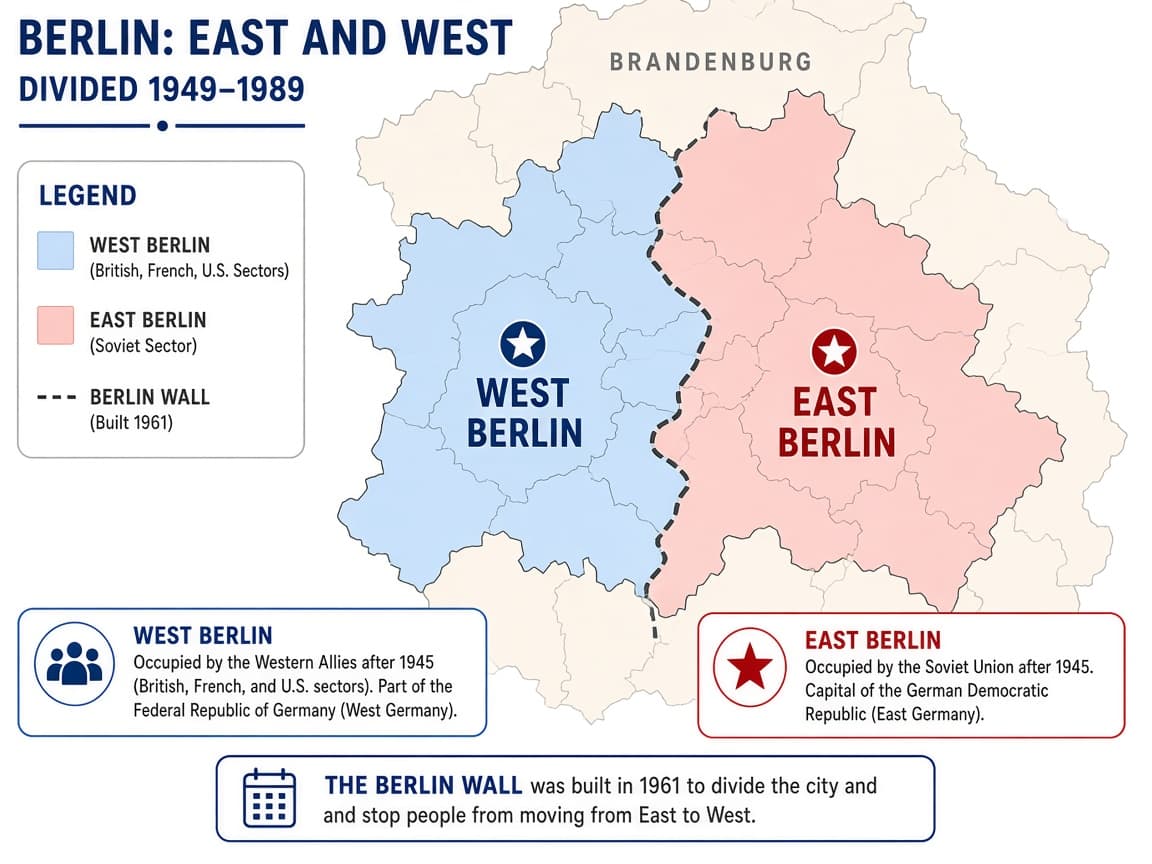
Postwar Berlin had been split among Allied occupation sectors after 1945. The Federal Republic and the GDR became rival German states in 1949. Currencies, parties and police differed, yet until 1961 people could still cross much of the city for work, shopping and family visits. That everyday porosity ended on 13 August. Factories lost staff who lived on the wrong side. Children visiting grandparents were trapped for days. Wedding plans collapsed into diplomatic pleas.
The Wall's later machinery was grimly systematic. Inner and outer walls, floodlights, dog runs, trip wires and shoot-to-kill orders turned escape into a lethal gamble. Exact death counts remain debated; researchers document well over a hundred people killed at the Berlin Wall alone, with more dying on the wider inner-German border. Escape stories (tunnels, hidden car compartments, leaps from windows in Bernauer Strasse) became Cold War folklore because the alternative was a life sentence of separation.
Western leaders protested. President John F. Kennedy reinforced the U.S. garrison but did not tear the wire down by force; a hot war over Berlin risked nuclear escalation. In June 1963 Kennedy's "Ich bin ein Berliner" speech framed the city as a democratic outpost. The Wall stabilized the GDR's population loss and froze the Cold War map in Central Europe for nearly three decades.
Daily life adapted in bitter ways. Western tourists climbed viewing platforms to wave. Easterners lived with propaganda that painted the barrier as protection from Western sabotage. Stasi surveillance thickened. Yet cross-border radio and television still leaked other realities into Eastern living rooms. The Wall controlled bodies more completely than it controlled ideas.
On 9 November 1989, after months of protest across East Germany and a botched press conference on new travel rules, crowds pressured checkpoints until guards opened. People danced on the concrete. Demolition became souvenir hunting. German reunification followed in 1990. Fragments of the Wall now stand in museums worldwide as warnings, not decorations.
For readers born after 1989, 13 August 1961 is the day a government chose architecture over consent. Borders exist everywhere. This one announced that a state would rather cage its citizens than hear why they left. Remembering the first night of wire keeps later celebrations of 1989 honest: freedom had a construction date for its opposite.
Families mailed letters through narrow official channels and sometimes risked tunnel digs or forged papers. Western radio stations broadcast into the East, reminding listeners that the wire was not the only border in play. Economists studied how sealing Berlin changed labor markets and currency flows on both sides. The Wall's economics were as real as its concrete: East Germany stopped losing skilled workers at the rate that had embarrassed Ulbricht before August 1961. Allied air corridors into West Berlin stayed open, so the city remained a symbol of Western commitment even while the Wall stopped foot traffic. Kennedy and later presidents used Berlin speeches to test Cold War rhetoric. The Wall's fall in 1989 reversed the shock of 1961 but did not erase the decades when families measured distance in checkpoints instead of kilometers.
Eagle Frame's takeaway: 13 August 1961 is when East Germany began walling West Berlin away to stop an exodus. Know the refugee crisis that preceded the wire, know the death strip that followed and know why 1989's opening still answers that August dawn.