On this day: Bertha Benz makes the first long car journey
In early August 1888, commemorated on 5 August, Bertha Benz drove her husband's Patent-Motorwagen about 106 kilometres from Mannheim to Pforzheim with her two teenage sons. She did not tell him she was going, and she proved that the motor car could travel.
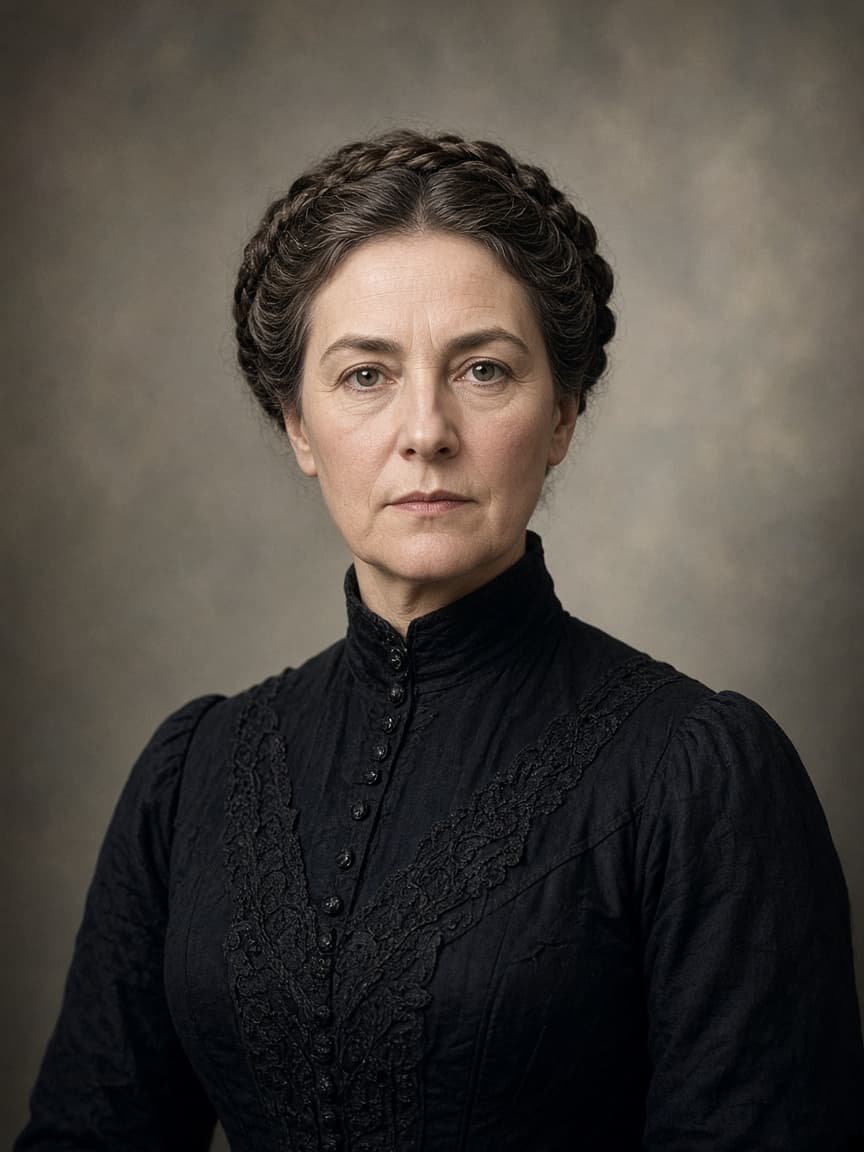
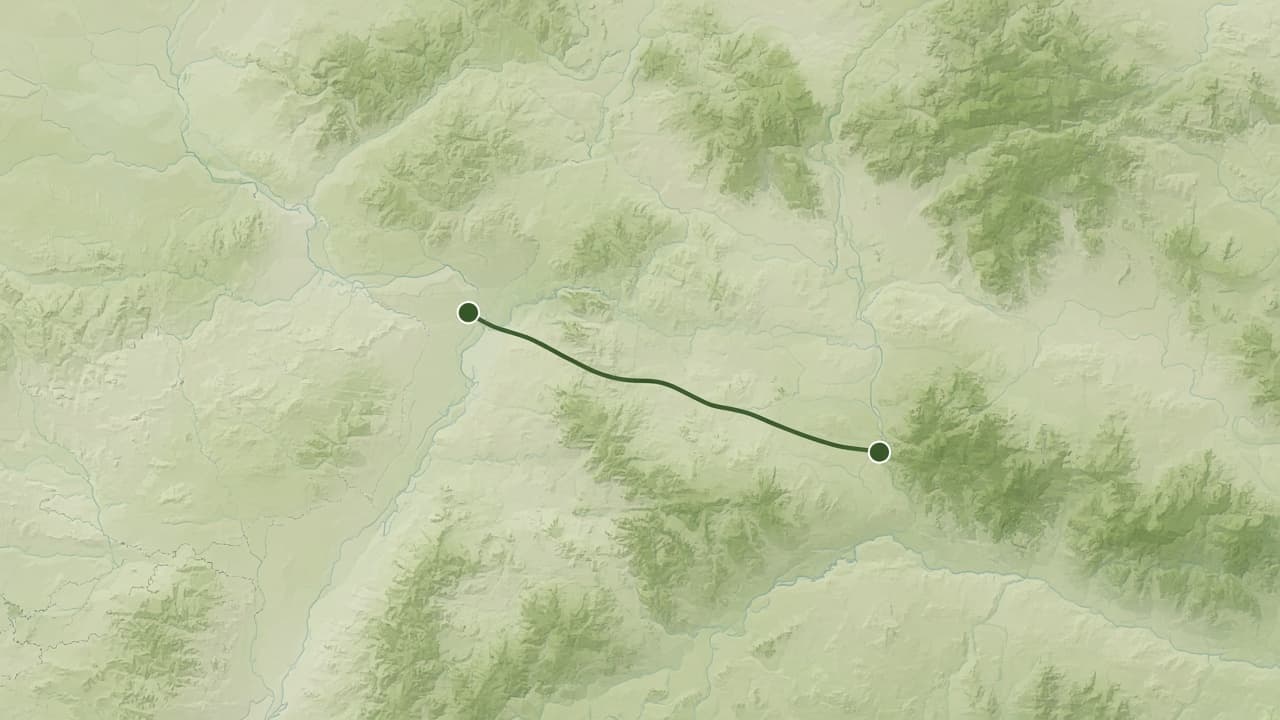
Before dawn on a morning in early August 1888, Bertha Benz and her sons Eugen, 15, and Richard, 13, pushed a three-wheeled machine out of a workshop in Mannheim so the engine noise would not wake Carl Benz. She left a note saying she was taking the children to visit her mother in Pforzheim, about 106 kilometres to the south. There were no filling stations, no repair shops, no road signs written for cars and no precedent for what she was doing. They arrived after dark and sent a telegram. The exact calendar day was never recorded at the time, which is why German commemorations settled on 5 August, and that is the date the anniversary is kept on.
She was born Cacilie Bertha Ringer in Pforzheim on 3 May 1849, the daughter of a master builder, and she married Carl Benz in 1872. Her role in the business started before the wedding. As an unmarried woman she could invest her dowry, and she put it into Benz's struggling iron foundry and then into the engine workshop that grew out of it. Under the German civil law of the time, a wife's property passed into her husband's control on marriage, so everything she contributed after 1872 was recorded in his name. Her signature is missing from the company documents for legal reasons, not for want of involvement.
The machine she took out that morning was the third version of a vehicle Carl Benz had patented on 29 January 1886 as German patent 37435, a carriage driven by a gas engine. The Model III had a wooden frame, three wire-spoked wheels with solid rubber tyres, a tiller instead of a steering wheel for the single front wheel and a horizontal single-cylinder four-stroke engine of about 1.7 litres producing roughly two horsepower. Flat out it managed about 16 kilometres an hour. It weighed a little over 350 kilograms, which mattered on hills.
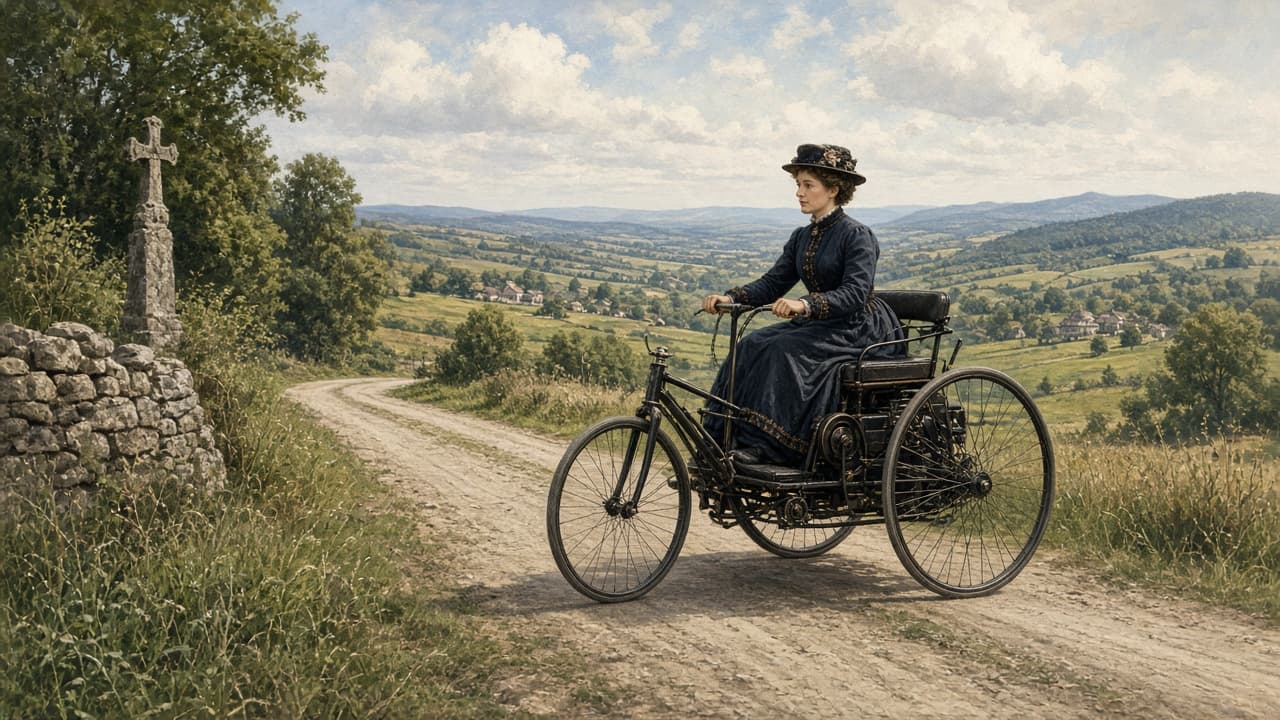
It is worth walking through how the thing actually ran, because every one of the day's breakdowns follows from the design. The engine used the four-stroke cycle: the piston drew in a mixture of air and fuel vapour, compressed it, was pushed down by the burning charge and then pushed the burnt gas out. Fuel vapour came from a surface carburettor, a shallow tray of ligroin over which incoming air passed, so the fuel evaporated rather than being sprayed. A battery and a trembler coil made the spark. A large flywheel lying flat under the seat carried the engine through the strokes where no power was produced. Drive went by leather belt to a countershaft, then by chains to the rear wheels, through a differential so the wheels could turn at different speeds in a corner. Cooling was by evaporation, which meant water boiled off and had to be refilled.
Carl Benz had been running the car in short loops around Mannheim for two years and selling almost none. He had shown it publicly, been mocked in the local press and had grown cautious about failing in front of an audience. Bertha's reasoning was commercial rather than sentimental. Nobody would buy a vehicle that had never been seen going anywhere, and the only way to demonstrate range was to cover some. She took the road south through Heidelberg, then Wiesloch and Bruchsal, then Durlach and on into Pforzheim.
The repairs are the part engineers still teach. When the ligroin ran low she bought more at the Stadt-Apotheke in Wiesloch, a pharmacy that sold it as a cleaning solvent, which makes that shop the world's first filling station. When the fuel line blocked she cleared it with her hat pin. When ignition wiring shorted she insulated it with a garter. On the long descent toward Pforzheim the wooden brake blocks wore through, so she stopped at a cobbler in Bauschlott and had him nail leather onto them, producing the first brake lining. On the climbs the boys got out and pushed, which told her the gearing was wrong, and Carl added a lower gear to later cars because of it. She also had a blacksmith work on a drive chain along the way.
She drove home a few days later by a slightly different road, partly to avoid the worst of the hills. The press noticed. Word of a woman driving a machine across Baden did more for the business than any exhibition had and orders began to arrive. The Model III was shown at an engineering exhibition in Munich in the autumn of 1888 and at the Paris World's Fair in 1889. Benz and Cie grew from a workshop into the largest car maker in the world by the end of the century, building 572 vehicles in 1899.
What the trip proved was not speed. It proved that a motor vehicle could be refuelled from ordinary supply chains, repaired at the roadside by anyone with basic tools and driven over unknown ground by someone who had not built it. Those three things are the difference between an experiment and a product. The fuel problem produced filling stations, the brake problem produced friction linings sold as a part and the hill problem produced gearboxes. One day on the road generated an agenda the industry worked through for decades.
Carl and Bertha later lived in Ladenburg, where the house is now a museum. He left the company's board in 1903 after disagreements over design direction, and the 1926 merger with Daimler created the firm that still carries both names. On her 95th birthday, 3 May 1944, the technical university in Karlsruhe made Bertha Benz an honorary senator. She died two days later. For most of the century after that the story was told as Carl Benz's alone, and her part reached school textbooks and corporate histories only recently. The memorial route between Mannheim and Pforzheim, opened in 2008, is now an official German industrial heritage trail.
Eagle Frame's takeaway: the first long drive in history was a marketing decision made without permission. Bertha Benz understood something her engineer husband did not, that a machine only becomes a product once a stranger watches it arrive somewhere, and the fixes she improvised on the way, fuel bought at a pharmacy, a leather brake lining and the need for a lower gear, are still in every car on the road.