On this day: Britain enters the First World War
At 11pm London time on 4 August 1914, Britain went to war with Germany. The trigger was the German army's march into neutral Belgium, and the decision turned a continental quarrel into a world war.
German troops crossed the Belgian frontier near Gemmenich in the early hours of 4 August 1914. London responded with an ultimatum: Germany was to give an assurance that Belgian neutrality would be respected, and the deadline was 11 o'clock that night, London time, which was midnight in Berlin. No satisfactory reply came. At 11pm the Admiralty signalled the fleet to begin hostilities against Germany, and a crowd that had been gathering outside Buckingham Palace all evening sang the national anthem. Britain was at war, and because Britain was at war so were Canada, Australia, New Zealand, South Africa, Newfoundland and India.
The chain that led there had been running for five weeks. Archduke Franz Ferdinand was assassinated in Sarajevo on 28 June. Austria-Hungary declared war on Serbia on 28 July. Russia, Serbia's protector, began mobilizing. Germany declared war on Russia on 1 August and on France on 3 August. Through all of it the British cabinet had no legal obligation to fight anybody, and until the evening of 2 August it was not clear that it would.
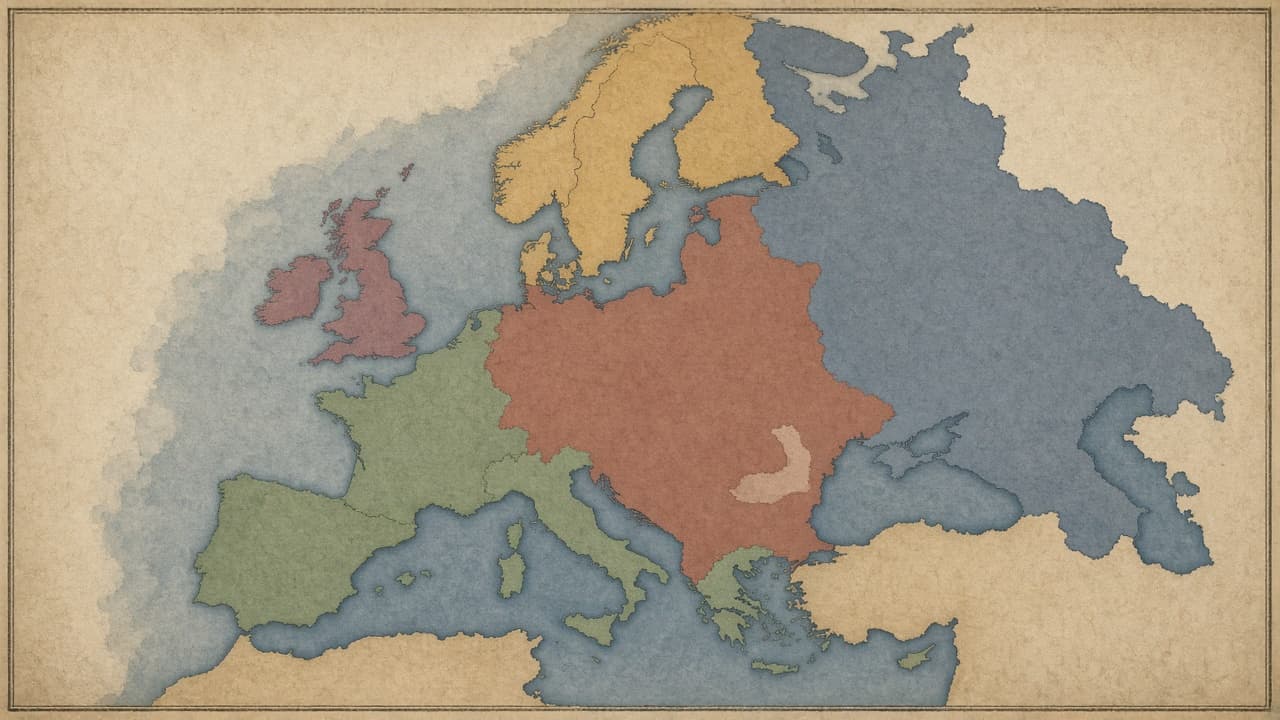
Britain's position needs care, because the word alliance gets used loosely. The Entente Cordiale with France in 1904 and the Anglo-Russian convention of 1907 settled colonial disputes in Africa, Persia and central Asia. Neither was a mutual defence treaty. What did exist was an understanding built up afterwards: staff talks between the British and French armies from 1906 and an exchange of letters in 1912 between Foreign Secretary Sir Edward Grey and the French ambassador Paul Cambon recording that the two navies had arranged their fleets on the assumption of cooperation. France had concentrated in the Mediterranean and left its Channel and Atlantic coast largely to the Royal Navy. That was a moral commitment rather than a legal one, and several cabinet ministers said so loudly.
Belgium was different because Belgium was on paper. The Treaty of London of 1839 created the Belgian state and guaranteed its neutrality, and the guarantors included Britain and Prussia, whose obligations Germany had inherited. The German war plan, drafted by Alfred von Schlieffen and modified by Helmuth von Moltke the Younger, assumed a two-front war and required knocking France out in weeks before Russia could mobilize fully. The only way to get around the fortified Franco-German border fast enough was to go through Belgium. On 2 August Germany demanded free passage. On 3 August the Belgian government of King Albert refused, knowing what refusal meant.
The invasion settled British politics in a day. Herbert Asquith's Liberal cabinet had been badly split, with a large group opposed to any continental commitment and the Chancellor, David Lloyd George, undecided until late. Grey put the case to the House of Commons on the afternoon of 3 August, resting it on Belgium and on British obligations rather than on love of France, and the House accepted it. Two ministers resigned in protest, John Burns and Lord Morley. The opposition Conservatives backed intervention. John Redmond pledged Irish nationalist support. The German chancellor, Theobald von Bethmann-Hollweg, reportedly complained to the British ambassador that Britain was going to war over a scrap of paper, a phrase that went round the world and hardened opinion further. Grey's remark that the lamps were going out all over Europe was written down years later in his memoirs, but it captured the evening accurately enough to last.
What Britain brought to the war was not an army. It was the Royal Navy, the largest fleet in the world with more than 20 dreadnought battleships, which within weeks had swept German merchant shipping off the oceans and begun the economic blockade that would grind down German food supply for four years. It was the City of London, which financed allied purchasing in the United States. And it was the empire, whose manpower, shipping and raw materials were committed automatically. India alone eventually sent about 1.3 million men to serve in France, Mesopotamia, East Africa and Gallipoli.
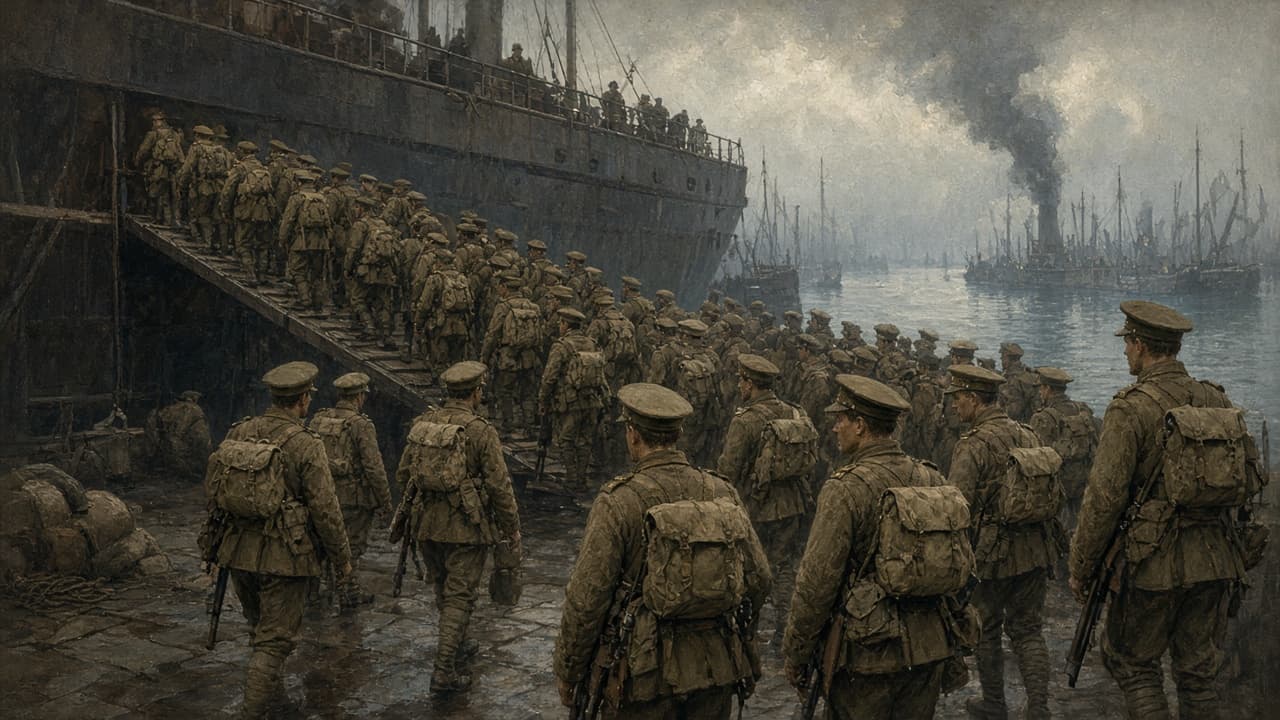
The land contribution started small. The British Expeditionary Force was roughly 100,000 men in six infantry divisions and a cavalry division, professional, extremely well trained in rifle fire and negligible next to French and German armies counted in the millions. It began crossing to France on 9 August, met the German First Army at Mons on 23 August, fought a sharp delaying action and then joined a two-week retreat that ended at the Marne, where the German timetable broke. The old regular army was largely used up by the end of the First Battle of Ypres in November 1914.
At home the state changed shape immediately. The Defence of the Realm Act, passed on 8 August, gave ministers sweeping powers over speech, movement, industry and land, and the habit of emergency government it created never entirely went away. Lord Kitchener, brought in as Secretary of State for War, told a disbelieving cabinet the war would last years and called for volunteers. About 2.46 million men enlisted voluntarily before conscription arrived in January 1916. Railways were taken under state control, war loans were floated, food prices were regulated and, in 1916, the clocks were moved forward to save coal.
The bill was four years and three months long. Around 886,000 servicemen from the United Kingdom were killed and close to 1 million across the whole empire. About 1.6 million British servicemen came home wounded. Britain went into the war as the world's largest creditor and came out owing the United States. Irish politics was transformed by the 1916 Rising and its aftermath, women got the parliamentary vote in 1918 in part because of what they had done in the factories and the Liberal party that took the country into the war never formed a majority government again.
Historians still argue whether the ultimatum was necessary. One case says Britain should have stayed out, that a German victory over France and Russia would have left the Royal Navy and the empire untouched for a generation and spared nearly a million lives. The other says a Germany controlling the Channel ports and dominating the continent was a strategic outcome no British government could accept, and that a guarantee signed in 1839 has to mean something when it is tested. Both sides accept the historical point about the actual decision: the cabinet was split over France and united by Belgium.
Eagle Frame's takeaway: 4 August 1914 is the date a European war became a world war, because Britain's entry brought the empire, the blockade and the financial system with it. The detail worth remembering is that the argument in London was not settled by alliances or by a general plan. It was settled by a treaty from 1839 and by the fact that German troops were already in Belgium.