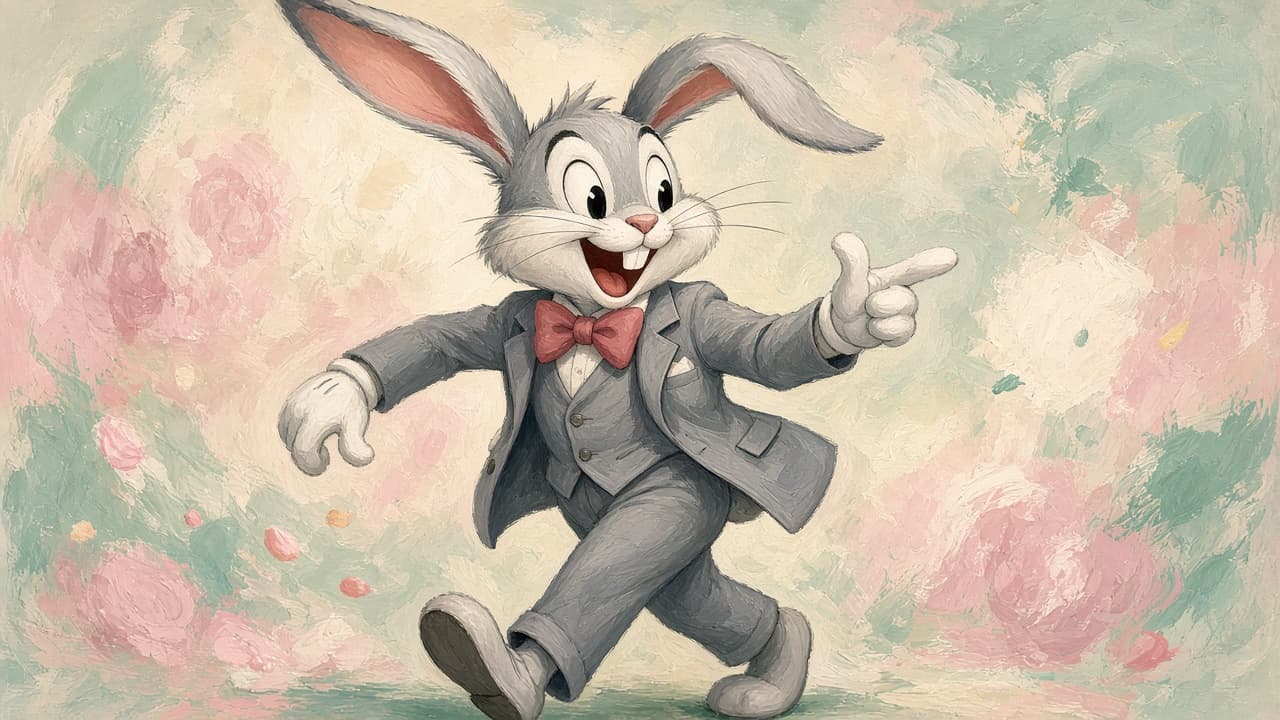
On this day: Bugs Bunny makes his official debut
On 27 July 1940, Warner Bros. released A Wild Hare, the cartoon that fixed Bugs Bunny's voice, attitude and catchphrase. Earlier rabbits had appeared in Looney Tunes shorts, but this is the one the studio counts as the start.
On 27 July 1940, Warner Bros. released a seven-minute Merrie Melodies short called A Wild Hare. A hunter creeps through the woods and tells the audience to be very quiet. A grey rabbit pops out of a hole, chewing a carrot, and asks: "What's up, Doc?" That is the moment Warner Bros. treats as the official arrival of Bugs Bunny, and the rabbit has been a fixture of American popular culture ever since.
The word official is doing real work in that sentence. A rabbit had turned up in Warner shorts before. Porky's Hare Hunt in 1938, directed by Ben Hardaway and Cal Dalton, featured a manic white rabbit who bounced around the frame and irritated Porky Pig. Hare-um Scare-um and Elmer's Candid Camera followed with variations. The character sheet for Hardaway's rabbit was labelled "Bugs' bunny" after his nickname, which is where the name is generally thought to come from.
What A Wild Hare added was character rather than design alone. The earlier rabbits were simply hyperactive. Director Tex Avery slowed the rabbit down and made him calm, which turned out to be the whole joke. Bugs is not frightened of the man with the shotgun. He is bored by him. That relaxed superiority gave animators a reliable engine: the hunter tries something, the rabbit absorbs it without effort and returns it with interest.
Mel Blanc supplied the voice, a blend of Brooklyn and Bronx accents that signalled street-smart to American audiences of 1940. Blanc would voice Bugs for nearly fifty years, along with Daffy Duck, Porky Pig, Tweety, Sylvester and much of the rest of the Warner roster. Elmer Fudd, also voiced by Arthur Q. Bryan, took his recognizable round-faced form in the same period. The pairing of a nervous, well-meaning hunter and an unbothered rabbit gave the studio a formula it could run for decades.
It helps to know how these cartoons were made and sold. Theatrical shorts ran before feature films. Warner Bros. produced two series, Looney Tunes and Merrie Melodies, out of a unit on the Sunset Boulevard lot that staff nicknamed Termite Terrace. Animation was drawn and inked by hand onto transparent celluloid sheets, photographed one frame at a time over painted backgrounds, at 24 frames per second. A seven-minute short therefore needed roughly ten thousand exposed frames and thousands of individual drawings.
The Warner house style deliberately differed from Disney's. Disney invested in smooth motion, depth and sentiment. Warner directors including Tex Avery, Bob Clampett, Friz Freleng and Chuck Jones went for speed, exaggeration and gags that acknowledged the audience. Characters talked to the camera, ran off the edge of the film strip and commented on their own cartoons. Bugs is the clearest product of that approach. He knows he is in a cartoon and uses it.
A Wild Hare was nominated for the Academy Award for Best Short Subject, Cartoons. It lost, but the nomination told the studio what it had. Bugs quickly became Warner's most valuable character and appeared in more than 160 theatrical shorts. Chuck Jones later codified an important rule for the writers: Bugs never starts the fight. Someone hunts him, provokes him or cheats him first, and only then does he retaliate. That rule is why audiences root for a character who always wins.
The wartime years pushed Bugs further into national life. He appeared in shorts aimed at service audiences, sold war bonds and was adopted as a mascot by military units. Some of those wartime cartoons, along with a number of shorts from the 1930s and 1940s across the whole animation industry, contain racial caricature that Warner Bros. has since kept out of general circulation or released with historical context. That part of the catalogue is a fact of the period and worth naming rather than quietly editing away.
Television gave the character a second life. From the 1960s, Warner shorts were packaged into Saturday morning programming, which introduced Bugs to children who would never see a theatrical short. The Bugs Bunny Show and its successors ran in some form for decades. Space Jam in 1996 put him on screen with Michael Jordan. Warner Bros. still uses his silhouette on studio branding, and he has a star on the Hollywood Walk of Fame.
The reason the character lasted is simpler than nostalgia. Bugs is a competence fantasy for anyone who has been pushed around: outnumbered, outgunned, completely unbothered and smarter than the person with the weapon. He solves problems with wordplay, disguise and timing rather than force. That formula travels across languages and generations in a way that most 1940 entertainment does not.
Eagle Frame's takeaway: 27 July 1940 is the date Warner Bros. uses for the arrival of Bugs Bunny, and the distinction between the prototype rabbits of 1938 and 1939 and the finished character in A Wild Hare is the interesting part. The design mattered less than the attitude. Tex Avery made the rabbit calm, Mel Blanc gave him the voice and the studio spent the next fifty years running the same joke.