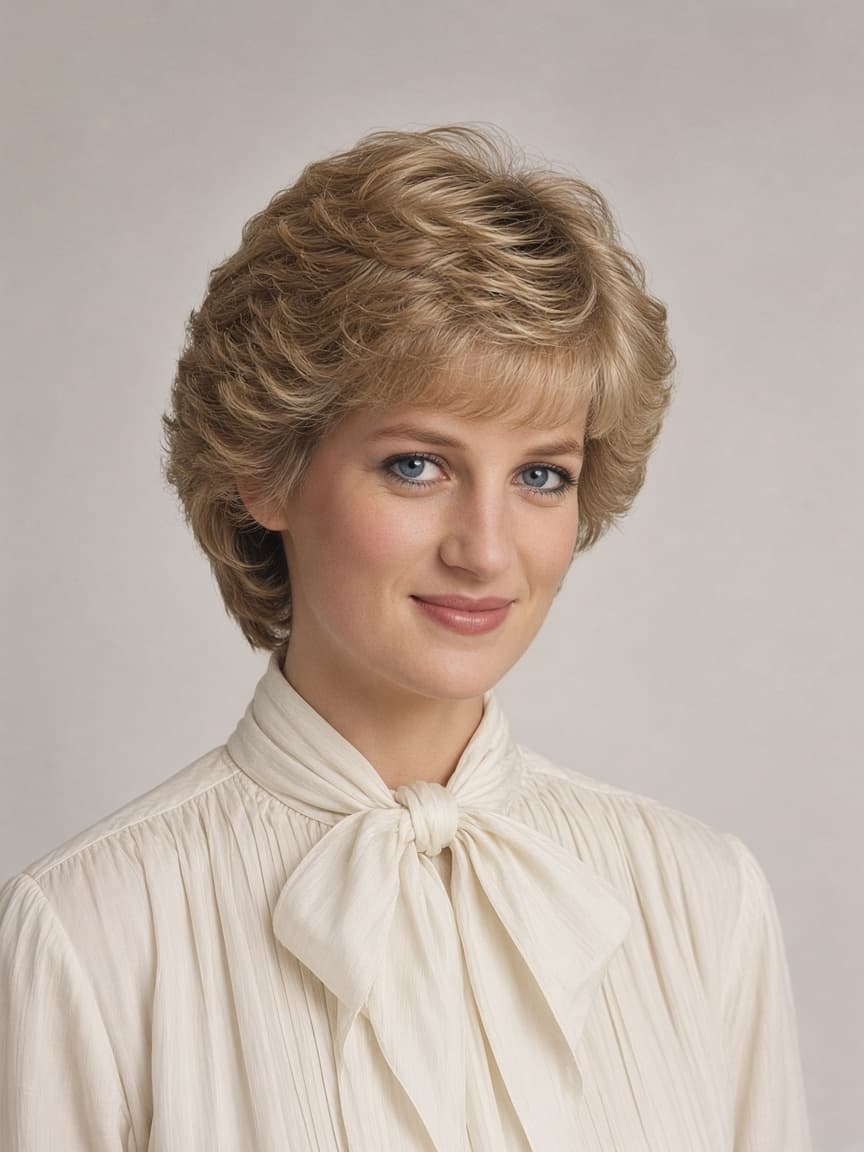
On this day: Charles and Diana marry at St Paul's
On 29 July 1981, the Prince of Wales married Lady Diana Spencer at St Paul's Cathedral in front of an estimated global television audience of 750 million. The marriage ended in divorce fifteen years later, and Diana's public life changed the monarchy anyway.
The wedding of Charles, Prince of Wales, and Lady Diana Spencer took place at St Paul's Cathedral on the morning of 29 July 1981. He was 32 and she was 20. The United Kingdom took a public holiday, hundreds of thousands of people slept on the pavements along the route the night before and the ceremony was broadcast live to 74 countries. The audience figure most commonly cited is about 750 million, which would have made it the largest shared television event to that point. In Britain alone around 28 million people watched.
Diana Frances Spencer came from an aristocratic family with long royal connections rather than from outside the establishment, a detail often lost in the later retelling. Her father was the eighth Earl Spencer, she grew up at Park House on the Sandringham estate and later at Althorp in Northamptonshire, and her grandmother was a lady-in-waiting to the Queen Mother. She left school at sixteen with no A-levels, moved to London, shared a flat in Earls Court and worked part time at the Young England Kindergarten in Pimlico, which is where photographers found her in the autumn of 1980 when the press began speculating about the prince.
The engagement was announced on 24 February 1981. Diana chose her ring from a Garrard catalogue, a twelve-carat Ceylon sapphire surrounded by diamonds costing about 28,000 pounds, and the fact that it was an off-the-shelf item rather than a bespoke commission was itself commented on at the time. During the engagement interview, asked whether they were in love, Charles added the phrase whatever in love means, which passed with little notice then and has been quoted constantly since.
St Paul's was picked over Westminster Abbey for practical reasons. Wren's cathedral seats considerably more people, about 3,500 guests attended, and the longer processional route from Buckingham Palace along the Strand and Fleet Street gave the crowds more to see. Diana travelled in the Glass Coach with her father, who had suffered a stroke in 1978 and walked the aisle with visible difficulty, leaning on her arm as much as she leaned on his.
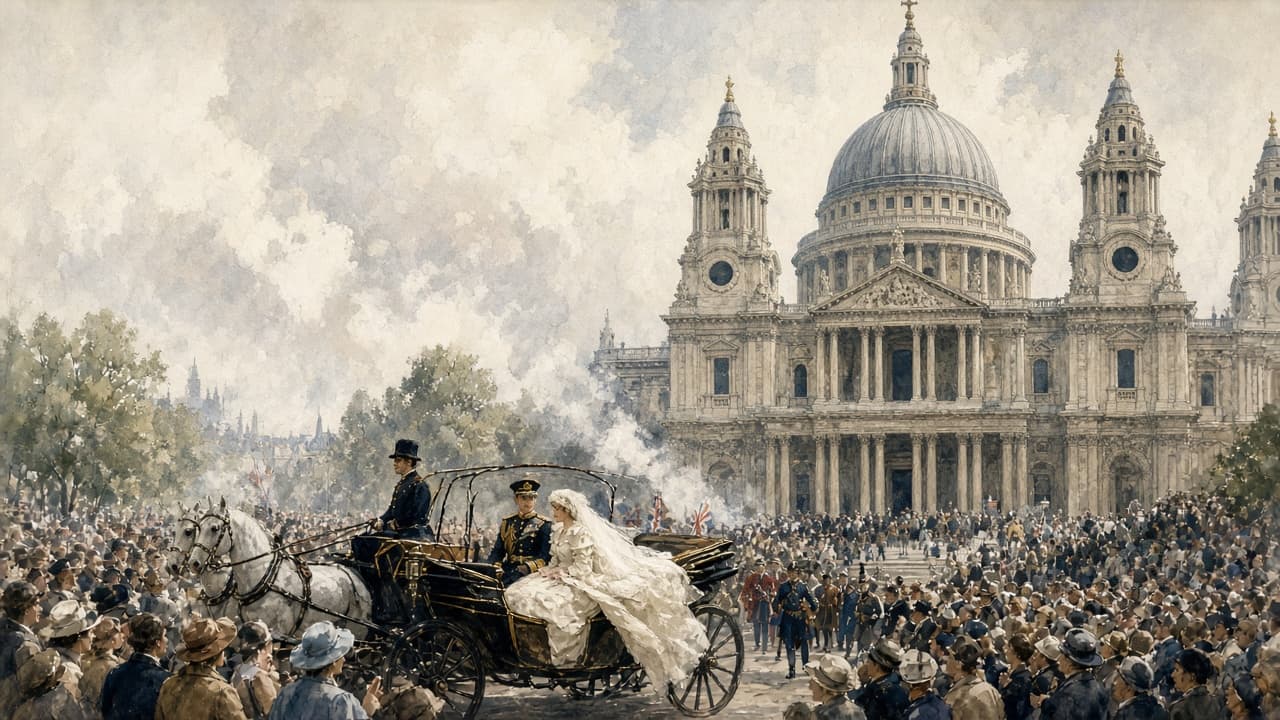
The dress was the most closely guarded garment in Britain. David and Elizabeth Emanuel, a young couple who had a small London studio, made an ivory silk taffeta gown with antique lace, thousands of hand-sewn sequins and pearls and a 25-foot train, the longest ever worn at a royal wedding. It had been kept in a safe, and a decoy design was reportedly prepared in case of a leak. The train filled the cathedral aisle and also came out of the coach heavily creased, which the designers had anticipated and could not prevent.
The ceremony itself ran for about an hour and a half. The Archbishop of Canterbury, Robert Runcie, opened by saying this is the stuff of which fairytales are made, a line that has aged into bitter irony and was meant at the time as a reflection on public hope rather than a prediction. Diana muddled the groom's names in her vows, saying Philip Charles Arthur George instead of Charles Philip, and the congregation heard it. Neither party promised to obey, an omission Diana requested. Kiri Te Kanawa sang Handel. Diana's wedding band, like every royal one since 1923, was cut from the same nugget of Welsh gold.
Afterwards the couple appeared on the Buckingham Palace balcony and kissed, prompted by the crowd. It looks like tradition now and it was not. No royal couple had done it before, and every balcony appearance since has been measured against it. The honeymoon began at Broadlands in Hampshire, continued on a Mediterranean cruise aboard the royal yacht Britannia and finished at Balmoral. Prince William was born on 21 June 1982 and Prince Harry on 15 September 1984.
The marriage was in trouble well before the public knew. The couple separated formally in December 1992, in an announcement made to the House of Commons by the prime minister John Major, and divorced on 28 August 1996. Both gave television interviews about the failure, Charles in 1994 and Diana to the BBC's Panorama in November 1995, an interview the BBC later accepted had been obtained through falsified documents and for which it apologised in 2021. Diana kept the title Princess of Wales but lost the style of Royal Highness.
Her separate public work is the part with lasting consequences. In 1987 she shook hands with a man with HIV at the Middlesex Hospital without gloves, at a moment when public fear about casual transmission was widespread, and the photograph did more to correct that fear in Britain than any official campaign. In January 1997 she walked through a partially cleared minefield in Huambo, Angola, for the Halo Trust, and the images gave the campaign against anti-personnel mines a momentum it had not had. The Ottawa Treaty banning such mines was signed in December 1997, three months after she died in a car crash in Paris on 31 August at the age of 36.
The wedding day now functions as a marker for how royal coverage changed. It was the last major royal occasion staged for a deferential press and consumed as pure spectacle. Everything afterwards, including the tabloid pursuit of Diana, the disclosures of the 1990s and the way her sons have handled their own families and the media, belongs to a different relationship between the institution and the public. Charles became king on 8 September 2022 and was crowned the following May, with Camilla as queen.
Eagle Frame's takeaway: 29 July 1981 was sold as a fairytale and is better understood as the last royal event that could be sold that way. The marriage failed, and the woman at the centre of it went on to prove that the most effective thing a royal figure can do is turn up in the places other public figures avoid.