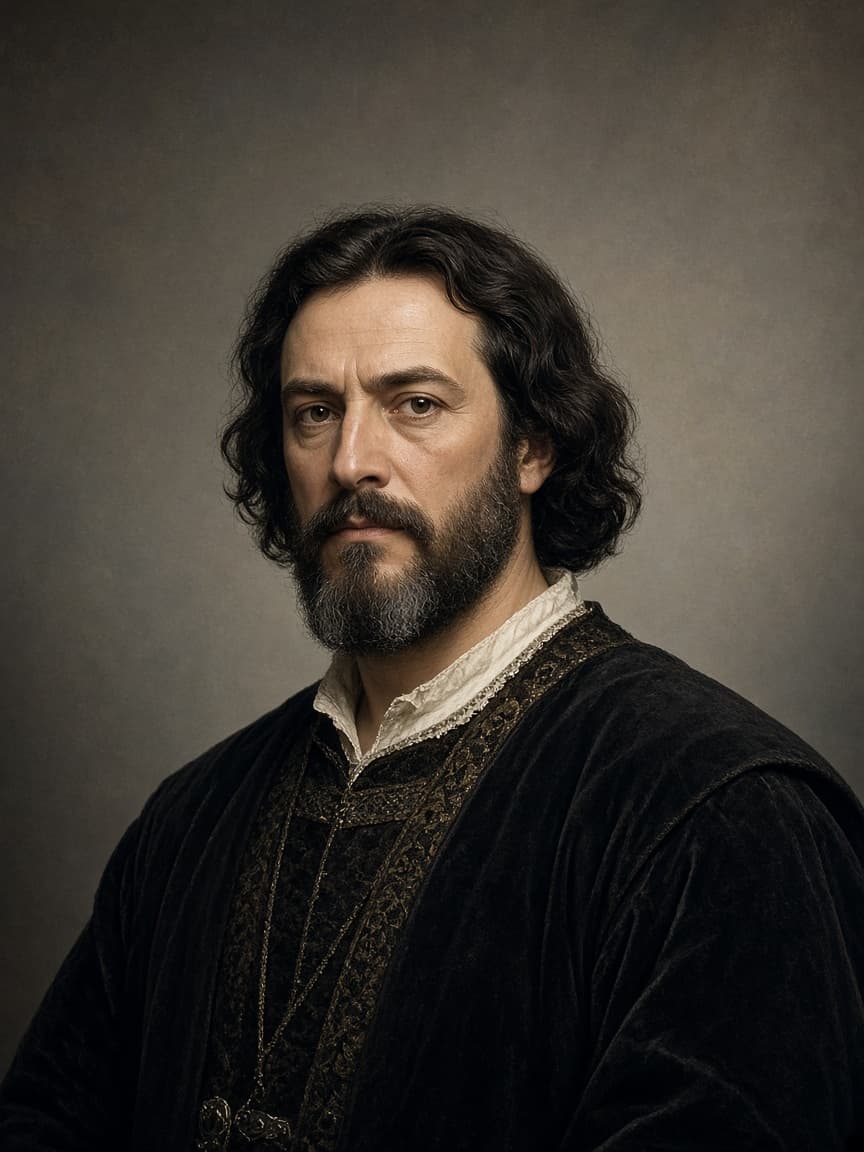
On this day: Columbus sails from Spain
On 3 August 1492, three ships left Palos de la Frontera under Christopher Columbus. The voyage did not find an empty world. It opened permanent contact between Europe and peoples who had lived in the Americas for thousands of years.
Before sunrise on 3 August 1492, three ships slipped out of Palos de la Frontera, a small port on Spain's Atlantic coast near the mouth of the Rio Tinto. The Santa Maria was a nao, a broad merchant hull that served as flagship. The Pinta and the Nina were caravels, smaller and faster. Their commander was Cristoforo Colombo, a Genoese navigator the Spanish court called Cristobal Colon and English speakers know as Christopher Columbus. He was not sailing to find a new continent. He was trying to reach the spice markets of Asia by going west instead of around Africa.
Columbus was probably born in Genoa around 1451 into a family of weavers and traders. He went to sea young, worked the Atlantic routes out of Portugal, lived for a time in Madeira and learned chart-making alongside sailing. His proposal was simple to state and wrong in its arithmetic. He argued that the Earth was smaller than most scholars calculated and that Asia stretched farther east than the maps allowed, so a ship could cross from Iberia to Japan in a few weeks. Portuguese royal advisers rejected the plan more than once. Their objection was not that the world was flat, a myth invented centuries later. Educated Europeans had known the Earth was a sphere since antiquity. The experts simply thought his distance estimate was far too short, and they were right.
Spain said yes for reasons of timing and politics. In January 1492 the combined crowns of Castile and Aragon took Granada, the last Muslim-ruled emirate on the Iberian peninsula, ending a long reconquest campaign. Money and attention freed up. In April, Queen Isabella I of Castile and King Ferdinand II of Aragon agreed to the Capitulations of Santa Fe, a contract that promised Columbus the title of Admiral of the Ocean Sea, the governorship of any lands he claimed and a tenth of the wealth he brought back. Palos was ordered to supply two of the ships as a penalty it owed the crown. Local sailing families made the voyage possible, above all the brothers Martin Alonso Pinzon, who captained the Pinta, and Vicente Yanez Pinzon on the Nina.
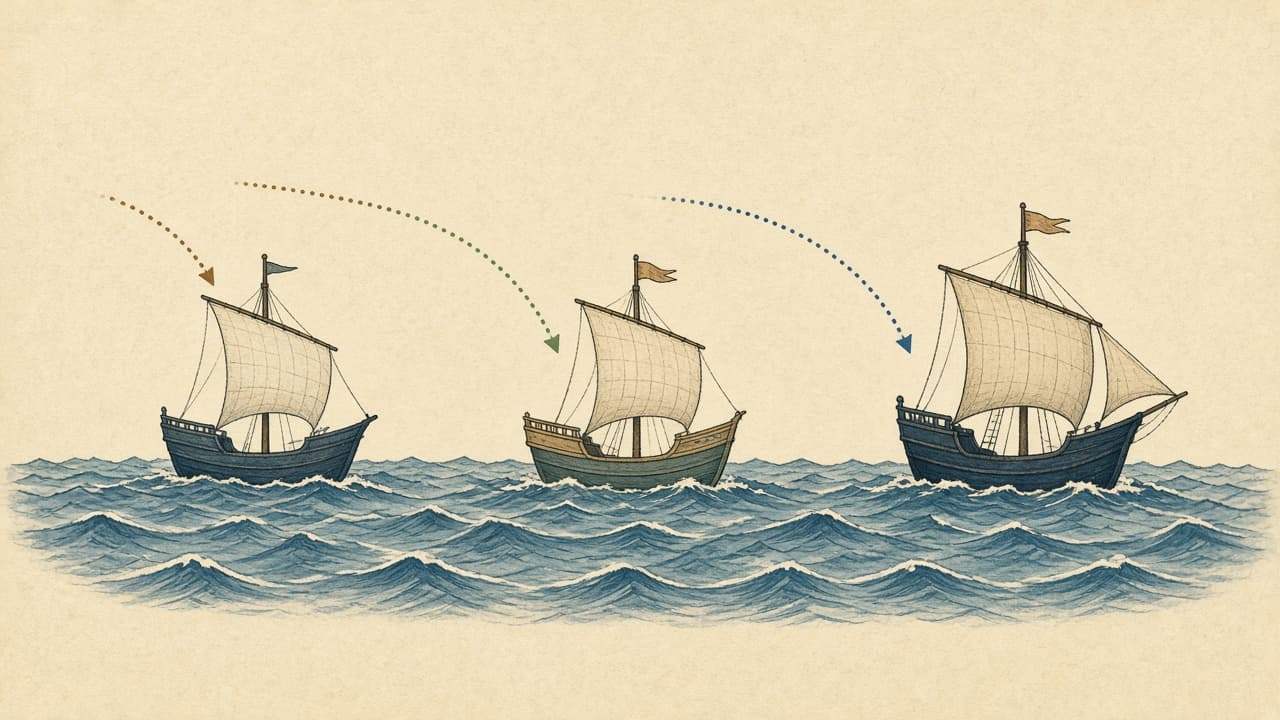
The fleet carried something in the range of ninety men. It sailed first to the Canary Islands, where the Pinta's rudder was repaired and the Nina was re-rigged, and left La Gomera on 6 September. From there Columbus rode the northeast trade winds, a belt of steady following wind that made the westward crossing far easier than sailors used to European coastal work expected. Five weeks of open water tested nerves more than seamanship. Columbus kept a running distance log and, by his own account, showed the crew shortened figures so the gap from home would seem less alarming. Land appeared on 12 October 1492. It was a low island in the Bahamas that its inhabitants, the Lucayan people, called Guanahani. Columbus renamed it San Salvador and claimed it for Castile.
Here is the part that older schoolbooks handled badly. Columbus did not discover an empty hemisphere. The Americas had been continuously inhabited for well over ten thousand years by the time his ships arrived, and current estimates put the population of the two continents in 1492 somewhere in the tens of millions. The people who watched those sails approach were Lucayans, part of the wider Taino world of the Caribbean. Beyond them lived the Mexica of Tenochtitlan, a lake city larger than most European capitals, the Maya with their written script and astronomical tables, the Inca running a road network of thousands of kilometres through the Andes, the Mississippian mound builders of the Ohio and Mississippi valleys and hundreds of other nations with their own languages, laws and farms. Maize, potatoes, beans, squash and cassava were domesticated in the Americas by those societies, not brought there. Norse sailors had also reached Newfoundland around the year 1000 and left a settlement at L'Anse aux Meadows, so 1492 was not even the first Atlantic crossing.
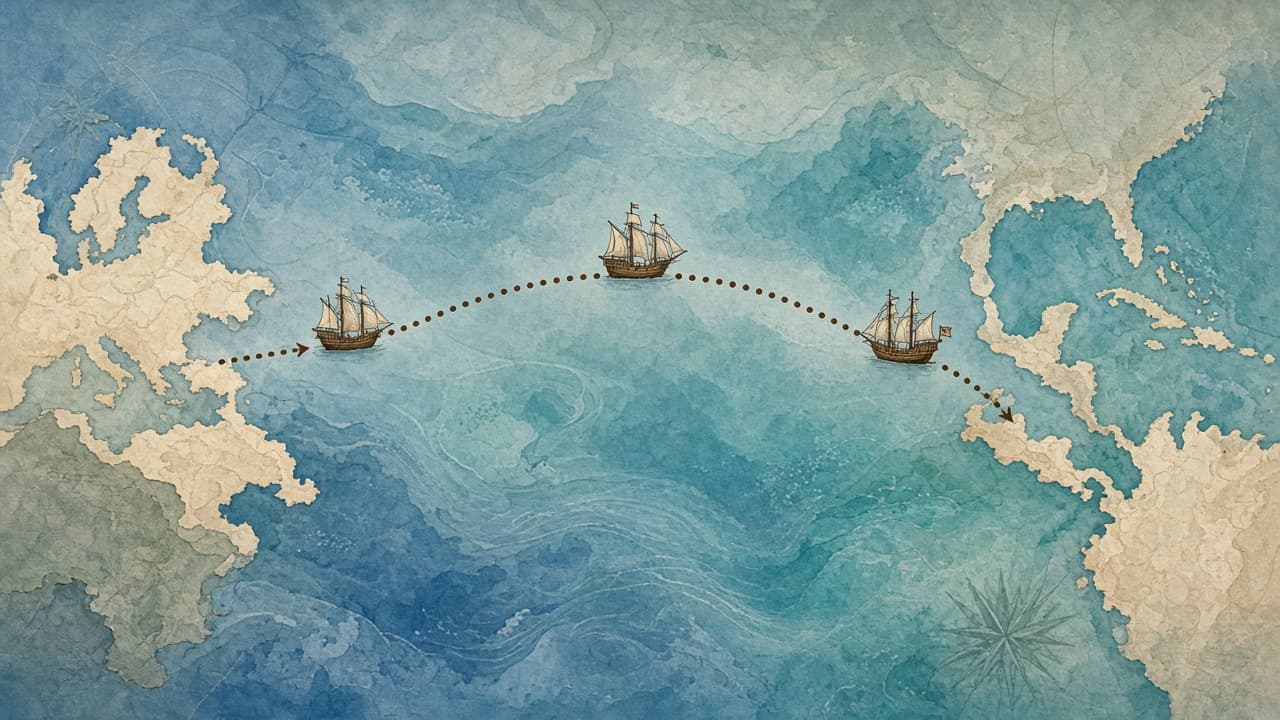
What did begin on 3 August 1492 was sustained contact and then colonization. Earlier crossings left no lasting link. This one did, because Columbus found the wind pattern home as well as out: sail north to catch the westerlies, then run east to Iberia. That round trip turned a one-off voyage into a shipping lane. Columbus made four crossings between 1492 and 1504. On the first he wrote in his journal that the islanders were generous and unarmed and that a small force could subdue them, an assessment that reads today as exactly what it was. Spanish settlement of Hispaniola followed within a year, along with gold tribute quotas, forced labour under the system later formalized as the encomienda and the shipping of captives to Europe.
Disease did what soldiers could not. Smallpox, measles, influenza and typhus had circulated in Afro-Eurasia for centuries and the populations of the Americas had no acquired immunity. Epidemics moved faster than settlers, often reaching communities before any European did. The Taino population of Hispaniola, which may have numbered in the hundreds of thousands, was reduced to a remnant within about fifty years. Across the hemisphere the collapse over the following century was one of the largest demographic catastrophes in recorded history. That is not a footnote to the voyage. It is the central consequence of it.
Goods and organisms moved both ways in what historians call the Columbian Exchange. Maize, potatoes, tomatoes, cacao, chilies, vanilla, rubber and tobacco went east and reshaped diets from Ireland to Sichuan. Wheat, sugarcane, rice, horses, cattle, pigs and sheep went west and reshaped farming and warfare in the Americas. Sugar plantations in the Caribbean then created a labour demand that Europeans met by expanding the transatlantic trade in enslaved Africans, a traffic that carried roughly twelve million people across the ocean over the next three and a half centuries. The Atlantic became a single economic system, and its profits and its cruelties travelled together.
Columbus himself did not end well by his own standards. He proved a disastrous governor. Settlers complained of arbitrary punishments and broken promises, and in 1500 a royal investigator named Francisco de Bobadilla arrested him on Hispaniola and shipped him back to Spain in irons. The crown released him but stripped the governorship and most of the contractual privileges. He sailed once more, was marooned for a year in Jamaica and died in Valladolid in 1506, still insisting that he had reached the outer fringe of Asia. The continents were eventually named for Amerigo Vespucci, a Florentine navigator who argued in print that these were lands unknown to Ptolemy rather than a corner of the Indies.
That is why the date is argued over now. The United States built a federal Columbus Day in 1937, partly at the urging of Italian American organizations facing discrimination who wanted a national figure of their own. Several states and many cities have since replaced or paired it with Indigenous Peoples' Day. Statues have been removed in some places and defended in others. The useful position is not to pick a cartoon. Columbus was a skilled deep-water navigator who solved a hard wind problem, and the process he started involved conquest, forced labour and demographic collapse for people whose descendants are still here. Both sentences are true and neither cancels the other.
For readers who travel, the physical traces are easy to find and worth seeing honestly. Palos still has the church of San Jorge where the crews heard mass before sailing, and replica ships sit at the nearby Muelle de las Carabelas. In the Dominican Republic and Puerto Rico, museums and archaeological sites preserve Taino carving, ball courts and cave art that predate 1492 by centuries. Visiting both ends of the route in one trip does more for understanding than any anniversary argument conducted at a distance.
Eagle Frame's takeaway: 3 August 1492 is the day a European fleet left Palos and found a reliable way back, which is what turned one crossing into five centuries of contact, colonization and exchange. Know the trade winds, know the Capitulations of Santa Fe and know the names of the Lucayan and Taino people who were standing on the beach when the ships arrived.