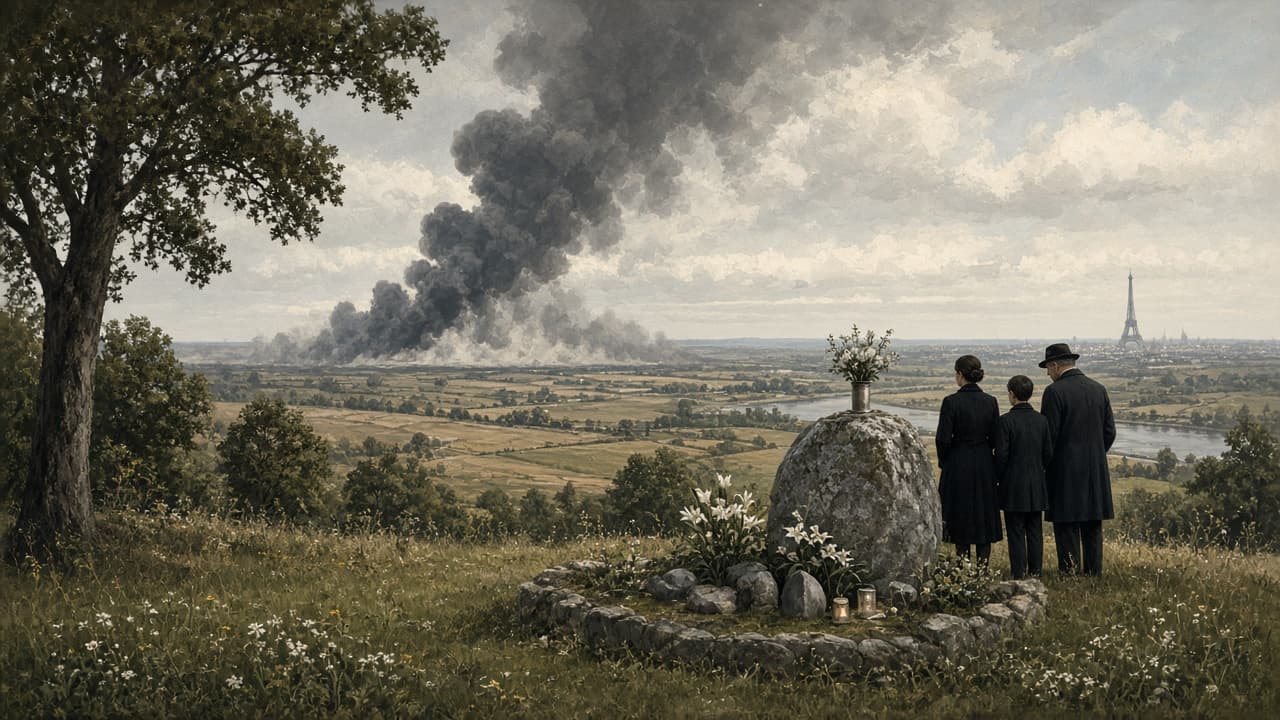
On this day: Air France Concorde Flight 4590 crashes
On 25 July 2000, a Concorde caught fire on takeoff from Paris and crashed into a hotel in Gonesse, killing 113 people. A strip of metal lying on the runway started a chain of failures that ended supersonic passenger flight.
At about 16:43 local time on 25 July 2000, Air France Flight 4590 rolled down runway 26 right at Charles de Gaulle airport outside Paris. It was a charter, not a scheduled service: 100 passengers, most of them German holidaymakers travelling to New York to join a cruise ship, and nine crew. The aircraft lifted off trailing a plume of fire longer than its own fuselage. It stayed in the air for barely 90 seconds, never climbed above about 200 feet and came down on a hotel in the village of Gonesse. All 109 people on board and four people on the ground were killed.
Concorde needs describing rather than assuming, because nothing like it flies today. It was a supersonic airliner built jointly by Britain and France, in service from 1976, cruising at Mach 2.02 or roughly 1,350 mph, which is about twice the speed of sound and twice the speed of a normal jet. Paris to New York took around three and a half hours. Only 20 airframes were built and only 14 ever carried passengers, split between Air France and British Airways. Four Rolls-Royce Snecma Olympus 593 engines with afterburners produced the thrust, and the slender delta wing that made supersonic cruise possible left very little room inside for anything else.
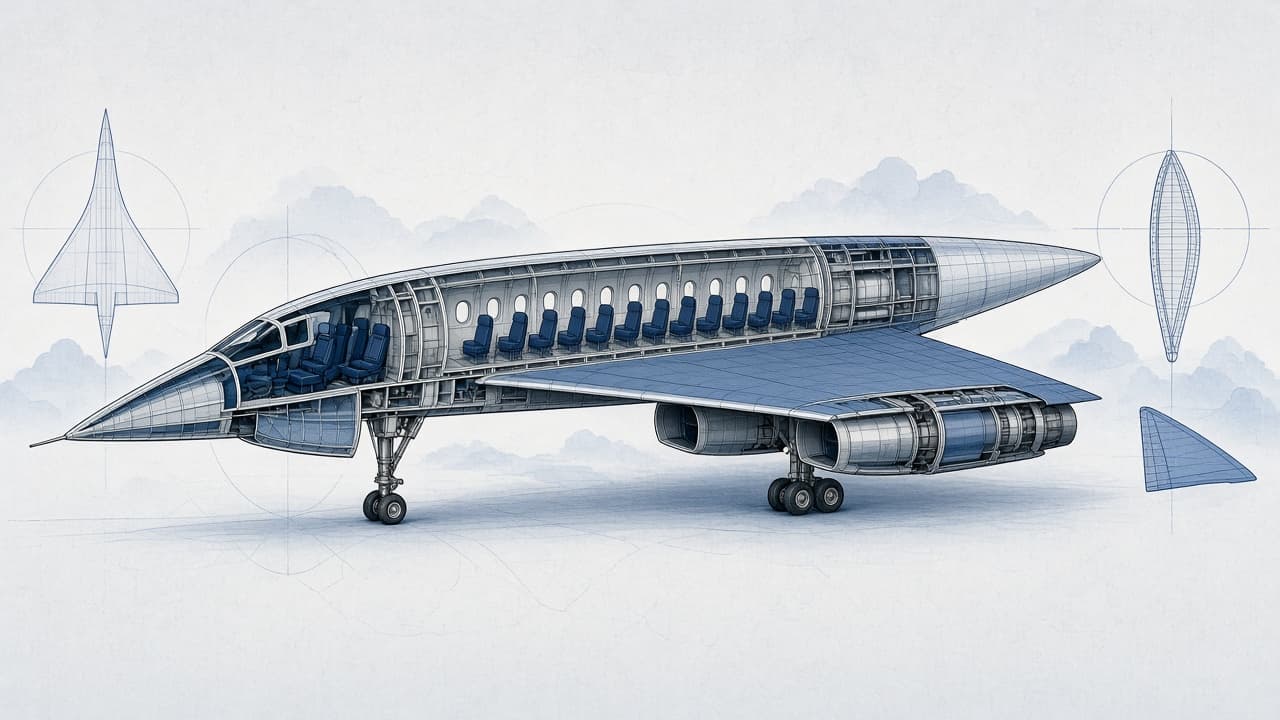
That layout matters for what happened. Because the wing was thin, the tanks sat close to the skin and directly above the wheels and engines. Fuel was also used as movable ballast, pumped forward and aft to keep the aircraft balanced as it accelerated through the sound barrier. On this flight the tanks were full for a transatlantic crossing, and the aircraft was at or slightly above its maximum takeoff weight with the centre of gravity further aft than normal.
Four minutes before AF4590 began its roll, a Continental Airlines DC-10 had used the same runway and had shed a titanium wear strip from one of its engine cowlings. The strip was about 435 mm long and roughly 30 mm wide, and it was lying on the concrete. At about 175 knots the Concorde's left main gear ran over it. The strip cut the tyre, which burst and threw off large pieces of rubber, one of them weighing around 4.5 kg.
The next step is the part investigators had to reconstruct from physics rather than eyewitnesses. The rubber did not punch a hole through the wing. It slammed into the underside of a full tank, and the impact sent a pressure wave through the fuel inside. That wave blew a piece of the tank skin outward from the inside, opening a hole roughly 30 by 30 cm. Fuel poured out at something like 100 kg per second. It ignited within a second, most likely from an electrical arc in the landing gear bay or from the hot engine exhaust just behind it, and the fire fed itself from the open tank.
By then the crew had no good options. The aircraft was already past V1, the speed after which a takeoff cannot safely be abandoned, so Captain Christian Marty had to fly. Engines one and two lost thrust as the fire disrupted their airflow. The landing gear would not retract, which left the aircraft dragging enormous drag at a speed barely above the stall. Airspeed hung near 200 knots and would not rise. The crew declared an emergency and aimed for Le Bourget, a few miles ahead, but the aircraft yawed left, rolled and struck the Hotelissimo. From tyre burst to impact was under two minutes.
The French accident bureau, the BEA, published its final report in January 2002 and named the runway debris as the trigger. It also documented factors that made a bad situation worse: the aircraft was overweight for the conditions with a tailwind component, extra baggage had been loaded late, and a spacer was missing from the left main gear bogie beam after maintenance, which may have made the gear track slightly askew. The report noted something more uncomfortable as well. Concorde had suffered dozens of tyre failures over the years, and in June 1979 an Air France Concorde at Washington Dulles had burst tyres that punctured tanks and cut wiring. The warning existed and the fleet kept flying.
Airworthiness certificates were withdrawn on 16 August 2000 and the fleet was modified before it flew again. Engineers lined the tanks with flexible Kevlar bladders to slow any leak, Michelin developed a near zero growth radial tyre far less likely to shred, and wiring in the gear bays was rerouted and armoured. Concorde returned to service on 7 November 2001, into a transatlantic market that had just collapsed after the September 2001 attacks. Air France and British Airways announced retirement in April 2003. The last Air France commercial flight was on 31 May 2003 and British Airways finished on 24 October 2003.
The legal aftermath ran for another decade. In December 2010 a French court convicted Continental Airlines and one of its mechanics of involuntary manslaughter over the titanium strip. An appeal court quashed the criminal conviction in 2012 while leaving Continental with partial civil liability, and Air France had already compensated the families. The practical legacy is less dramatic and more useful: airports tightened runway inspection and sweeping regimes, because the accident showed that a piece of metal the size of a ruler can destroy an airliner.
Supersonic passenger flight has not returned. The obstacles were never only safety. Concorde burned about three times the fuel per passenger of a subsonic jet, sonic booms kept it off overland routes in the United States and elsewhere, and no airline ordered one after the early 1970s. Startups including Boom Supersonic are working on new designs, and NASA has flown quiet boom research aircraft to test whether the overland ban can be revisited. None of that has yet produced a ticket you can buy.
Eagle Frame's takeaway: 25 July 2000 was not a failure of exotic technology so much as a failure of margins. A discarded strip of titanium, a burst tyre, a shock wave through full fuel and a fire behind two engines were enough, and Concorde had so little spare performance on takeoff that the crew never had a second chance.