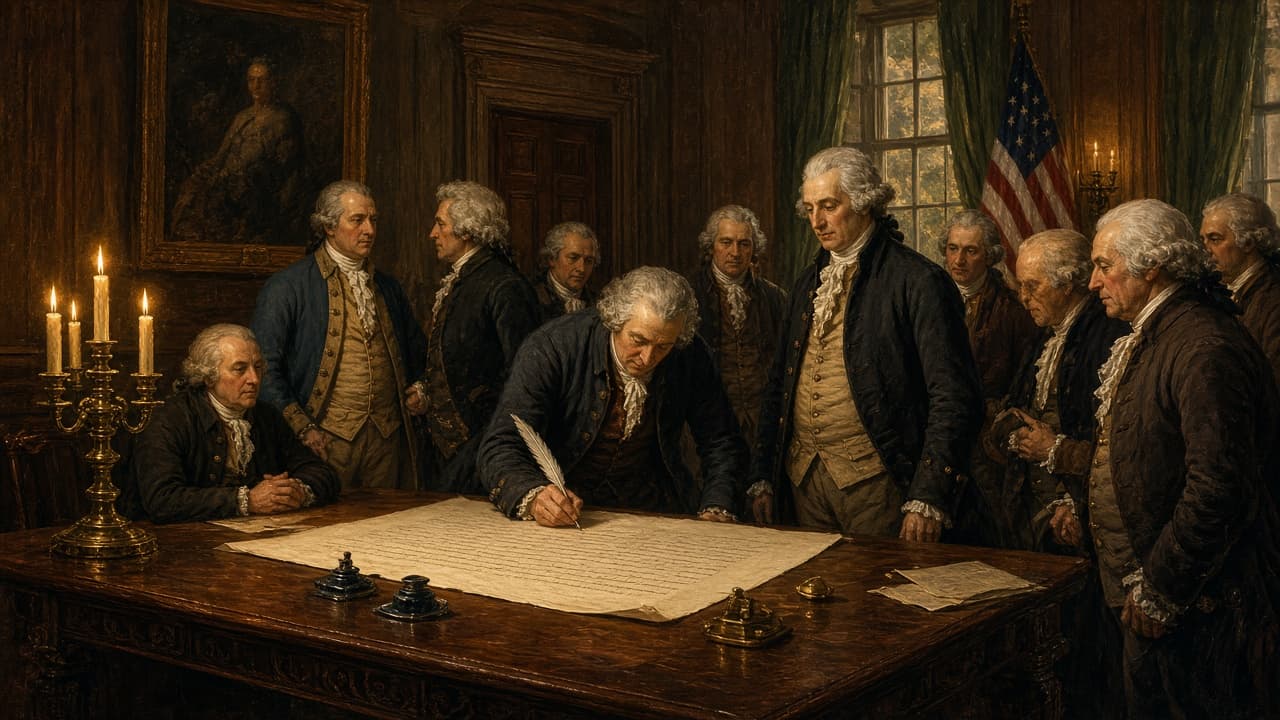
On this day: most delegates sign the Declaration of Independence
On 2 August 1776, most members of the Continental Congress signed the engrossed parchment of the Declaration of Independence. The vote for independence came on 2 July and the text was adopted on 4 July, which is why the famous document carries a date it was not signed on.
The journal of the Continental Congress for 2 August 1776 contains one dry sentence that fixes a date most Americans get wrong: the declaration of independence being engrossed and compared at the table was signed. That was the day John Hancock wrote the large signature everyone can picture, and the day most of the other delegates added theirs. The parchment they signed is the one displayed at the National Archives in Washington. It is headed 4 July 1776, and almost nobody signed it on 4 July 1776.
Untangling this takes three dates and one piece of vocabulary. On 2 July 1776, Congress voted on the resolution introduced by Richard Henry Lee of Virginia declaring that the united colonies are, and of right ought to be, free and independent states. Twelve colonies voted yes and New York abstained pending instructions. That vote is the legal act of separation. On 4 July, Congress approved the wording of the document explaining the decision, drafted mainly by Thomas Jefferson and edited hard by the floor. The word to know is engrossed, which simply means copied out formally in a large clear hand on durable material. On 19 July, once New York had joined, Congress ordered the text engrossed on parchment under a new title, the unanimous Declaration of the thirteen united States of America, and that when engrossed it be signed by every member of Congress.
Somebody had to do the writing, and the penman was almost certainly Timothy Matlack, a Philadelphia brewer and assistant to Charles Thomson, the secretary of Congress. Matlack worked on prepared animal skin, which is what parchment is, using iron gall ink. The job took roughly two weeks. That is the physical object: about sixty by seventy-five centimeters of sheepskin, hand-lettered, then signed on 2 August 1776.
John Adams was the one who predicted the wrong holiday. Writing to his wife Abigail on 3 July 1776, he said the second day of July would be the most memorable epoch in the history of America and would be celebrated with pomp, parades, games, guns, bells, bonfires and illuminations from one end of the continent to the other. He had the festivities right and the date wrong by two days. What fixed 4 July in public memory was print. The Dunlap broadsides, a few hundred copies run off on the night of 4 July, carried that date at the top and were read aloud in towns and to Washington's troops in New York. The date on the poster became the date of the country.
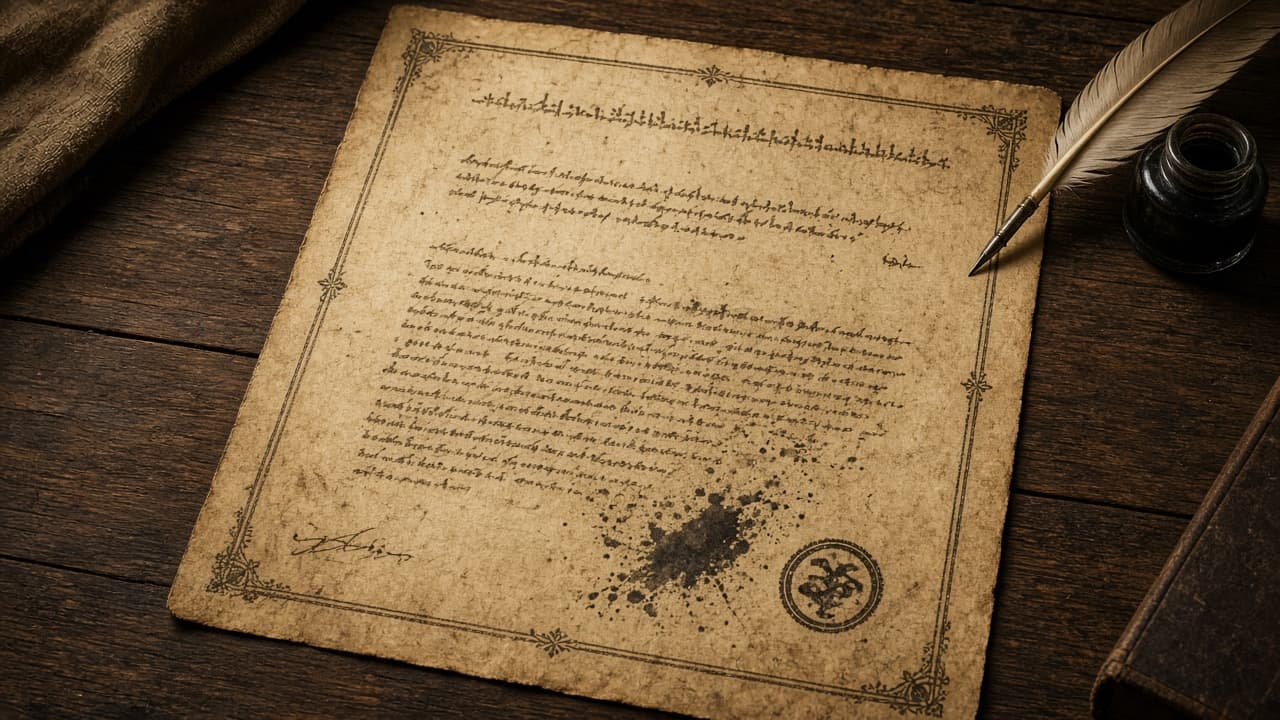
The signing had a protocol. Hancock signed first as president of Congress, in the centre beneath the text. The other delegates then signed by state in geographic order, starting at the right-hand column with the southern states and working across to New England, each state's men clustered together. Fifty-six delegates signed in the end. Not all of them were present on 2 August. Elbridge Gerry, Oliver Wolcott, Lewis Morris and Thomas McKean signed later, McKean possibly as late as 1781. Matthew Thornton of New Hampshire arrived in November and had to squeeze his name into the Connecticut column because his own state's space was full. Some members of Congress never signed at all, including Robert R. Livingston of New York, who had sat on the drafting committee.
Two familiar signing stories do not survive checking. Hancock is supposed to have said he wrote large so King George could read it without spectacles, a line first recorded long after the fact. Benjamin Franklin's remark about hanging together or hanging separately is also a later attribution. What is true is that the risk was real. These were subjects of the Crown putting their names to a document that named the king a tyrant while a British fleet and army were assembling off New York. Congress did not publish the list of signers until January 1777, after Washington's winter victories at Trenton and Princeton made the cause look survivable. Secrecy was not modesty. It was self-preservation.
The signers were not a cross-section of anything. They were merchants, planters, lawyers, doctors and printers, almost all of them men of property. A substantial number enslaved people, including Jefferson, who wrote the sentence about all men being created equal while holding more than a hundred people in bondage at Monticello. An earlier draft passage attacking the king over the slave trade was struck out on the floor at the insistence of South Carolina and Georgia and some northern shipping interests. The document's promise and the document's silence were written into it in the same summer.
The parchment then had a rough two centuries. It travelled with Congress through the war, was rolled and carted out of Washington ahead of the British in 1814, was displayed for decades in bright light at the Patent Office where the ink faded badly, spent the Second World War in the vault at Fort Knox and finally went on permanent display at the National Archives in 1952. It is now kept in a sealed titanium and aluminium case filled with inert argon gas, monitored continuously, under filtered light. Much of the writing is now very faint, which is why photographs usually show a facsimile.
For readers who like their anniversaries accurate, the honest summary is that American independence has three birthdays and they do different jobs. The second of July is when Congress decided. The fourth of July is when Congress agreed on how to say it, and that is the date printed on everything since. The second of August is when men actually put their names on the parchment that survives, which is the moment they personally attached their necks to the decision. Fireworks on the fourth are fine. It is still worth knowing what happened on the second.
Eagle Frame's takeaway: 2 August 1776 is the day the Declaration got most of its signatures, four weeks after the text was adopted and a month after the vote that actually made the break. Know the difference between the Lee resolution, the printed text and the engrossed parchment, and know that Timothy Matlack's handwriting is the reason there was anything to sign.