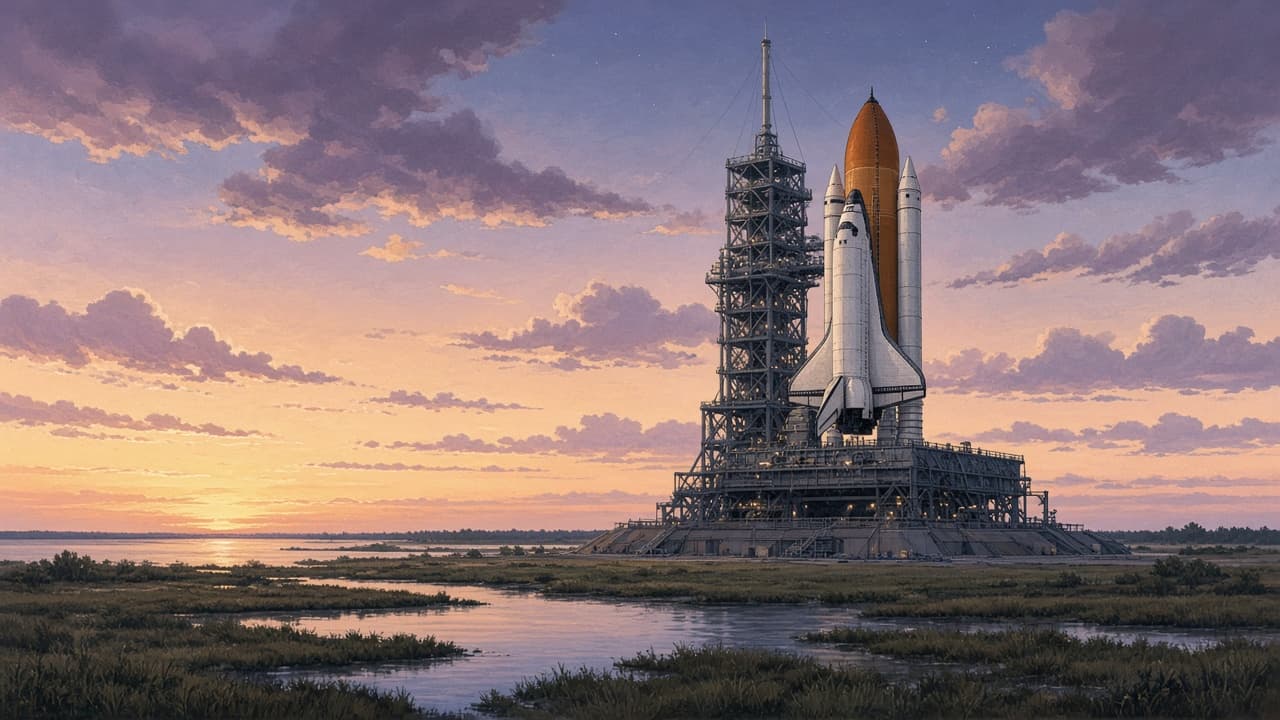
On this day: Space Shuttle Discovery flies for the first time
On 30 August 1984, Space Shuttle Discovery lifted off on STS-41-D, its maiden flight. The orbiter would become the fleet's workhorse across decades of missions.
On 30 August 1984, Space Shuttle Discovery launched from Kennedy Space Center on mission STS-41-D, the orbiter's first flight. Commander Henry Hartsfield led a crew that deployed communications satellites and tested the experimental solar array wing. Discovery joined Columbia and Challenger in NASA's reusable fleet. Over the next decades it would fly more missions than any other orbiter, from satellite deliveries to Hubble service and International Space Station assembly flights.
What was the Space Shuttle system? It combined a winged orbiter that could land on a runway, two solid rocket boosters recovered from the ocean and a huge external tank that fed liquid hydrogen and oxygen to the orbiter's main engines and burned up after separation. The promise was routine access to low Earth orbit with a cargo bay large enough for satellites, labs and later station modules. "Routine" always hid risk. The stack was still a controlled explosion pointed up.
Space Shuttle Discovery first flew in August-September 1984 as part of a stack that joined orbiter, external tank and twin solid rocket boosters. At liftoff the solids and tank engines together lifted the winged orbiter. After booster separation and tank discard, Discovery flew as a spaceplane with a cargo bay for satellites and experiments. The labeled stack diagram teaches why shuttle missions looked like rockets going up and airplanes coming home. Payload specialists and career astronauts shared the middeck on early Discovery logistics flights.
Landing on a runway with wheels down completed the reusable promise in public view. Discovery would go on to fly satellite deployments, Hubble servicing support roles and assembly flights across decades before retirement. Early missions proved the orbiter's systems after Columbia and Challenger's program learning curve (Challenger's later loss still ahead in 1986). The landing image is the payoff of thermal tiles, flight computers and pilot skill. The stack image is the violence required to get there. Tile inspections after landing fed engineers data that kept the fleet flying between major redesigns.
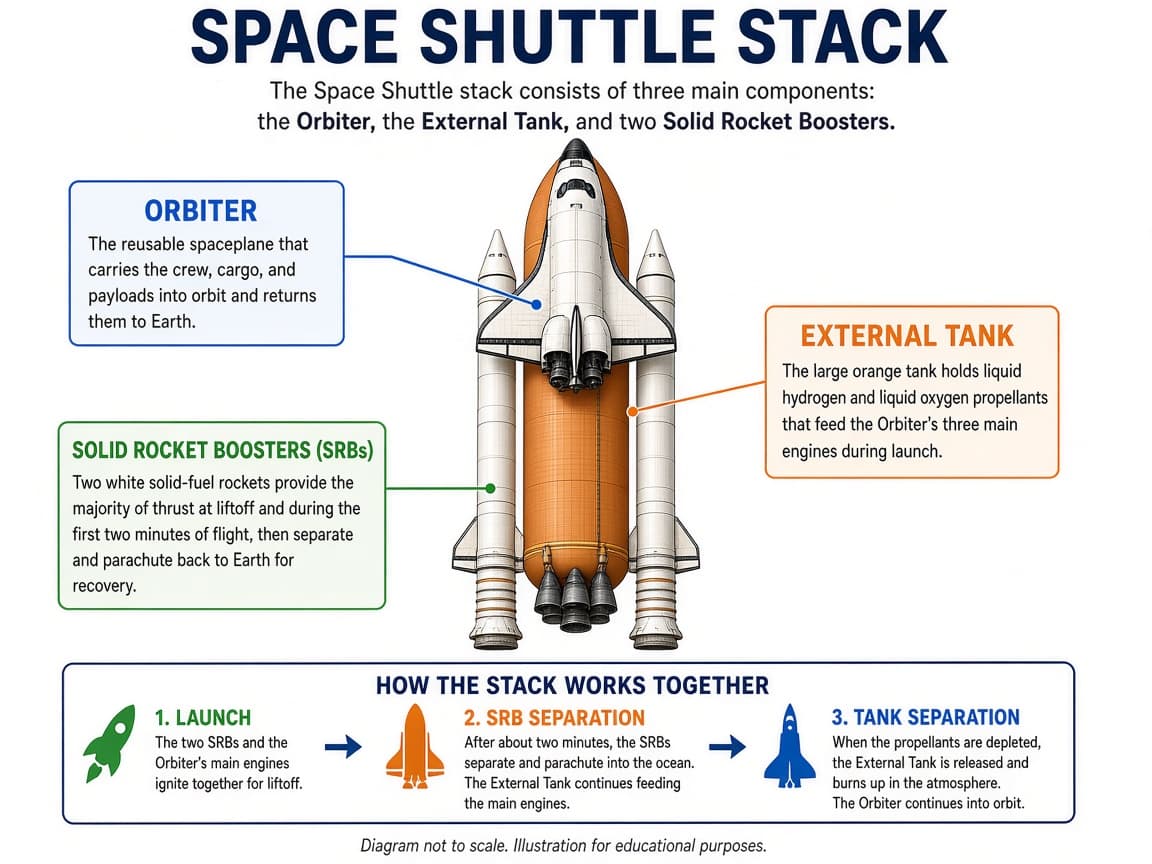
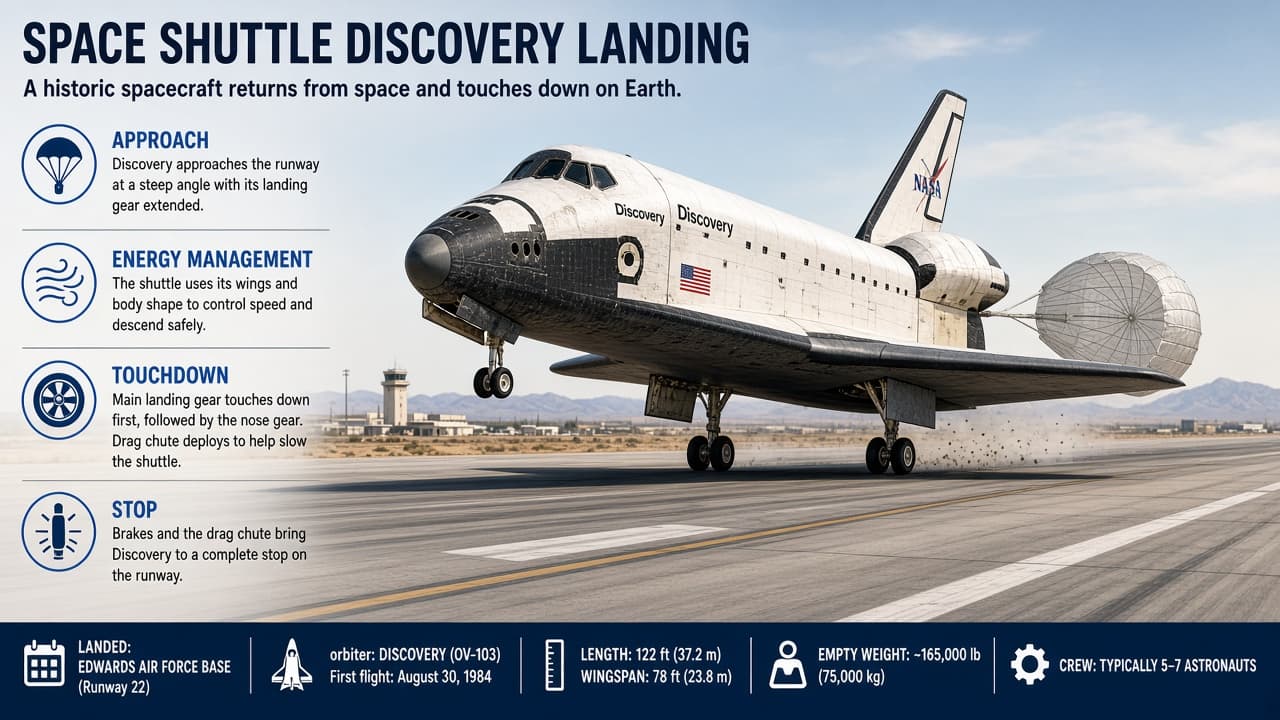
How launch worked, in steps. Main engines ignited on the pad, then boosters lit and held the vehicle until bolts released. Boosters burned out and parachuted into the Atlantic for recovery. The tank emptied and separated. The orbiter's orbital maneuvering system finished circularizing the orbit. On the way home, the crew fired thrusters to reenter, rode heat across plasma blackout and glided to a landing. Discovery's first flight rehearsed that choreography with a new airframe.
STS-41-D had scrubbed earlier after engine trouble; patience on the ground protected the crew. Once aloft, satellite deployments proved the payload bay's commercial and military usefulness in the mid-1980s. The experimental OAST-1 solar array tested structures that later informed space power design. Maiden flights are engineering exams as much as flag moments.
Discovery's long resume later included the return-to-flight mission after Challenger (STS-26 in 1988), Hubble Space Telescope servicing, John Glenn's return to space in 1998 and many station construction flights. The orbiter retired in 2011 and now hangs in museum care at the Smithsonian's Udvar-Hazy Center. First flight day is the birthday of a machine that lived a full working life in vacuum. Critics of the shuttle program note cost, complexity and the Challenger and Columbia tragedies that showed how thin safety margins could be. Those facts belong beside anniversary pride. Discovery's reliability statistics do not erase lost crews on sister ships. They do show why NASA kept flying a design that could haul large cargo before capsules returned as the main crew taxi. For readers who see shuttles only as toys or movie props, 30 August 1984 is a grounding date. A new orbiter left Florida, opened its bay doors and began a career of unfinished-looking spacework: bolts, antennas, solar wings and patient orbits. Exploration is often maintenance at altitude.
Naming orbiters after exploration ships (Discovery, Endeavour) tied NASA's brand to maritime history. Discovery's nameplate carried Captain Cook associations into low Earth orbit. Marketing aside, crews treated the vehicle as a flying workshop with temperamental toilets, noisy fans and checklists measured in hours. Romance and checklist shared the middeck.
By retirement, Discovery had logged thirty-nine missions. That statistic is why museums treat the airframe as a lead artifact of the shuttle age. First flight day is the opening chapter; the Hubble flights and station assembly flights are the middle; the ferry to the Smithsonian is the last line. 30 August starts that shelf life.
Payload customers in the 1980s treated the shuttle like a truck with wings: book a bay slot, pay a fee, watch your satellite spring from the canopy. Discovery's early flights sold that business model before accidents and costs forced a rethink. First flight day is therefore also a date in the history of space commerce dreams.
Thermal tiles, landing gear and a human-rated cockpit made Discovery different from an expendable rocket's tip. The orbiter had to fail gracefully enough for a runway. That dual identity (booster payload and airplane) is why first-flight engineers watched every sensor. A new ship's maiden orbit is a trust exercise with little spare hardware.
Eagle Frame's takeaway: 30 August 1984 is when Discovery first reached orbit on STS-41-D. Know the stack of tank and boosters, know the payload bay's job and you understand why this orbiter became the workhorse of the shuttle era.