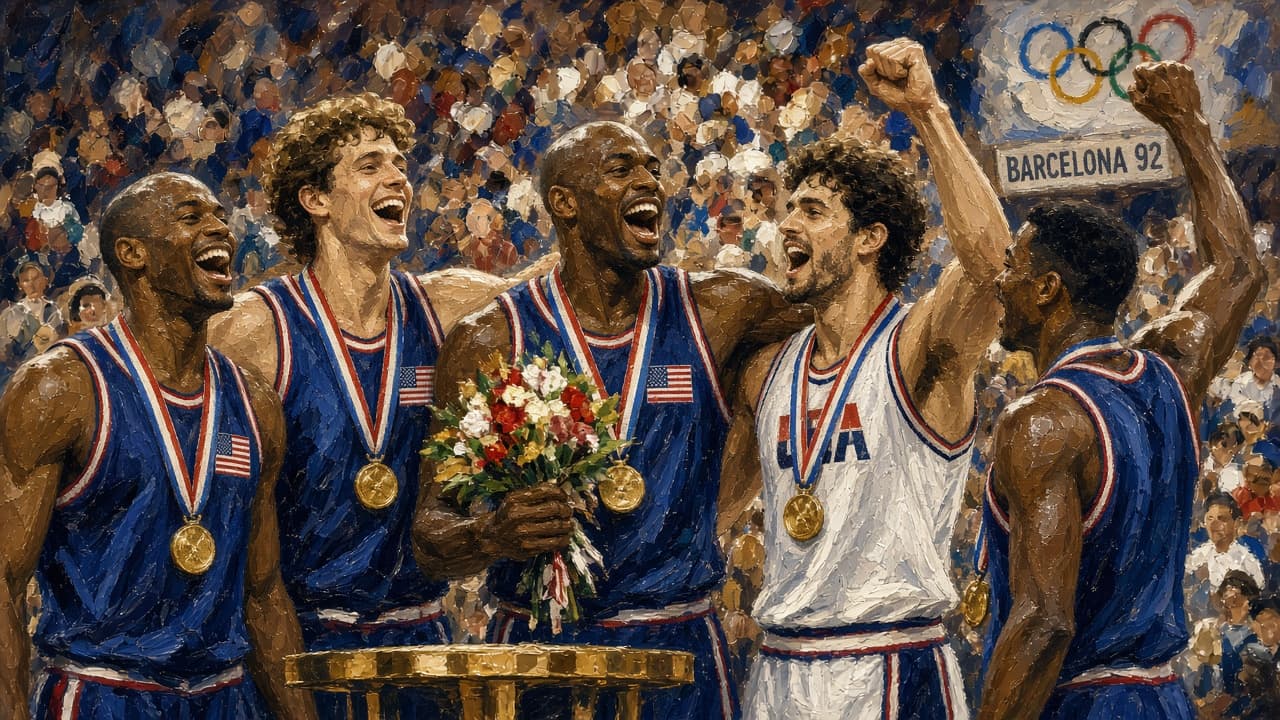
On this day: the US Dream Team wins Olympic basketball gold
On 8 August 1992, the United States beat Croatia 117-85 in Barcelona to win Olympic basketball gold. The first American team built around NBA stars changed how the rest of the world played the game.
On 8 August 1992, the United States men's basketball team beat Croatia 117-85 in the Olympic final at Badalona, just outside Barcelona. The result surprised nobody. The Americans had won their eight games by an average of more than 40 points, and coach Chuck Daly never once called a timeout in the tournament. What made the day matter was not the scoreline but the roster. For the first time, professional players from the National Basketball Association had been allowed into the Olympics, and the squad Americans had already nicknamed the Dream Team turned a sports competition into a global introduction.
The rule change came first. Until 1989 the Olympic basketball tournament was officially for amateurs, which in practice meant the United States sent college players against national teams whose best men had played together for years. That worked until it did not. The Soviet Union won in Munich in 1972 in a disputed finish, the United States lost the 1988 Seoul semi-final to the Soviets and took bronze, and the gap was no longer explainable as bad luck. In April 1989 FIBA, the sport's world governing body, voted to open its competitions to professionals. USA Basketball then built the team that critics of the old system had been demanding.
The names still read like a museum wall. Michael Jordan, Magic Johnson, Larry Bird, Scottie Pippen, Charles Barkley, Karl Malone, John Stockton, David Robinson, Patrick Ewing, Chris Mullin and Clyde Drexler were all NBA stars, and eleven of the twelve are now in the Hall of Fame. The twelfth spot went to Duke's Christian Laettner, the last amateur on an Olympic American roster. Daly, who had just won two championships with the Detroit Pistons, coached a group with no need for plays. Magic Johnson had retired the previous November after announcing he was HIV positive, and Bird's back was failing him. Both came anyway and both retired soon after.
Barcelona treated them like touring musicians rather than athletes. Security concerns and crowd size kept the team out of the Olympic village and in a hotel on Passeig de Gracia, where fans gathered on the pavement for days. Opposing players asked for photographs before tip-off and swapped jerseys afterwards. The opener against Angola finished 116-48, and Barkley's elbow on an Angolan player drew the tournament's only real criticism of the squad's conduct. Crowds cheered American baskets. Television audiences outside the United States watched players they had previously only read about in magazines.
The best game they played was against each other. During training in Monte Carlo, Daly split the roster and let them scrimmage, and the session that followed has been retold for 30 years by everyone who was in the gym. Magic Johnson led one side, Jordan the other, the trash talk ran continuously and the intensity exceeded anything the tournament produced. Jordan's group won. The tape of that scrimmage sat in a vault for decades before excerpts appeared in documentaries. It is the only credible answer to the question of who could have beaten that team.
Croatia in the final was its own story. The country was playing its first Olympics as an independent state, weeks into a war that followed Yugoslavia's breakup, with a team good enough to have won gold in almost any other year. Drazen Petrovic was already starring for the New Jersey Nets, Toni Kukoc was on his way to the Chicago Bulls and Dino Radja was heading for Boston. The Americans had beaten them 103-70 in group play. In the final Croatia actually led briefly in the opening minutes, trailed 56-42 at the break and lost by 32. Petrovic scored 24. He died in a car crash in Germany less than a year later, aged 28.
The effect on the sport arrived within a decade. Kids in Lithuania, Spain, Argentina, Serbia and later China grew up copying players they had first seen in Barcelona, and NBA rosters filled with them. The 1992 tournament is where Kukoc, Divac, Sabonis and their successors stopped being curiosities and became the expected pipeline. By 2002 a United States team lost a World Championship game on home soil. By 2004 in Athens the Americans took bronze behind Argentina and Italy. The Dream Team did not only demonstrate American superiority. It exported the coaching, the spacing and the ambition that ended it.
There were fair objections at the time and they have not disappeared. Games decided by 40 points are not competitive sport. Amateur athletes lost Olympic places to millionaires. Nike and its rivals treated the podium as advertising space, and the medal ceremony produced a row over whether players would wear the official Reebok tracksuit. Isiah Thomas, a two-time champion with Detroit, was left off the roster in a selection decision still argued about. Leaving Laettner's place to a college player rather than the young Shaquille O'Neal looks stranger every year.
None of that changed what the tournament proved. A single team, assembled once, playing eight games in a fortnight, moved a sport's center of gravity. Every American Olympic squad since has been measured against it, including the 2008 group that called itself the Redeem Team after Athens. The comparison is unfair in both directions, because the 1992 team faced opponents who had never seen them play and today's opponents grew up watching the same league on the same broadcasts.
Eagle Frame's takeaway: 8 August 1992 was a 32-point win that mattered for the wrong reason. The gold medal was never in doubt once FIBA let professionals in, so read Barcelona as the fortnight when American basketball taught the world its game and guaranteed it would eventually lose that advantage.