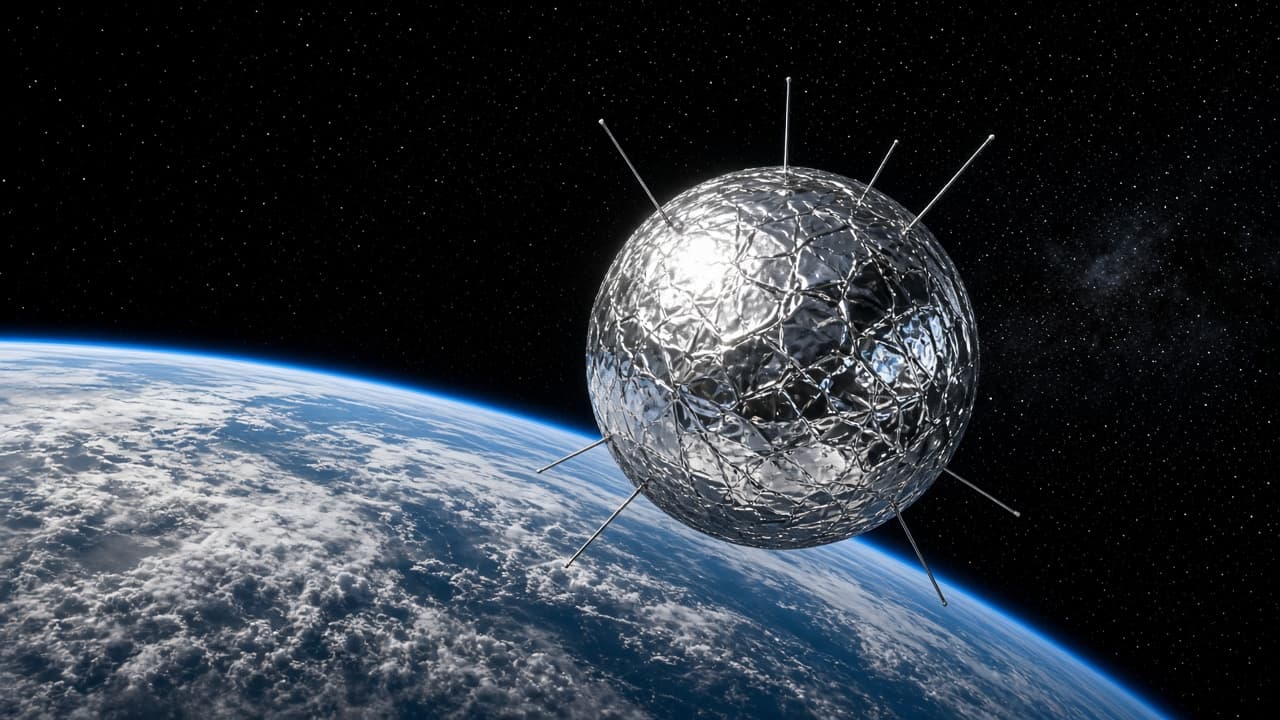
On this day: Echo 1, the first passive communications satellite, launches
On 12 August 1960, NASA launched Echo 1, a giant reflective balloon satellite. Radio signals bounced off its metalized skin from continent to continent.
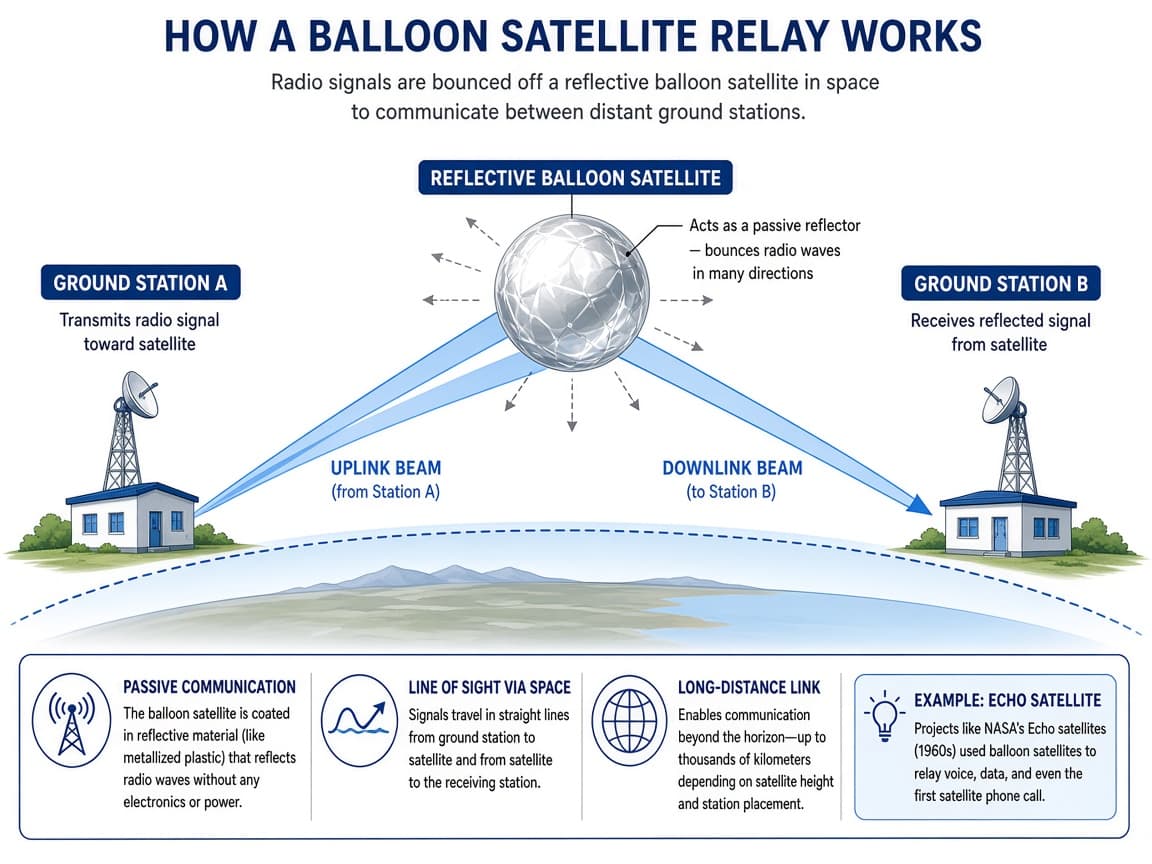
On 12 August 1960, NASA launched Echo 1 from Cape Canaveral. Once in orbit, the payload inflated into a shiny balloon about 100 feet (30 meters) across. It was a passive communications satellite: it carried no radio transmitter of its own for the relay. Ground stations aimed microwave signals at the balloon and the metalized surface reflected them back toward Earth so another station could catch the bounce. For a public still new to spaceflight, a glittering sphere that you could sometimes see at dusk made the idea of orbital relays feel real.
Start with the mechanism in plain steps. A transmitter on the ground sends a focused radio beam toward the satellite's predicted position. The balloon's skin acts like a curved mirror for those wavelengths. Energy that hits it scatters back toward Earth. A receiving antenna elsewhere, pointed at the same satellite, picks up a tiny fraction of that energy and amplifies it into a usable signal. Voice, music and data of the era could ride that path when geometry lined up.
Echo 1's communications trick was geometry, not onboard electronics. A ground station aimed a microwave beam at the balloon's orbital track. Metalized Mylar reflected a fraction of that energy toward a second station hundreds or thousands of miles away. Engineers tracked the satellite optically and by radio so antennas could lead the moving mirror. Voice and data experiments proved that space could relay signals even when the spacecraft carried no amplifier. Later active satellites improved efficiency, but Echo taught the bounce first.
The launch from Cape Canaveral put a Thor-Delta stack into the public eye as a peaceful answer to Sputnik-era anxiety. Once inflated, Echo was bright enough that ordinary people could watch it cross the night sky. That visibility was policy as well as science: a shining American sphere anyone could point to. When gas leaked and the skin wrinkled, performance faded, which also taught honesty about temporary hardware. The mission's dual legacy is a physics lesson about reflection and a cultural memory of a satellite you could see without a dish.
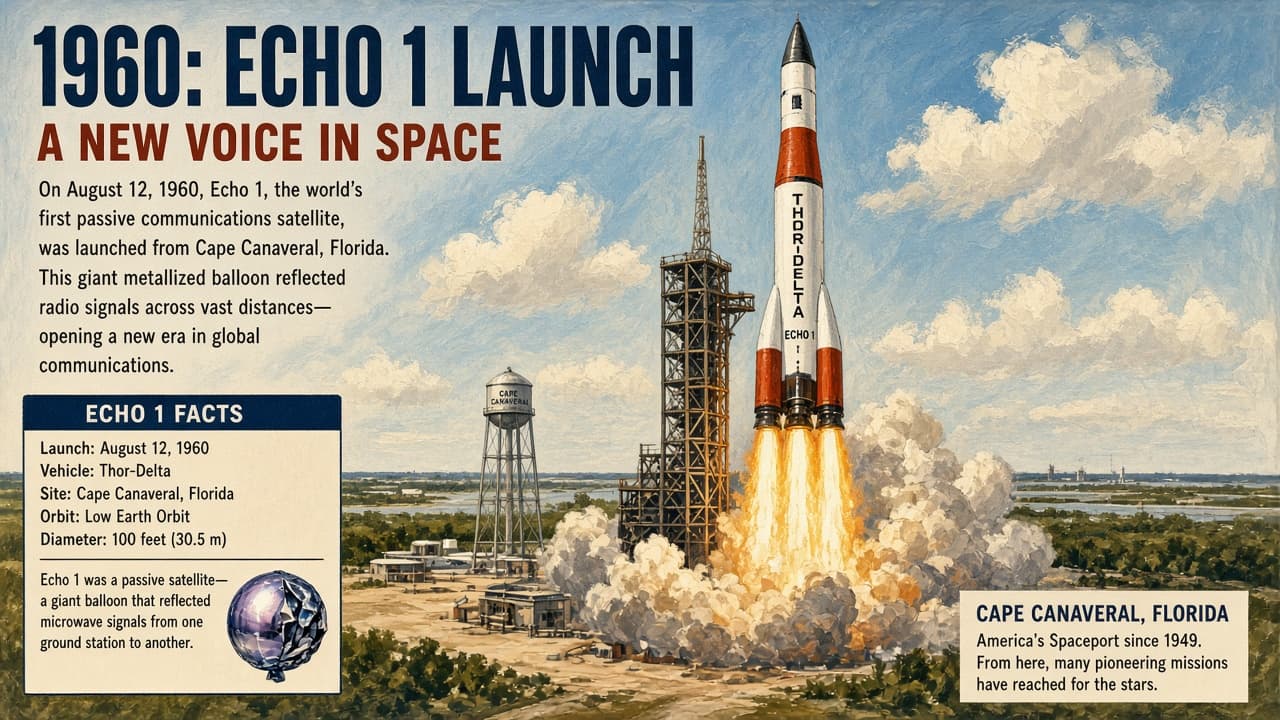
Echo 1 rode a Thor-Delta rocket into a roughly 1,000-mile-high orbit. Inflation used residual air and sublimating powders that turned to gas in vacuum, stretching the Mylar sphere smooth. The skin was coated with aluminum so thin it was measured in atoms of thickness, yet reflective enough for the experiment. Engineers also tracked the balloon to study atmospheric density at high altitude, because drag slowly changed its orbit.
Why bother with a balloon? Active satellites with onboard receivers and transmitters are more efficient, but in 1960 they were heavier and riskier. Echo proved geometry and public engagement first. Bell Labs and NASA partners demonstrated transcontinental telephone and other signals. The success helped justify later active relay satellites such as Telstar (1962) that amplified signals onboard instead of only reflecting them.
Cold War context mattered. Sputnik in 1957 had shocked American audiences. Echo was peaceful science with obvious prestige: a visible American object in the sky that carried human voices without wires across oceans. Newspapers printed viewing tips. Families looked up. Space was no longer only a beeping Soviet surprise; it was a shared evening spectacle.
Limits were honest. Reflection wastes most of the transmitted power. Weather, pointing accuracy and the balloon's wrinkling as gas leaked all degraded performance. Micrometeoroids and ultraviolet light aged the skin. Echo 1 reentered in 1968. Echo 2 followed with a larger design. The balloon era was a bridge, not a permanent architecture for global telecom.
Modern readers live among active satellites: GPS constellations, TV broadcast birds, broadband megaconstellations. Those systems amplify and process onboard. Echo's lesson still teaches the first principle: line of sight to a shared sky point can replace a cable when you control timing and antennas. The balloon was the simplest shared sky point imaginable: a mirror you inflated after launch.
Museums and textbooks keep Echo as a gentle entry into space communications before the jargon thickens. If you can picture a beach ball the size of a building reflecting a shout from California toward the East Coast, you already understand half of what later engineers optimized with better electronics.
Project Echo also trained teams in tracking, inflation in vacuum and large structure deployment. Those skills fed later NASA programs that carried active repeaters and scientific instruments. Engineers who worked on the balloon understood that space hardware must survive launch vibration and then perform a second job in orbit. Echo's glittering sphere was crude compared with modern satellites, yet it made the orbital relay concept legible to taxpayers who funded the rockets. Ham radio operators and university labs bounced signals off Echo for experiments in delay, Doppler shift and antenna aiming. Those exercises trained a generation that would build Telstar and the satellite telephone era. Echo itself was temporary hardware. The habit of aiming dishes at a moving point in the sky became permanent infrastructure for global communications.
Eagle Frame's takeaway: 12 August 1960 is when Echo 1 turned a giant orbiting balloon into a radio mirror between continents. Know passive reflection, know why active satellites replaced it and know that a visible sphere helped teach the public what communications from space could mean.