On this day: Einstein signs the letter that helped start the Manhattan Project
On 2 August 1939, Albert Einstein signed a letter to President Franklin Roosevelt warning that Germany might build an atomic bomb. Here is the physics behind the warning and what the letter actually set in motion.
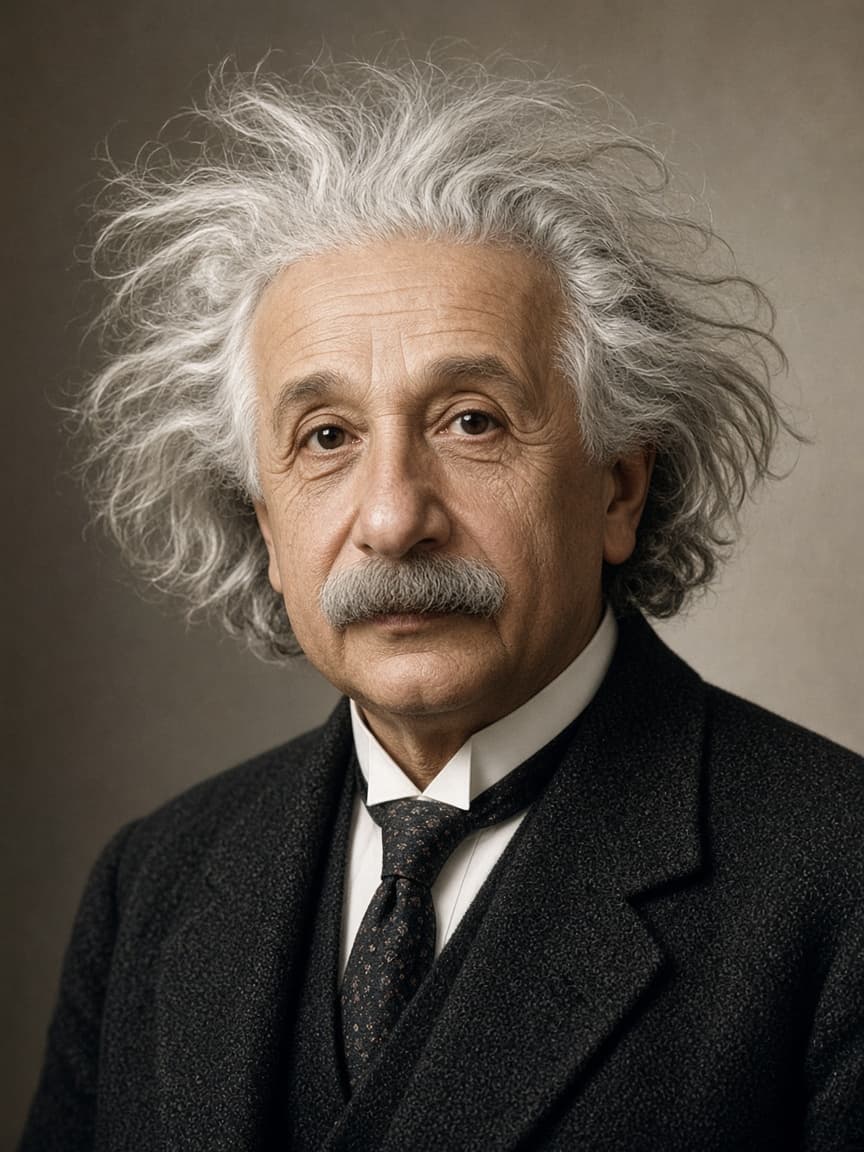
On 2 August 1939, in a rented summer cottage on Long Island, Albert Einstein put his signature on a two-page letter addressed to Franklin D. Roosevelt. It told the president that recent work in physics made it conceivable to build an extremely powerful bomb from uranium, that Germany had stopped the sale of uranium ore from mines it now controlled in Czechoslovakia and that the United States should secure supplies and fund research. Einstein did not write the letter and did no work on the weapon that followed. He signed it because he was the most famous scientist alive and the physicists who did write it needed a name the White House would not ignore.
The real author was Leo Szilard, a Hungarian physicist who had left Germany in 1933 and had been thinking about chain reactions since 1933, when he worked out the principle while waiting at a London traffic light. He drafted the letter with two other Hungarian emigres, Eugene Wigner and Edward Teller. Wigner drove Szilard out to Peconic on Long Island, where Einstein was sailing for the summer, and the group went over the text. Einstein read it, discussed the wording and signed the version dated 2 August 1939. The three men had fled fascism in Europe and did not need convincing about what a German bomb would mean.
To see why they were alarmed, you need what had happened in the previous seven months. In December 1938, in Berlin, the chemists Otto Hahn and Fritz Strassmann bombarded uranium with neutrons and found barium in the residue. Barium is roughly half the mass of uranium, which made no sense under existing theory. Lise Meitner, a physicist who had worked with Hahn for thirty years and had just escaped to Sweden because she was Jewish, worked out the explanation with her nephew Otto Frisch over Christmas. The uranium nucleus had split. They named it fission, borrowing the word biologists use for a dividing cell.
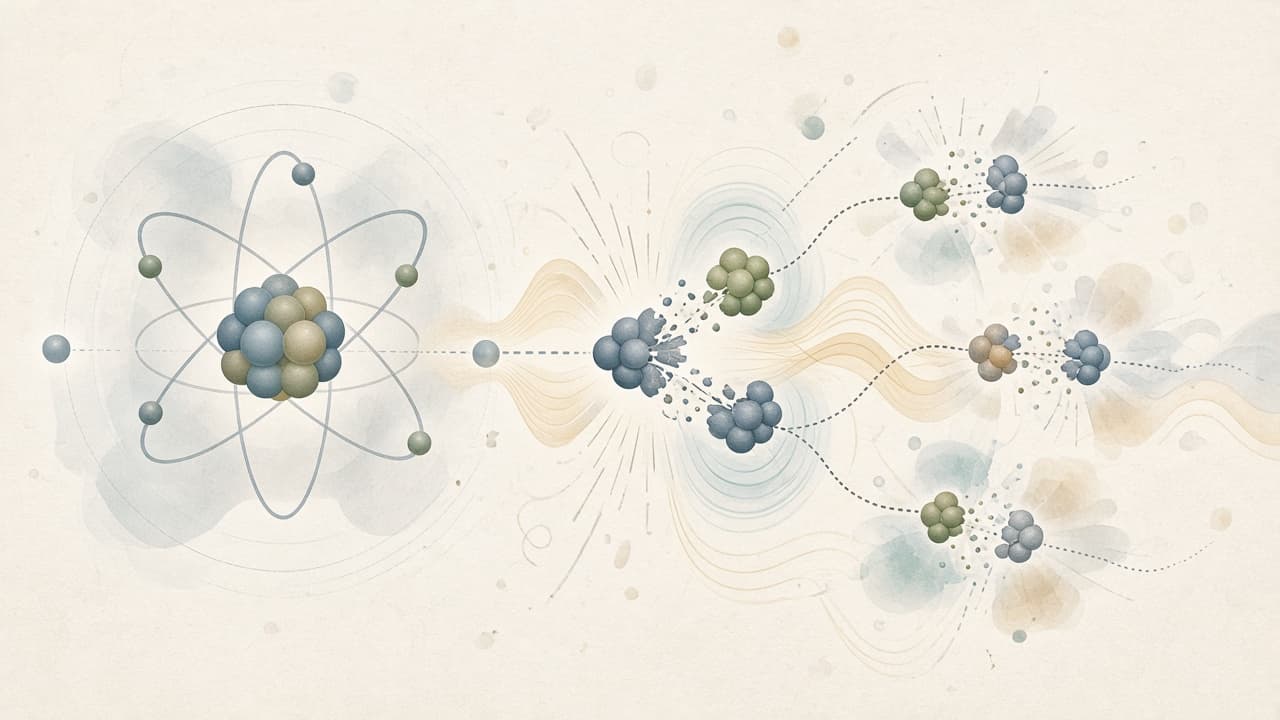
Here is the mechanism in plain language. An atom of uranium-235 has a heavy, crowded nucleus held together only just. Hit it with a slow-moving neutron and it wobbles apart into two lighter fragments. Those fragments fly off carrying kinetic energy, and crucially the split also throws out two or three spare neutrons. If those neutrons find other uranium-235 nuclei, they split them too, and each of those releases more neutrons. That is a chain reaction. Control it and you get a power reactor. Let it run away in a few millionths of a second in a mass of sufficiently pure material and you get a bomb. Szilard had predicted the chain reaction idea years before anyone had a reaction to attach it to, which is exactly why he grasped the danger the moment fission was announced.
One complication saved several years. Natural uranium is about 99.3 percent uranium-238 and only 0.7 percent uranium-235, and the isotope that fissions easily with slow neutrons is the rare one. Separating them is chemically impossible because both are the same element, so the work has to exploit a tiny mass difference through gaseous diffusion, centrifuges or electromagnetic separation. That industrial problem, not the physics, is what makes a bomb hard to build. It is still the problem at the centre of every modern argument about enrichment.
The letter did not go straight to Roosevelt. Szilard used Alexander Sachs, an economist with access to the White House, as the courier. The war in Europe began on 1 September 1939 and Sachs did not get his meeting until 11 October, more than two months after Einstein signed. He read the letter aloud, added his own argument and Roosevelt understood the point. The president told an aide that what Sachs was after was making sure the Nazis did not blow them up. He created the Advisory Committee on Uranium under Lyman Briggs of the National Bureau of Standards, which met on 21 October 1939 and approved six thousand dollars for graphite and uranium oxide.
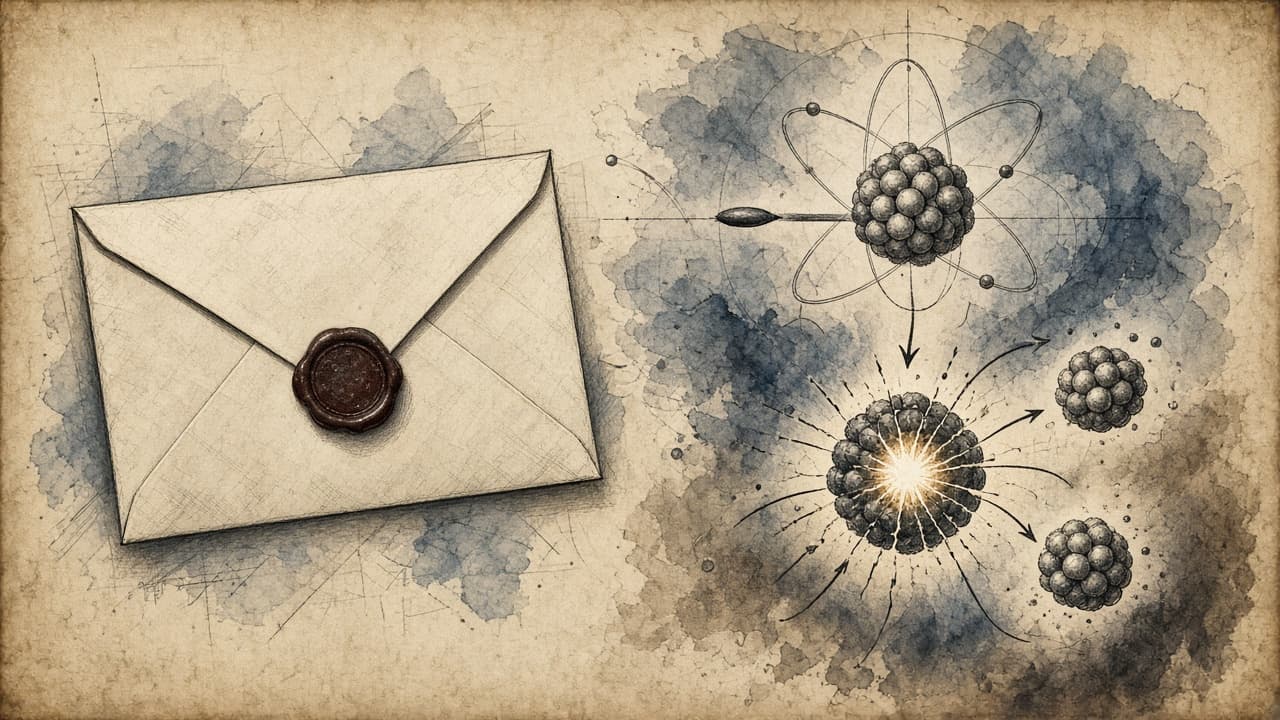
Six thousand dollars is the detail that keeps the story honest. The letter did not create the Manhattan Project. It created a small, slow and underfunded committee. The decisive push came from Britain in 1941, when the MAUD Committee concluded that a uranium bomb was not a theoretical curiosity but a practical device that could be finished during the war. American organization accelerated after that report, the project moved under the Army Corps of Engineers in 1942 with Brigadier General Leslie Groves in charge, and the codename Manhattan Engineer District gave the effort its lasting name. By 1945 it employed well over a hundred thousand people at Oak Ridge, Hanford and Los Alamos and cost around two billion wartime dollars.
Einstein had no part in any of it. He was a lifelong pacifist who had renounced German citizenship as a teenager, and American security officials considered him a risk and never granted him clearance. He did some unrelated consulting for the Navy on explosives. He learned that the bomb had been used on Hiroshima from a radio broadcast, and his reported first reaction was a groan of dismay. In 1954, the year before he died, he told Linus Pauling that he had made one great mistake in his life, signing the letter recommending that atom bombs be made, though he added that there had been some justification because the danger of the Germans doing it first was real.
As it turned out, the German programme never came close. Its scientists, including Werner Heisenberg, worked on reactors and never built the industrial separation plants a bomb would have required, hampered by funding, by the emigration of many of the physicists who would have been essential and by strategic doubt inside the regime. The men who wrote the letter could not have known that in 1939. They were reasoning from what was visible: a country with the world's best physics tradition, a government capable of anything and a fresh discovery sitting in the open literature.
Szilard, for his part, spent the rest of the war trying to slow down the thing he had started. He co-designed the first reactor with Enrico Fermi in Chicago, then in 1945 circulated a petition signed by dozens of project scientists urging Truman not to use the bomb on Japanese cities without a demonstration and a warning. The petition never reached the president before Hiroshima. Both men who created the 1939 letter ended up arguing for arms control, Szilard through the Council for a Livable World and Einstein through the Russell-Einstein Manifesto of 1955, issued days after his death.
Eagle Frame's takeaway: 2 August 1939 is the day a warning drafted by refugees and signed by the world's most famous physicist made its way to a president, and it began not with a bomb programme but with a committee and six thousand dollars. Know what fission is, know that isotope separation was the real barrier and know that Einstein signed the letter and then spent his last decade regretting it.