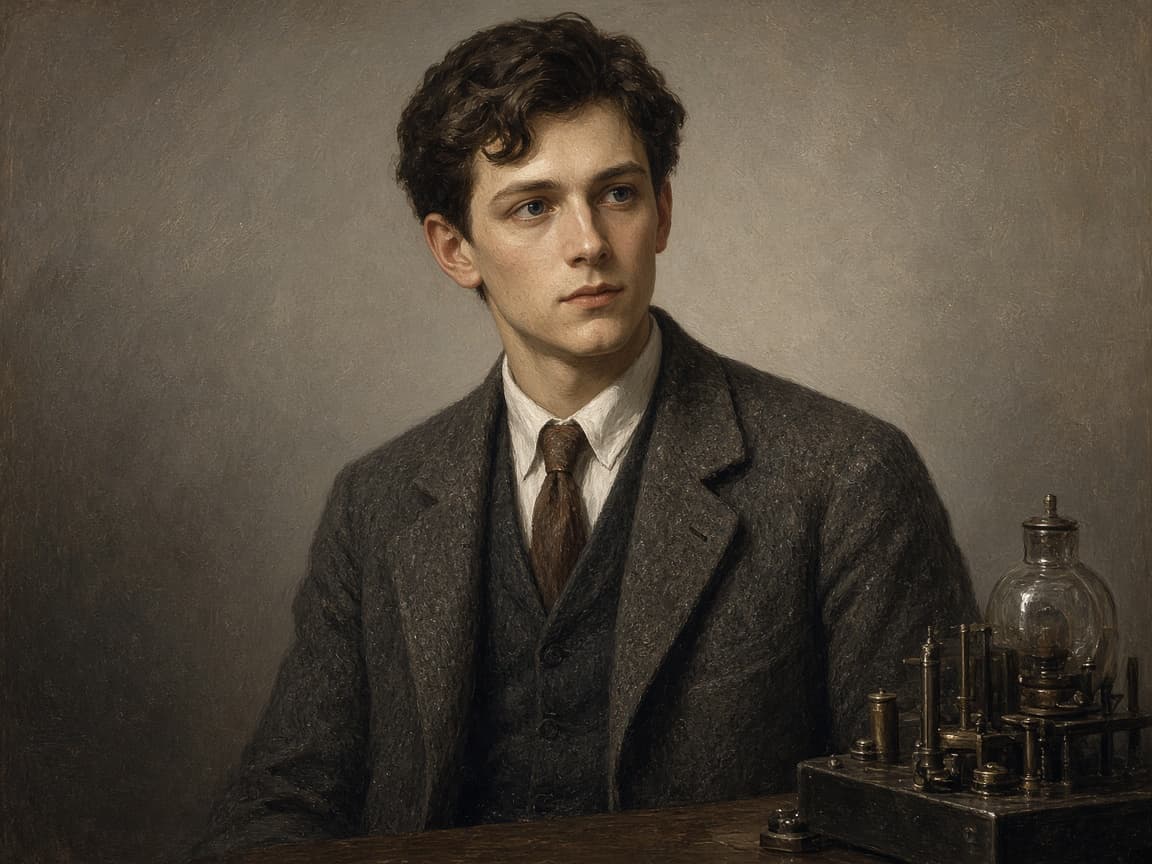
On this day: Farnsworth demonstrates electronic television
On 7 September 1927 in San Francisco, Philo Farnsworth transmitted a straight-line image with an all-electronic television system. The lab demo helped prove that TV could work without spinning mechanical disks.
On 7 September 1927, inventor Philo Taylor Farnsworth and his small lab team in San Francisco showed that an all-electronic television system could send an image. The first successful transmission was simple: a straight line scratched into a slide, appearing on a receiver. Crude as it looked, the line proved a principle. Pictures could be broken into electrons, sent as signals and rebuilt as light without a spinning mechanical disk.
Philo Farnsworth's electronic television system scanned an image with a beam inside a camera tube, converting light line by line into electrical signals that a receiver tube could rebuild. A cutaway of that tube shows why his approach beat mechanical spinning-disk televisions: no whirling parts had to keep pace with finer resolution. In September 1927 laboratory tests, simple geometric images proved the principle. Modern flat screens still descend from electronic scanning, not from Nipkow disks. Lab notebooks timed the first clear transmission of a straight-line image as the breakthrough marker.
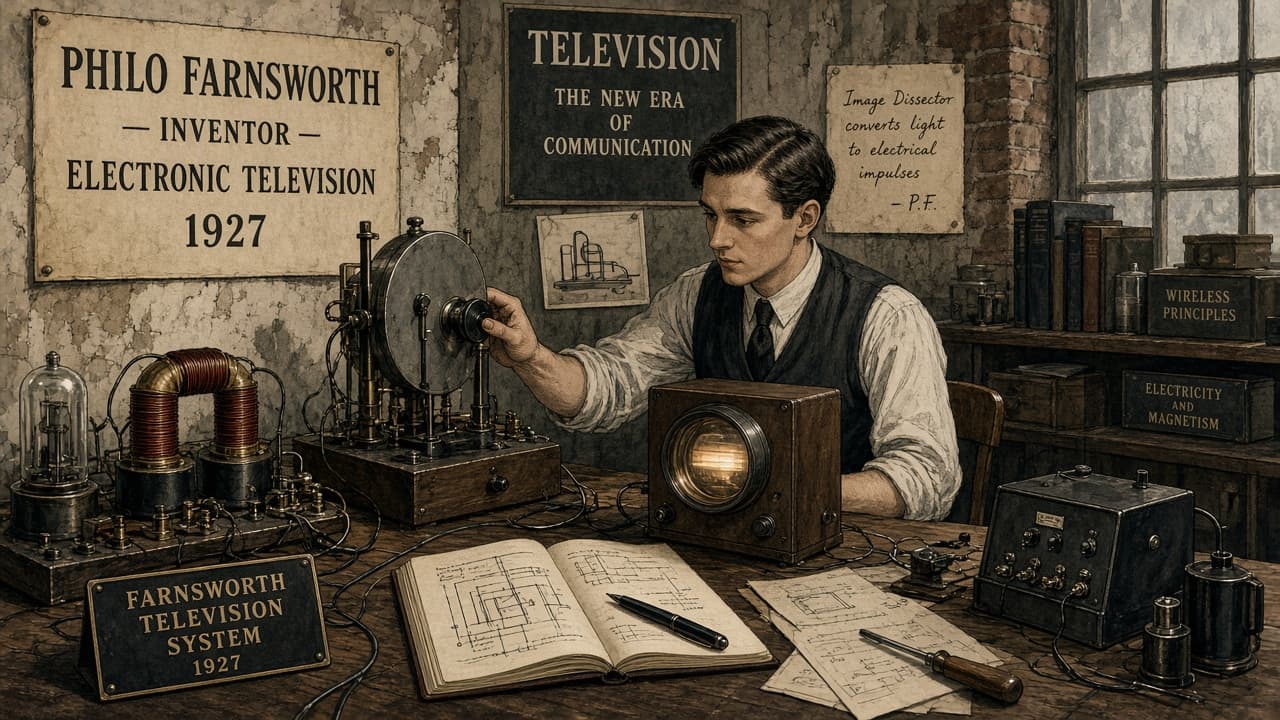
Farnsworth's 1920s lab bench (young inventor, glass tubes, jerry-built circuits) was a long way from living-room broadcasts. Patent fights with RCA and years of refinement stood between the first line image and commercial TV. Still, the lab scene names the person who insisted electrons, not only motors, should paint the picture. Pairing the tube diagram with the bench keeps mechanism and maker together on the anniversary of electronic television's proof. Investors who understood patents better than physics soon crowded the young inventor's bargaining table.
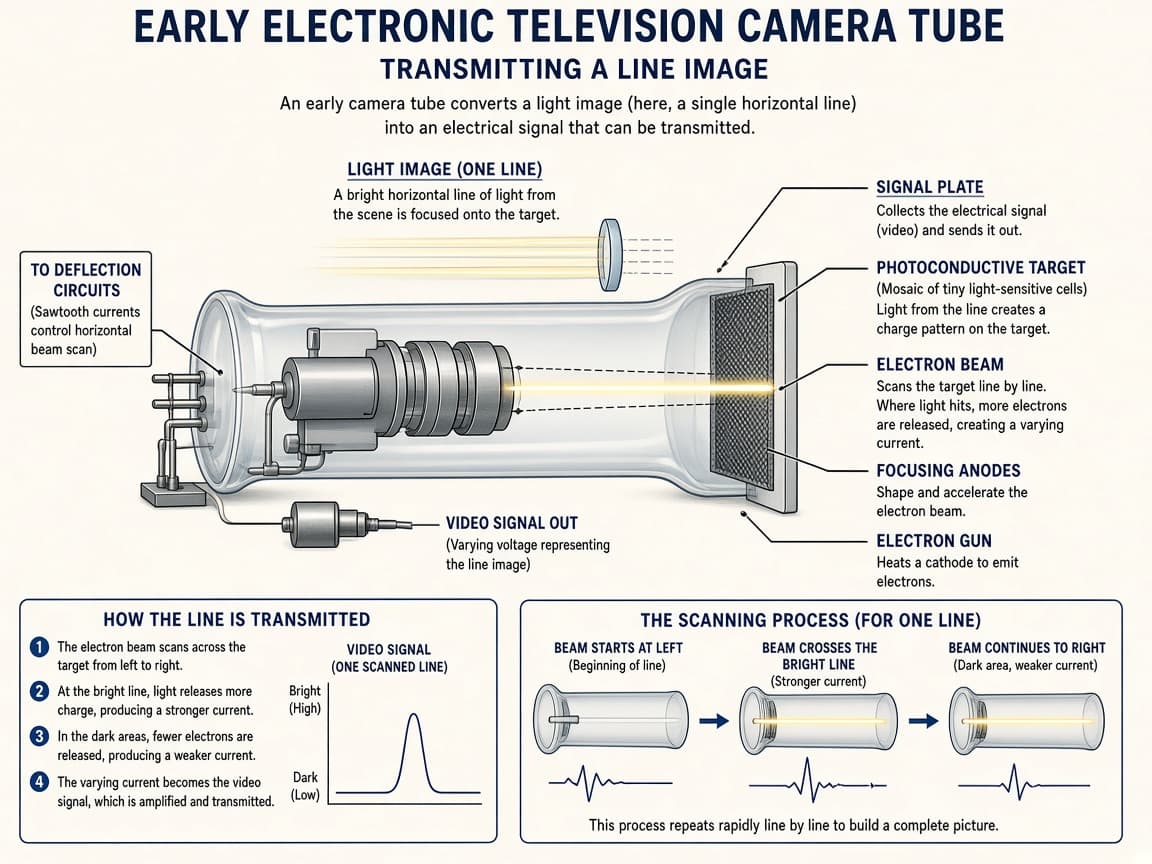
Start with the problem television had to solve. A scene is a field of brightness and color. To send it down a wire or through the air you must scan it somehow: sample points in order, transmit those samples and paint them back in the same order for a viewer. Early experimenters used mechanical scanners, often Nipkow disks with holes that swept across the image. Those disks were noisy, limited in resolution and awkward to scale.
Farnsworth's approach used an image dissector camera tube. Light from the scene hit a photosensitive surface that released electrons. Magnetic and electric fields swept that electron image so a collector could read brightness point by point. At the other end, a cathode-ray tube sprayed electrons onto a glowing phosphor screen, rebuilding the picture line by line. No motor had to spin a perforated disk in sync with the studio. Synchronization between camera and receiver had to stay locked or the rebuilt picture tore into nonsense; getting that lock stable was half the engineering fight.
Farnsworth was only 21 at the demonstration, a Utah-born tinkerer who had sketched scanning ideas as a teenager. Funding came from California backers willing to bet on a lab rather than a finished living-room product. Rival systems and patent wars followed, especially with RCA and Vladimir Zworykin's competing electronic designs. Courtrooms and corporate labs would argue for years over who owned which piece of the chain.
Why the straight line mattered: it was controllable proof. If the system could move a bright line and show it at a distance, the same sweep could later paint faces and football games. Resolution, brightness and synchronization still needed years of engineering. The 1927 date marks a working electronic path, not the first sitcom. Newspaper science pages that noticed the demo still struggled to explain electrons to readers who had never seen a glowing tube screen. Mechanical television did not vanish overnight. Some broadcasts in the late 1920s and early 1930s still used disks. Electronic methods won because they could go to finer lines, brighter tubes and eventually mass manufacturing. World War II paused consumer TV in many places; postwar boom years put cathode-ray sets into living rooms that Farnsworth's line had imagined in principle. Teaching the demo means separating three ideas students often mash together. Invention of scanning concepts, demonstration of an electronic camera-receiver pair and commercial broadcast service are different milestones. Farnsworth's September success sits in the middle: lab reality before network schedules.
Modern flat panels no longer fire electron guns at phosphors, yet they still scan: they still update millions of pixels in order many times a second. The grammar Farnsworth helped prove (sample, transmit, redraw) remains under OLED and LCD glass. That continuity makes a 1927 line more than a museum curiosity.
Pem Farnsworth and a small circle of lab assistants worked through failures before the line appeared. Vacuum pumps, glassblowing and high-voltage hazards made the workshop as much chemistry and craft as theory. Invention here was hands-on risk, not a pure chalkboard moment.
Zworykin's iconoscope and related RCA work followed overlapping paths toward electronic television. Historians still unpack how much each camp influenced the other and how patent offices assigned credit. What students need first is the shared physics: photoelectric conversion, electron beam scanning and phosphor glow.
By the late 1930s experimental stations were broadcasting to tiny audiences with sets that cost as much as a car. Farnsworth's 1927 line sits at the root of that tree. Without electronic scanning's room to grow, television might have stalled as a mechanical curiosity for hobbyists.
Eagle Frame's takeaway: 7 September 1927 is when Farnsworth's electronic television sent a straight-line image and showed that disks were not required. Keep the image dissector and cathode-ray rebuild in view, along with the later patent fights with RCA. That lab line is the ancestor of every scanned screen.