On this day: the Space Shuttle programme ends
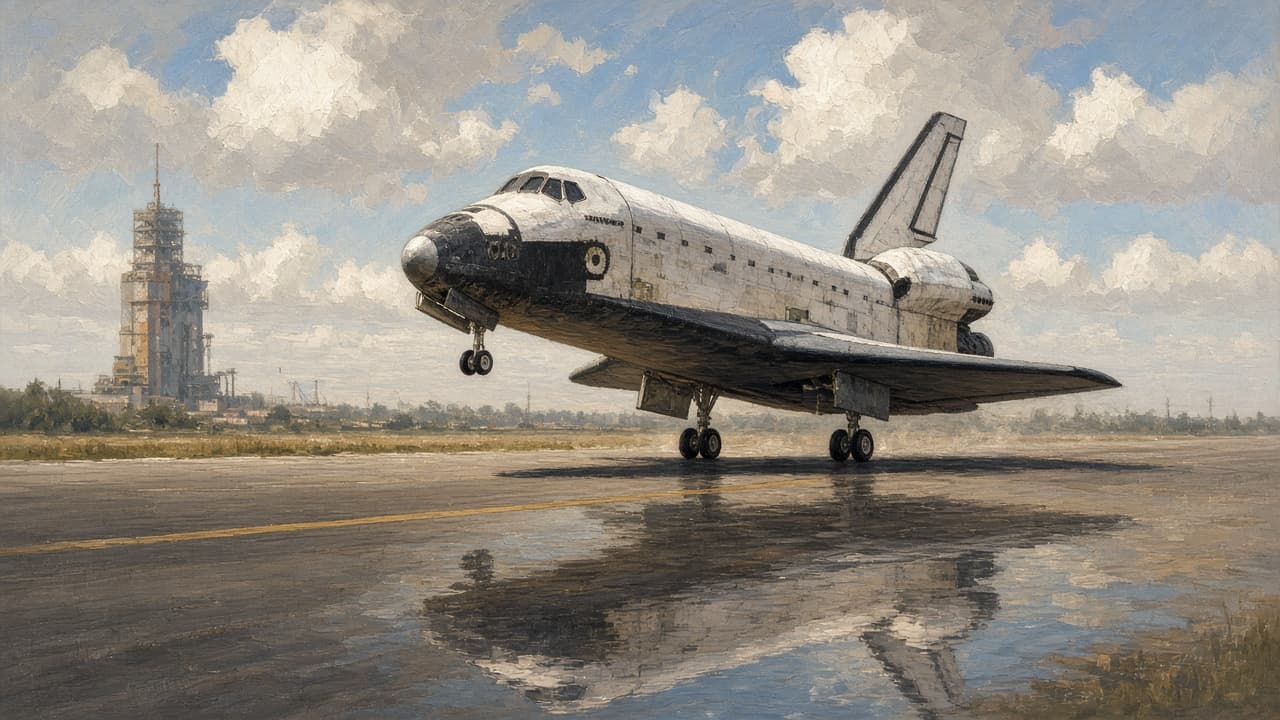
On 21 July 2011, Atlantis landed in darkness at the Kennedy Space Center and closed thirty years of Space Shuttle flight. The fleet built the International Space Station, flew 135 missions and lost two orbiters and fourteen astronauts.
At 5:57 in the morning on 21 July 2011, still dark at the Kennedy Space Center in Florida, the Space Shuttle Atlantis touched down on runway 15 and rolled to a stop. Commander Chris Ferguson, pilot Doug Hurley and mission specialists Sandra Magnus and Rex Walheim were aboard. Mission STS-135 was the 135th and last flight of the programme. "Having fired the imagination of a generation, a ship like no other, its place in history secured, the space shuttle pulls into port for the last time," Ferguson said on the runway.
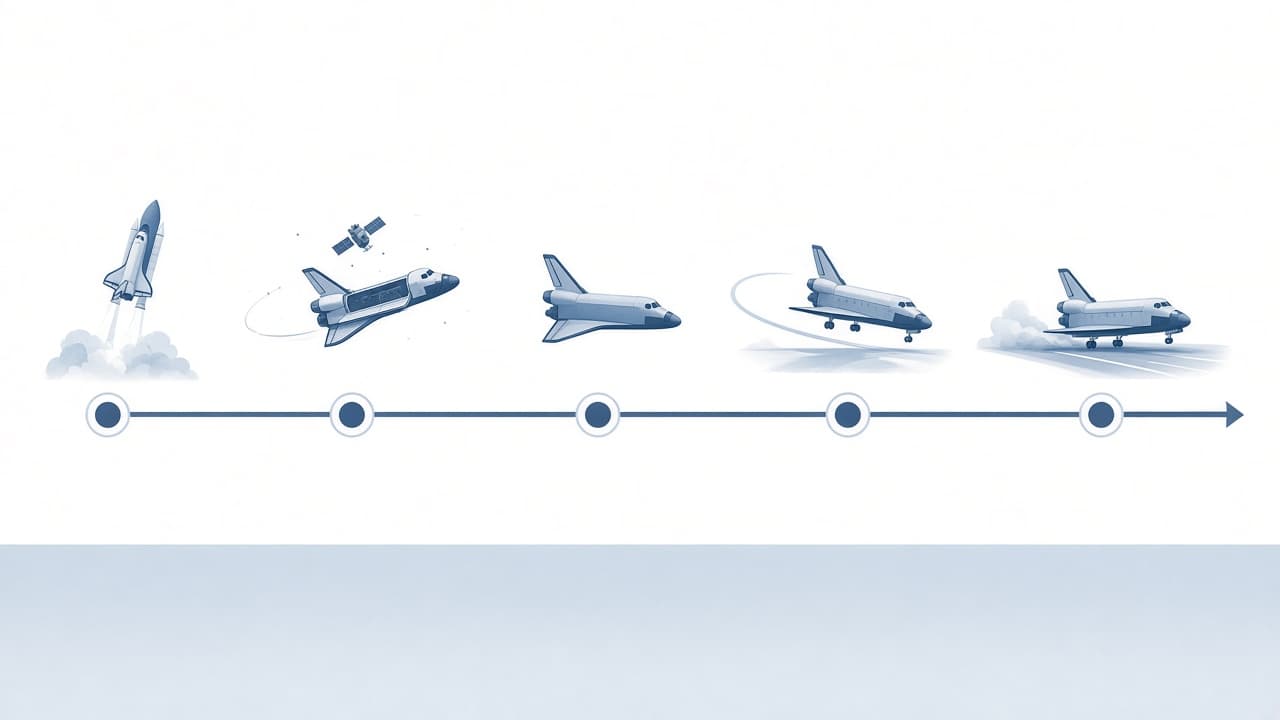
The Shuttle was a genuinely unusual machine and it helps to understand what it was trying to be. Every previous crewed spacecraft had been a capsule thrown away after one flight. The Shuttle was designed as a reusable winged orbiter that would launch like a rocket, operate in orbit like a spacecraft and land like a glider, carrying up to seven people and roughly 24 tonnes of cargo in a payload bay 18 metres long. The promise was routine, cheap access to space.
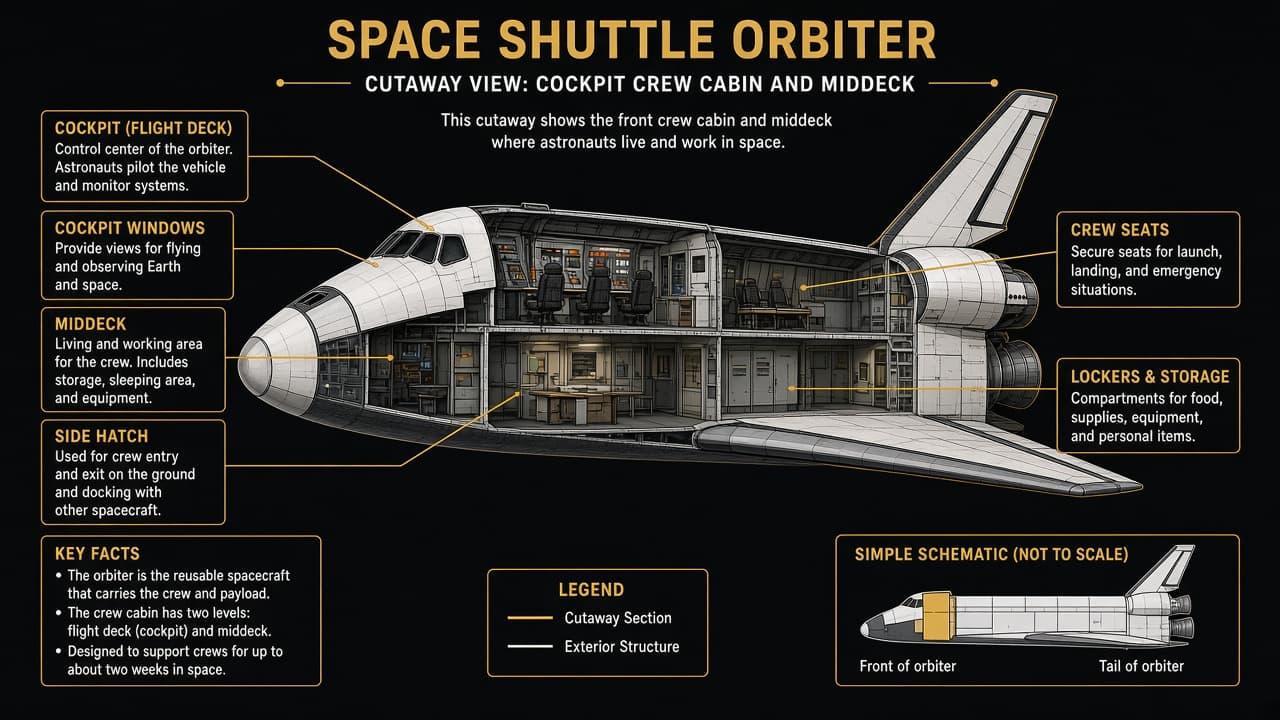
The launch configuration explains a lot of what went right and wrong. The orbiter carried three main engines but no fuel of its own for them; propellant came from the large orange external tank strapped to its belly. Two solid rocket boosters supplied most of the thrust for the first two minutes, then separated and parachuted into the sea for recovery. The tank was jettisoned just before orbit and burned up. Only the orbiter and the boosters came back, so the system was partly reusable rather than fully.
Coming home, the orbiter was a glider with no engines and one chance at the runway. It entered the atmosphere nose-high at about 40 degrees to present its underside, which was covered in more than 20,000 individually shaped silica tiles that could survive 1,650 degrees Celsius while staying cool enough to touch moments later. Reinforced carbon-carbon panels protected the nose and wing leading edges, which take the worst heating. That thermal protection system was the orbiter's greatest achievement and its fatal weakness.
The programme's accomplishments are substantial and specific. Shuttles deployed the Hubble Space Telescope in 1990 and then serviced it five times, including the 1993 mission that corrected its flawed mirror with corrective optics. No other vehicle could have done that. Shuttles carried Spacelab, launched interplanetary probes including Galileo and Magellan and, above all, built the International Space Station. The ISS modules were sized to the Shuttle's payload bay, and 37 Shuttle missions assembled it in orbit.
The losses have to sit in the same account. Challenger broke apart 73 seconds after launch on 28 January 1986 when a rubber O-ring seal in a solid rocket booster failed in unusually cold weather, allowing hot gas to escape and destroy the stack. Seven crew died, including teacher Christa McAuliffe. Columbia disintegrated during reentry on 1 February 2003 after a piece of insulating foam from the external tank had struck and breached a carbon panel on the left wing at launch. Seven more died. Fourteen astronauts in 135 flights is a loss rate of roughly one mission in 67.
Both investigations found the same underlying problem, which is why they are read together. Engineers had raised concerns about O-rings in cold weather and about foam strikes for years. In each case the concern was reclassified as an acceptable in-family risk because previous flights had survived it. The Rogers Commission and the Columbia Accident Investigation Board both described an organizational culture in which schedule pressure and the absence of a recent failure were treated as evidence of safety.
The original economics never arrived either. Early projections suggested dozens of flights a year at low cost per kilogram. The reality was roughly four to five flights a year, with each orbiter requiring months of inspection and tile work between missions. Cost per launch is usually estimated around 1.5 billion dollars when the programme total is divided by the number of flights. The vehicle was extraordinarily capable and extraordinarily expensive, and it was never the space truck it had been sold as.
President George W. Bush announced retirement in 2004, after the Columbia board concluded the fleet should be replaced. The station was finished, the orbiters were ageing and the money was redirected toward a return to the Moon. The replacement programme was cancelled and restructured more than once. The result was a gap: from July 2011 until May 2020, the United States had no way to launch its own astronauts and bought seats on Russian Soyuz rockets, eventually at more than 80 million dollars each.
The gap closed with a different model. NASA paid private companies to develop crew vehicles and buy services rather than owning the hardware. SpaceX's Crew Dragon flew Demo-2 in May 2020 with Doug Hurley, the pilot of the last Shuttle flight, and Bob Behnken aboard. The Falcon 9 booster returns and lands, achieving the reusability the Shuttle promised, though with a capsule rather than a winged orbiter. Boeing's Starliner has had a harder development.
The four surviving orbiters are museum pieces now. Atlantis is at the Kennedy Space Center visitor complex, displayed tilted with its payload bay open. Discovery is at the Smithsonian's Udvar-Hazy Center, Endeavour at the California Science Center and the prototype Enterprise, which never flew in space, is in New York. Around 355 people flew on Shuttles, including the first American woman in space, Sally Ride, and the first African American in space, Guion Bluford.
Eagle Frame's takeaway: 21 July 2011 is the day the United States retired the most capable and most complicated spacecraft ever flown. Its record is genuinely split. It built a space station, fixed a telescope and flew 355 people, and it killed fourteen astronauts in accidents that both inquiries traced to the same habit of treating a survived risk as a proven safe one.