On this day: tanks first go into battle
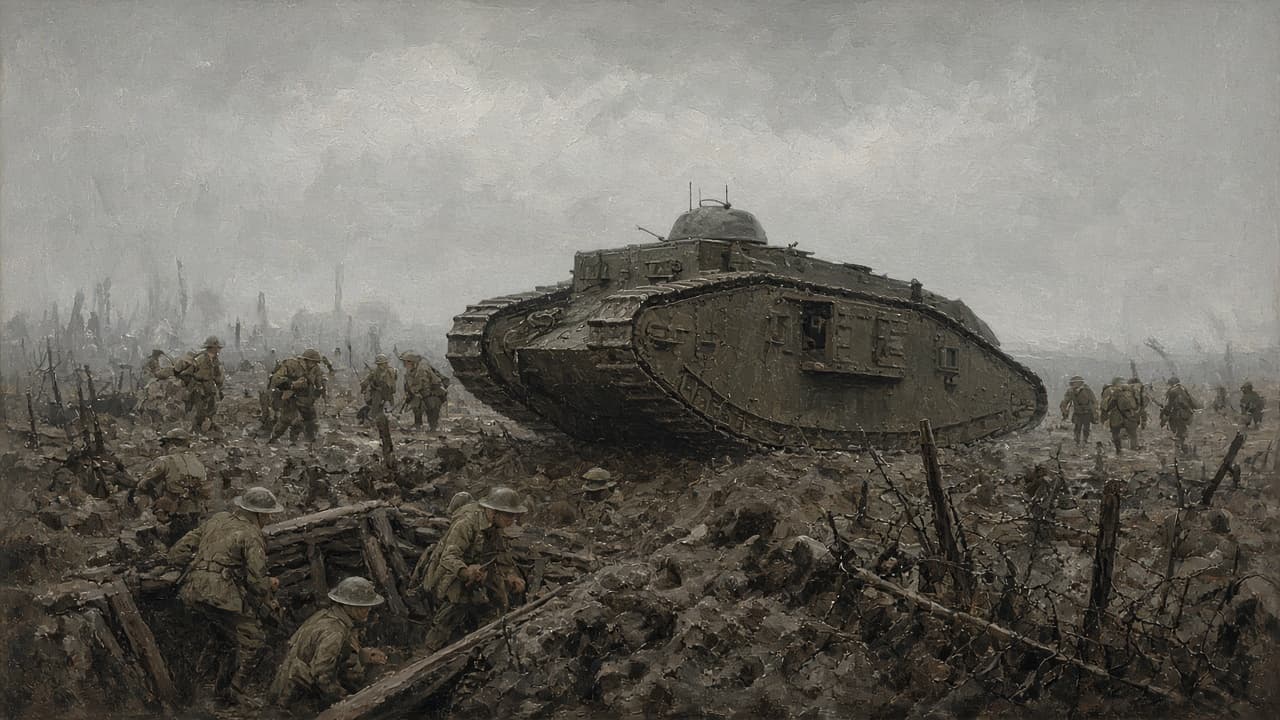
On 15 September 1916 at Flers-Courcelette on the Somme, British Mark I tanks entered combat for the first time. Dozens were committed, many failed, yet tracked armor had arrived on the industrial battlefield.
On 15 September 1916, during the Battle of Flers-Courcelette on the Somme front, Britain sent tanks into a major attack for the first time. The machines were Mark I tanks: rhomboid-shaped armored boxes on continuous tracks, crewed by soldiers who could barely hear one another over the engine noise. Of the dozens allotted to the operation, only a limited number reached the start lines in fighting order. Several ditched, broke down or were hit. A few pushed far enough to shock German infantry who had never seen such a thing.
The weapon began under other names. British development work spoke of landships. The cover story and factory label "tank" suggested water tanks or similar mundane cargo, a way to hide the project from spies and casual talk. By the time the Mark I reached France, the nickname had stuck. What rolled forward was still an experiment more than a finished branch of arms.
What is a tank, stripped to the mechanism? It is an armored vehicle that carries weapons and people while moving on tracks instead of ordinary wheels. Tracks spread weight over a longer footprint so the vehicle can cross mud, wire and trench lips that would stop a truck. Armor tries to keep bullets and shell splinters out. Early tanks were slow, hot and mechanically fragile, but they answered a trench problem: how to cross killing ground under fire when barbed wire and machine guns owned the open ground.
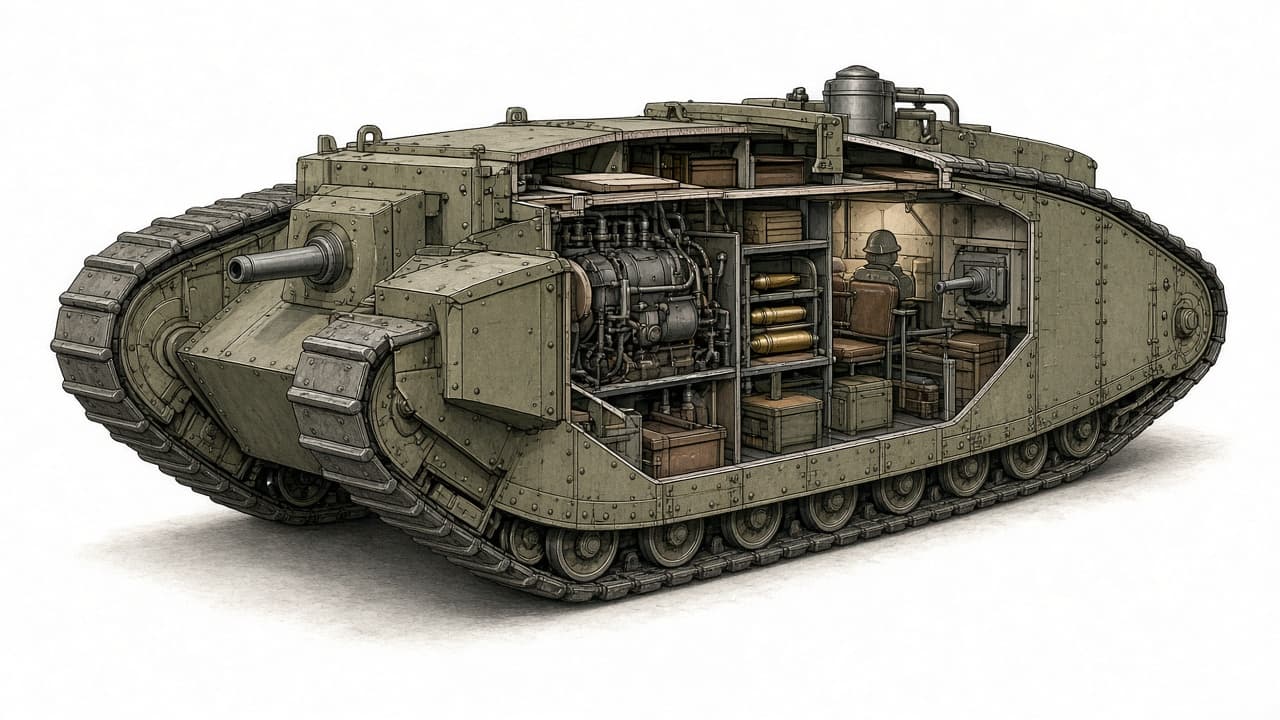
The Somme battle had already ground on since July with huge casualties for small gains. Commanders wanted a tool that could crush wire and span trenches while infantry followed. The Mark I came in "male" versions with naval guns in side sponsons and "female" versions armed with machine guns. Steering and gear changes demanded teamwork. Exhaust fumes, heat and noise made crews sick. Vision slits were narrow. Communication with outside units was crude. A successful few hundred yards could still feel like a different war to the men who watched from a trench.
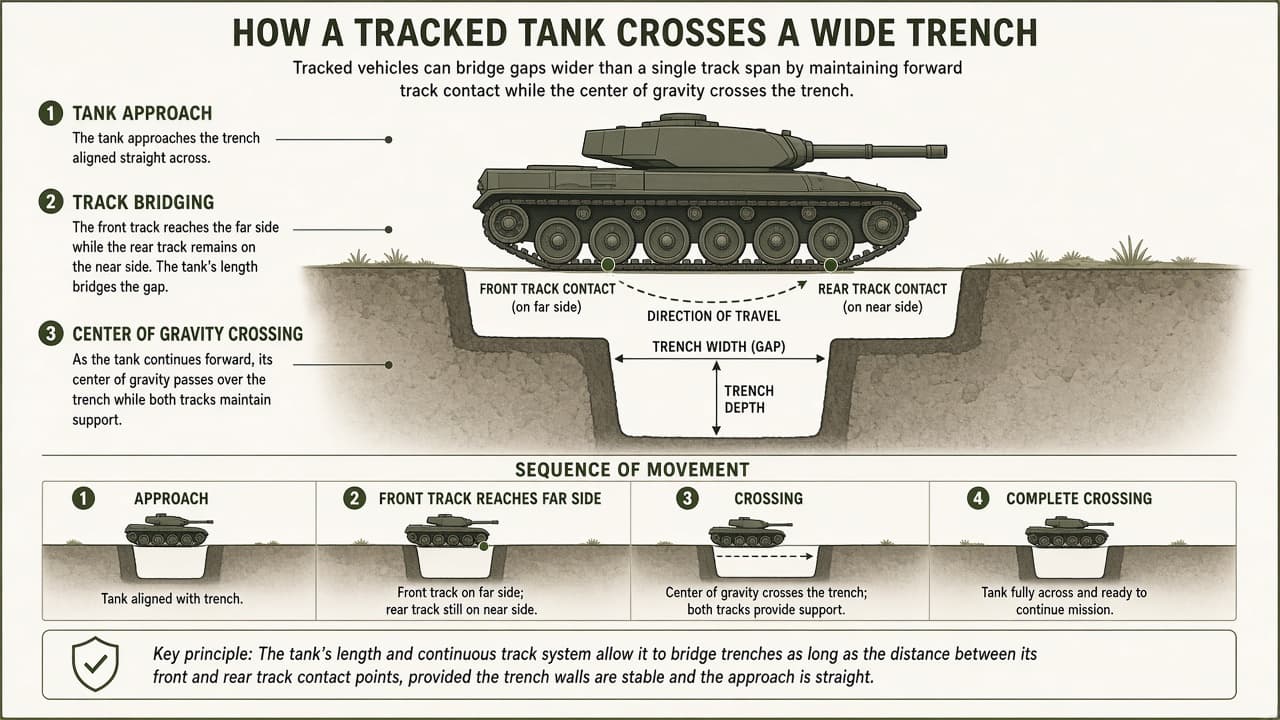
Results on the day were mixed. Mechanical failure rates were high. Where tanks worked, they could flatten wire and create local panic. Newspapers celebrated a new weapon. Soldiers learned that armor without reliable engines, tactics and numbers was only a hint of future warfare. The Somme did not end because of 15 September. The debut was not a clean breakthrough miracle. It was a noisy proof of concept paid for in breakdowns as well as in yards gained.
By 1918, tanks appeared in larger, better-coordinated attacks with improved machines and infantry-armor drill. Other armies copied and adapted the idea. The industrial battlefield had accepted tracked armor as a permanent problem and opportunity. From that muddy September morning grew the armored forces that shaped later twentieth-century wars, even though the first day looked as much like a mechanical graveyard as a revolution.
Crew conditions explain why early tankers were a special kind of exhausted. Eight men might share a metal box full of engine heat, carbon monoxide risk and the concussion of their own guns. Orders passed by hand signals and kicks. A ditch or shell hole could strand a Mark I as surely as enemy fire. Courage and mechanical luck were hard to separate when the tracks stopped.
Doctrine caught up slowly. 1916 showed surprise value. 1917 and 1918 taught mass, maintenance and infantry cooperation. French and German programs watched and responded. By the war's end, armored attack was a recognized method, still imperfect, no longer a rumor. Holding that timeline honest keeps Flers-Courcelette from turning into a myth of overnight victory.
Numbers keep the romance honest. Dozens of tanks were committed to Flers-Courcelette in the plan. Far fewer made a clean run into action. Breakdowns, ditches and late arrivals were as much a part of the story as the machines that reached German lines. Infantry still did most of the dying and the holding. The tank was a new tool on an old battlefield, not a substitute for the war's industrial grind.
Eagle Frame's takeaway: 15 September 1916 is the birthday of the tank in combat, not the day the Somme was won. Know the landship cover name, the Mark I male and female types and how many machines failed at Flers-Courcelette and still see why armies never gave the track-and-trench idea up.