On this day: the United States issues its first patent
On 31 July 1790, George Washington signed the first patent granted under American law. It went to a Philadelphia man named Samuel Hopkins for a better way of making potash, the industrial chemical behind soap, glass and gunpowder.
The first patent issued by the United States government is a single sheet of parchment dated 31 July 1790. It grants Samuel Hopkins the exclusive right for fourteen years to a new apparatus and process for making pot ash and pearl ash. Three signatures sit at the bottom: President George Washington, Attorney General Edmund Randolph and Secretary of State Thomas Jefferson. The whole American patent system, now handling well over half a million applications a year, starts with that page and with a chemical most people have never heard of.
The legal groundwork came from the Constitution. Article I, Section 8 gives Congress the power to promote the progress of science and useful arts by securing to inventors, for limited times, the exclusive right to their discoveries. That clause was uncontroversial at the convention, which is unusual for anything in that document. Congress turned it into the Patent Act of 1790, signed on 10 April. The act created a three-person patent board made up of the Secretary of State, the Secretary of War and the Attorney General, any two of whom could grant a patent if they judged the invention sufficiently useful and important. The fee came to roughly four or five dollars, deliberately low.
Jefferson did the reading himself, which makes him in practice the first American patent examiner. He was an inventor and a sceptic of monopolies at the same time, and he worried openly about granting exclusive rights to things that were obvious or already in use. That tension has never left patent law. The board was slow because its members had other jobs, and only three patents were granted in the whole of 1790. Applications piled up. By 1793 Congress gave up on examination altogether and switched to a registration system, which meant anyone could record almost anything and fight about validity later in court. Examination did not return until the Patent Act of 1836, which also created the Patent Office and started the numbering system used today.
Now the chemistry, because the invention itself is usually skipped. Potash is potassium carbonate. The traditional way to get it was to burn hardwood, soak the ashes in water in a barrel and let the water dissolve out the soluble salts. Draining that barrel gives a caustic solution, the lye that colonial households used for soap. Boiling the solution dry in an iron pot leaves a grey crust, and that crust is pot ash, named for the pot it was scraped from. Heating the crust further in a kiln, a step called calcining, burns off organic residue and leaves a whiter and purer product known as pearl ash.
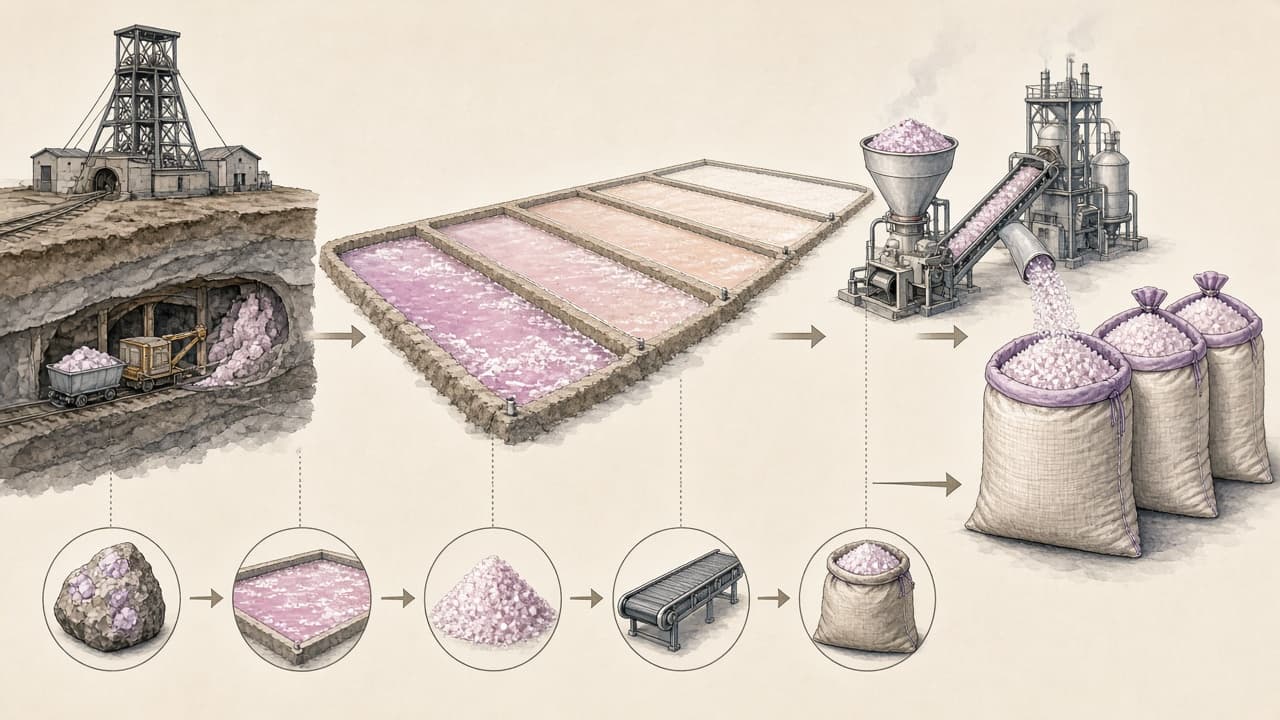
That grey powder was one of the most important industrial chemicals of the eighteenth century. Soap makers needed it. Glassworks used it as a flux to lower the melting point of sand. Textile bleaching depended on it, gunpowder production consumed it and farmers spread it on fields as fertiliser, since potassium is one of the three nutrients plants need in quantity. Britain imported enormous amounts, and the American colonies were well placed to supply it because settlers were clearing forest anyway and burning the timber they could not sell. Ashes were, for a while, one of the few cash products a frontier farm could generate.
What Hopkins patented was an extra step. Instead of soaking raw wood ashes directly, his process burned the ashes again in a furnace before the leaching stage, then ran the solution through a more efficient sequence of dissolving, boiling and calcining. The claim was that the same quantity of ash produced substantially more saleable pearl ash. That is the ordinary shape of most valuable inventions. It was not a new substance or a new principle, just a rearrangement of known steps that improved the yield of an existing trade.
For almost two centuries the man himself was misidentified. Reference works listed the patentee as a Samuel Hopkins of Pittsford, Vermont, and the error was repeated in textbooks and anniversary speeches. The Philadelphia lawyer and historian David Maxey published research in 1998 establishing that the patent had gone to a different Samuel Hopkins, a Quaker of Philadelphia who was living in Pittsford only later. The original parchment was destroyed when fire gutted the Patent Office in 1836, taking about 10,000 records with it, but a copy survived in private hands and is now held by the Chicago History Museum.
The practical legacy shows up in the shape of American industry. A cheap, low-barrier patent system open to ordinary artisans rather than court favourites produced a very high rate of patenting per head through the nineteenth century, and economic historians link that directly to the pace of mechanisation in the United States. The costs came too. Registration without examination in the 1793 to 1836 period created a thicket of overlapping and invalid grants, and famous fights over the cotton gin and the telegraph showed how badly a patent could work for the person who actually invented the thing.
Eagle Frame's takeaway: the first American patent was not a dramatic machine. It was a tweak to the process for turning wood ash into a soap and glass ingredient, granted in an office where the Secretary of State read the paperwork personally. Patent systems are judged by whether that kind of modest, useful improvement is worth someone's trouble to register, and in 1790 the United States decided it should be.