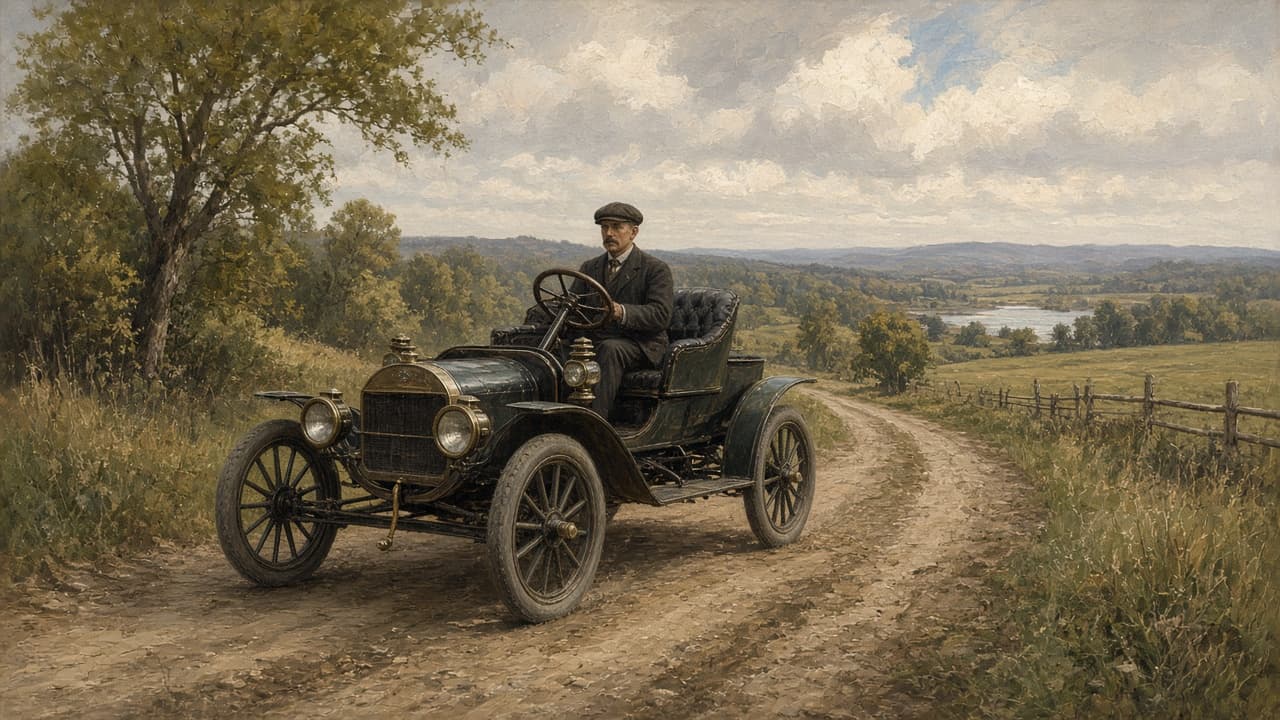
On this day: Ford sells its first car
On 23 July 1903, the young Ford Motor Company delivered a Model A to Dr. Ernst Pfennig, a Chicago dentist, for $850. The company had almost run out of money. Within a decade it was building cars on a moving assembly line and paying five dollars a day.
On 23 July 1903, the Ford Motor Company recorded the sale of a Model A to Dr. Ernst Pfennig, a dentist in Chicago. He paid $850, with an extra charge for the rear tonneau seat. The company had been incorporated five weeks earlier with about $28,000 raised from a dozen investors, and by the time that first payment arrived the bank balance was down to a few hundred dollars. The sale is generally treated as the moment Ford became a going concern.
Historians of the company have complicated the date, and it is worth saying so. Ford's own accounts receivable ledgers indicate that Pfennig's car, chassis number 11, was booked on 28 July, and that several other cars were sold on or before 23 July, including one to the Ohio Motor Car Company of Cleveland. The 23 July date has been used by Ford and by most reference works for a century. The safe formulation is that this is the traditional date for the company's first retail sale.
Henry Ford was 40 and this was his third attempt. The Detroit Automobile Company folded in 1901. The Henry Ford Company, founded that year, pushed him out in 1902 and was renamed Cadillac. What kept him in business between failures was racing. His 999 racer, driven by the cyclist Barney Oldfield, won attention and, with it, new investors. Coal dealer Alexander Malcomson provided the bulk of the capital and the Dodge brothers, John and Horace, supplied engines and running gear on credit in exchange for shares.
The 1903 Model A was not the car people picture when they hear the name. That is the 1927 Model A, a different vehicle entirely. The 1903 car was a light runabout with a two-cylinder engine lying flat under the seat, producing about eight horsepower and driving the rear axle by chain. It had a planetary transmission with two forward speeds, a top speed near 45 kilometres per hour and tiller-influenced controls that were closer to a carriage than to a modern car.
Ford did not manufacture much of it. The Mack Avenue plant was a rented wooden building where workers assembled components made by suppliers, chiefly the Dodge brothers. That assembly-only model is how a company with almost no capital could put a product on the road within weeks. About 1,750 Model As were built across 1903 and 1904, which made Ford a real but unremarkable participant in an industry with dozens of American entrants.
Ford's actual innovation took another decade and came in two parts. The first was the Model T in 1908, a deliberately simple, high-clearance, easily repaired car designed for unpaved rural roads. The second was the moving assembly line at Highland Park in 1913, borrowed in concept from meatpacking plants where carcasses moved past stationary workers. Instead of a team building one car in place, the chassis moved and each worker did one operation as it passed.
The effect on time and price is the number to remember. Assembling a Model T chassis had taken over twelve hours. On the moving line it fell to about ninety minutes. The price dropped from $850 in 1908 to under $300 by the mid-1920s. Ford built more than fifteen million Model Ts, and by the early 1920s roughly half the cars on Earth were Model Ts. The car stopped being a rich man's novelty and became a tool for farmers, tradesmen and travelling salesmen.
The line also created a labour problem that produced Ford's other famous decision. The work was so repetitive that turnover ran extraordinarily high, with the plant hiring many times more people each year than it employed. In January 1914 Ford announced a wage of five dollars for an eight-hour day, roughly double the going rate. It cut turnover sharply, attracted skilled applicants and is often described as creating a workforce that could buy the product. It came with a Sociological Department that inspected workers' homes and habits before granting the full rate.
Ford the man does not survive a rounded account comfortably. He published antisemitic material in the Dearborn Independent through the 1920s, circulated the forged Protocols of the Elders of Zion and was later honoured by Nazi Germany. He fought unionization violently into the late 1930s, and the Battle of the Overpass in 1937 saw company security beat United Auto Workers organizers. He also refused to update the Model T for too long, which let General Motors take the lead with annual model changes and a range of brands.
The system he built outlived those failures and became the default for making almost anything. Standardized interchangeable parts, a moving line, division of labour into single tasks and vertical integration of suppliers describe electronics, appliances and food production as much as cars. Critics from Charlie Chaplin in Modern Times to industrial psychologists have documented the human cost of the repetitive task, and later methods, notably the Toyota Production System, revised the model without abandoning the line.
Eagle Frame's takeaway: 23 July 1903 is the traditional date of Ford's first car sale, an $850 runabout bought by a Chicago dentist when the company had almost nothing left in the bank. The car itself was ordinary. What followed, the Model T and the moving assembly line, is what changed how goods are made and who can afford them.