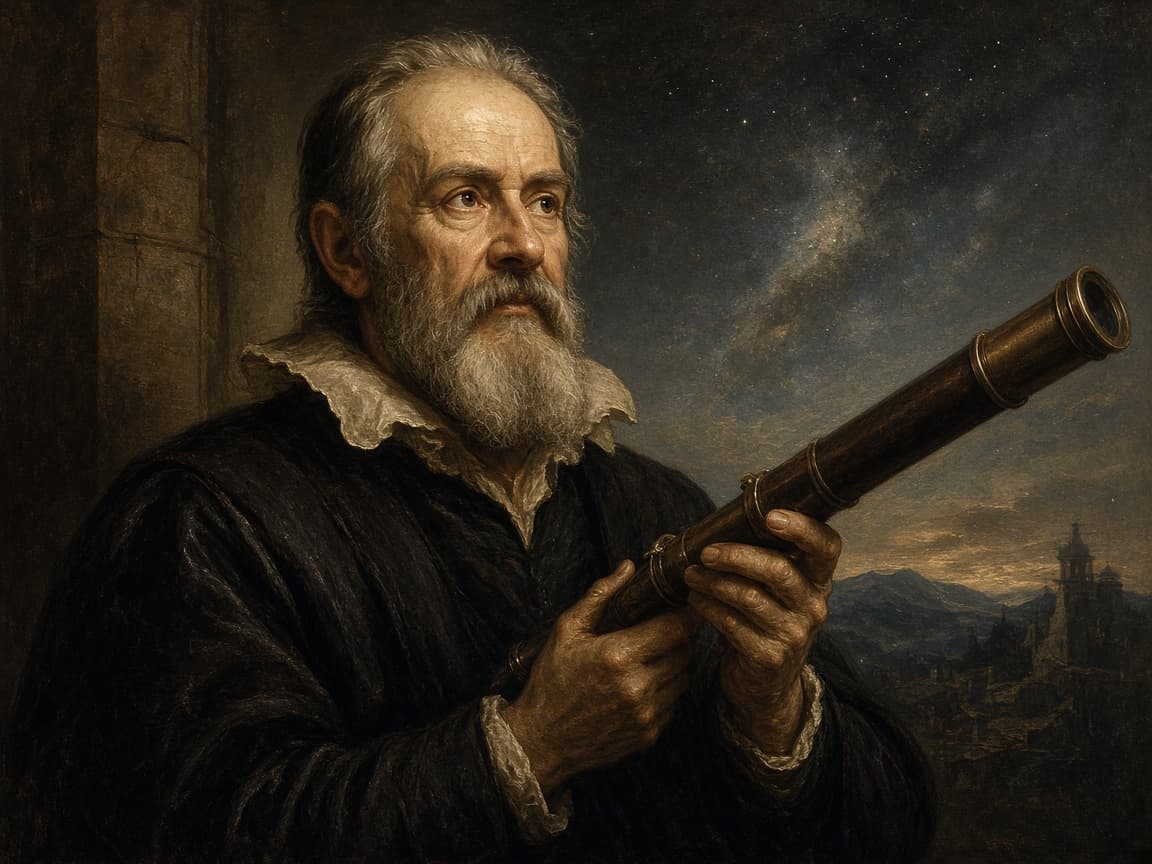
On this day: Galileo demonstrates his telescope
On 25 August 1609, Galileo Galilei showed Venetian leaders a spyglass improved for long sight. The tool that impressed a maritime republic soon remade astronomy when he turned it on the night sky.
On 25 August 1609, Galileo Galilei demonstrated an improved spyglass to Venetian leaders, including officials tied to the Senate and the Arsenal culture that prized practical optics for ships and harbors. News of Dutch-made refracting glasses had reached Italy. Galileo did not invent the first telescope from nothing. He grasped the military and commercial value of a better one, ground and fitted lenses and raised magnification enough to impress men who thought in terms of sails on the horizon.
Galileo's improved spyglass used a convex objective and a concave eyepiece in a tube to magnify distant scenes without the bulk of earlier novelty glasses. A labeled lens diagram shows the light path: rays bend at the objective, then the eyepiece presents an upright enlarged view suited to watching ships. Craft mattered as much as theory. Better grinding and stop-down apertures sharpened the image enough to impress practical Venetian officials who cared about lagoon security before they cared about moons of Jupiter.
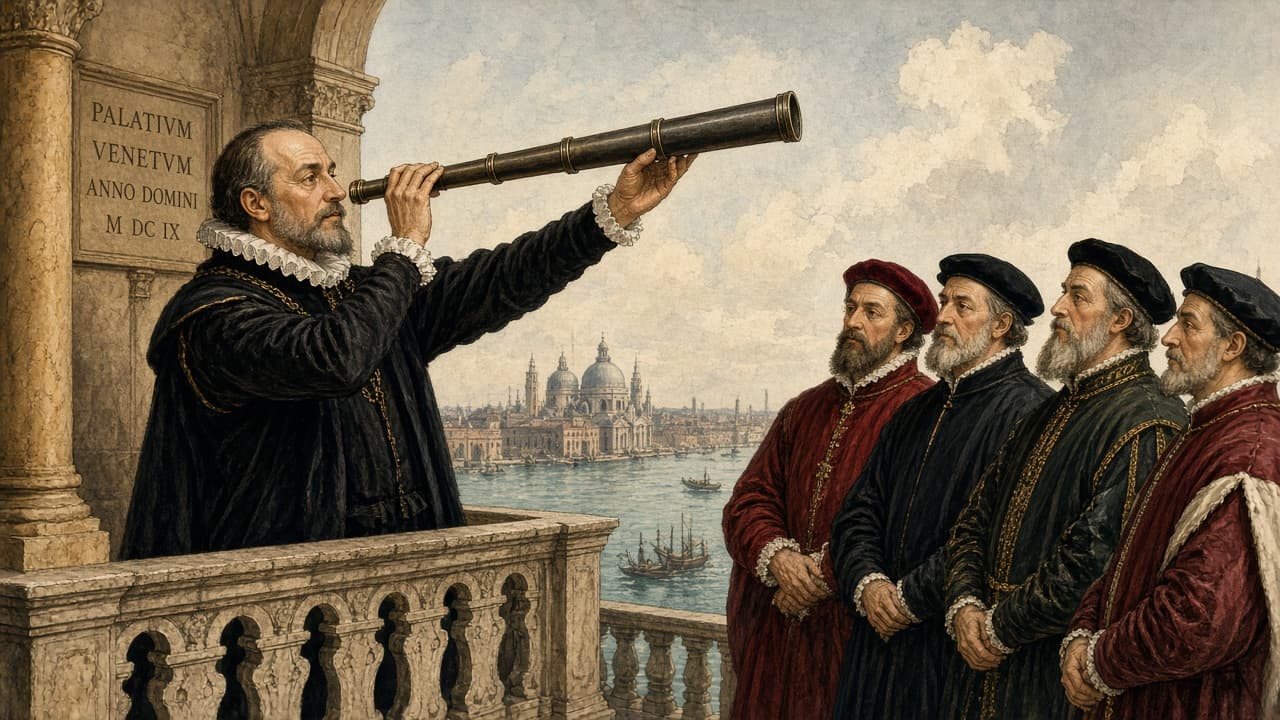
Demonstrating from a Venetian balcony turned optics into state theater. Senators and Arsenal men could see sails and towers earlier than with the naked eye, a clear maritime advantage. That patronage shield later helped Galileo pursue night-sky observations that challenged inherited cosmology with the same tube. The balcony scene is therefore not a cute anecdote. It is the funding and protection moment that linked maritime usefulness to scientific authority. Readers should picture politics and glassware in the same frame on 25 August 1609.
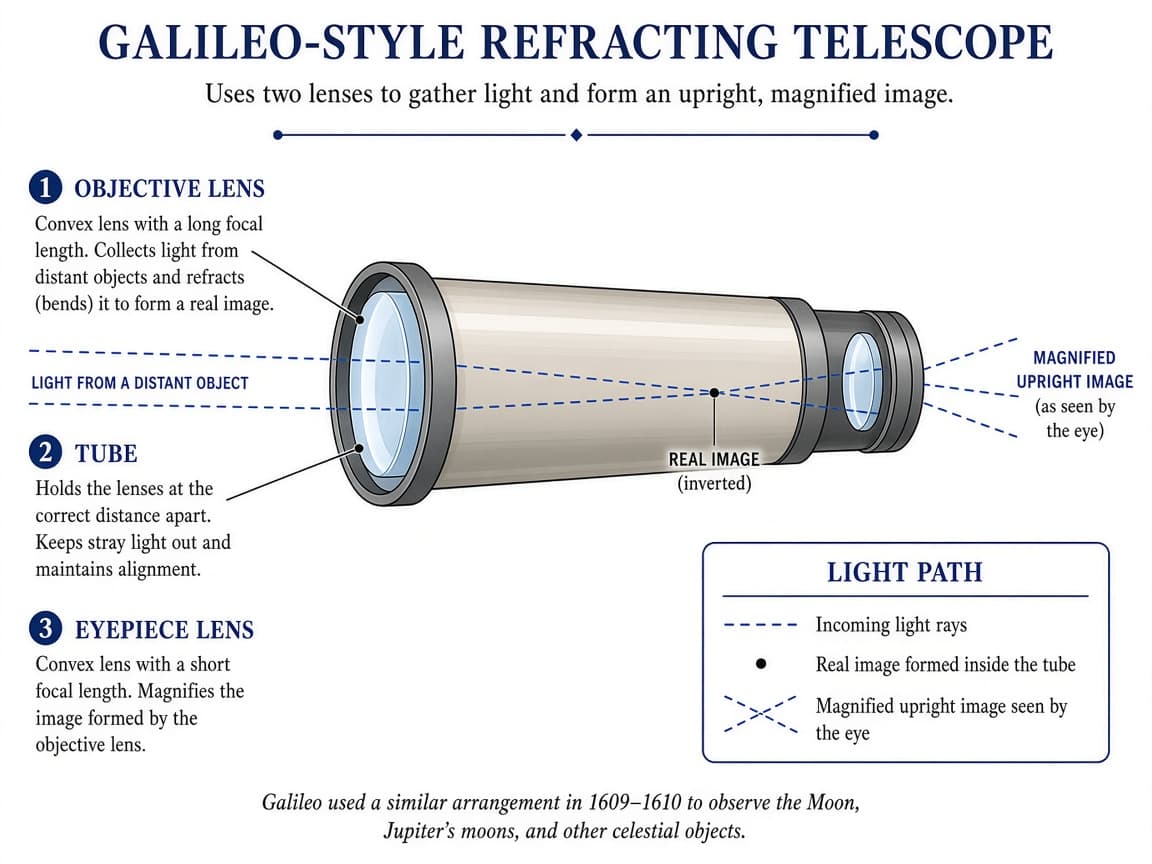
What is a refracting telescope, in plain language? Light from a distant object enters a convex objective lens that bends rays to form an image. An eyepiece lens near your eye magnifies that image. Early spyglasses were short tubes with modest power, often a few times magnification. Galileo pushed the design toward roughly twentyfold gains for some instruments by careful lens work and tube craft. The physics is geometry and glass. The breakthrough was treating the sky as a place the same tool could inspect.
Venice cared first about distant ships, fortifications and trade security on the lagoon and Adriatic. A glass that revealed sails earlier than the naked eye was a state asset. Galileo secured favor and a salary bump by showing that usefulness. Only afterward, through late 1609 and 1610, did he systematically turn similar instruments upward. Mountains on the Moon, countless stars in the Milky Way and the moons of Jupiter (which he called Medicean stars) became evidence that the heavens were not a perfect, unchanging crystal shell.
Those sky results mattered because European natural philosophy still leaned on Aristotle and on Ptolemaic Earth-centered models, even as Copernicus's Sun-centered math circulated among experts. Galileo's drawings and Sidereus Nuncius (Starry Messenger) in 1610 made the telescope a public argument, not only a dockside gadget. Seeing Jupiter's companions orbit another body undercut the idea that Earth was the unique center of all motion. Seeing lunar roughness undercut the idea of flawless celestial material.
The man himself was a professor and instrument maker as much as a rebel icon. He taught at Padua under Venice's wing, sold compasses and wrote on motion. Patronage politics later pulled him toward Florence and the Medici. Church conflict over Copernican advocacy came years after the 1609 demo; the August date is about a tool entering elite hands, not yet about trial and house arrest. Keeping the sequence straight prevents cartoon history.
Modern amateurs still build "Galilean" optics for teaching, even though later Keplerian designs with inverted images gave wider, sharper views for astronomy. Museums display tubes and lenses that look humble beside space telescopes. The lineage is real: once magnification proved the sky had structure, bigger mirrors and cameras were only a matter of centuries.
For readers who meet Galileo only as a slogan about science versus dogma, 25 August 1609 is a better door. It is the day a maritime republic rewarded better seeing and the same craft of glass soon let one observer collect facts that textbooks could not ignore. Instruments change arguments when they change what counts as visible.
Lens grinding was skilled manual labor. Soft glass, uneven curvature and narrow fields of view limited early tubes. Galileo's advantage was iterative craft plus a willingness to trust what the eye saw through imperfect glass. He sketched the Moon's terminator and Jupiter's changing attendant positions night after night, turning a novelty into a data log. Without that habit of repeated observation, the demo to Venice would have remained a harbor trick.
Universities and courts soon argued over priority and meaning. Thomas Harriot and others also pointed tubes skyward in the same years. Galileo's combination of instrument salesmanship, Medici patronage and printed report made his version the one Europe could not ignore. Technology spreads through networks of credit as much as through pure invention dates. By January 1610 he had published Sidereus Nuncius with Moon maps and Jupiter sketches that forced astronomers to argue with what the glass showed.
Eagle Frame's takeaway: 25 August 1609 is when Galileo's spyglass won Venetian attention as a practical eye on distant ships. Know how refraction works, know the later turn to the Moon and Jupiter and you see how a harbor tool became a hinge for modern astronomy.