On this day: Germany declares war on Russia
On 1 August 1914, Germany declared war on Russia and ordered its own general mobilization. Within four days a murder in Sarajevo had become a continental war, and the reason had as much to do with railway timetables as with diplomacy.
Shortly after seven in the evening on 1 August 1914, Count Friedrich Pourtales, the German ambassador to Russia, was shown into the office of the Russian foreign minister Sergei Sazonov in St Petersburg. He asked three times whether Russia would cancel the mobilization it had ordered two days earlier. Sazonov answered three times that it could not be undone. Pourtales then handed over Germany's declaration of war. He was so agitated that he gave Sazonov both prepared versions of the note, one written for a Russian refusal and one for a Russian climbdown, and then stood at the window and wept. Two hours earlier in Berlin, Kaiser Wilhelm II had signed the order for German general mobilization.
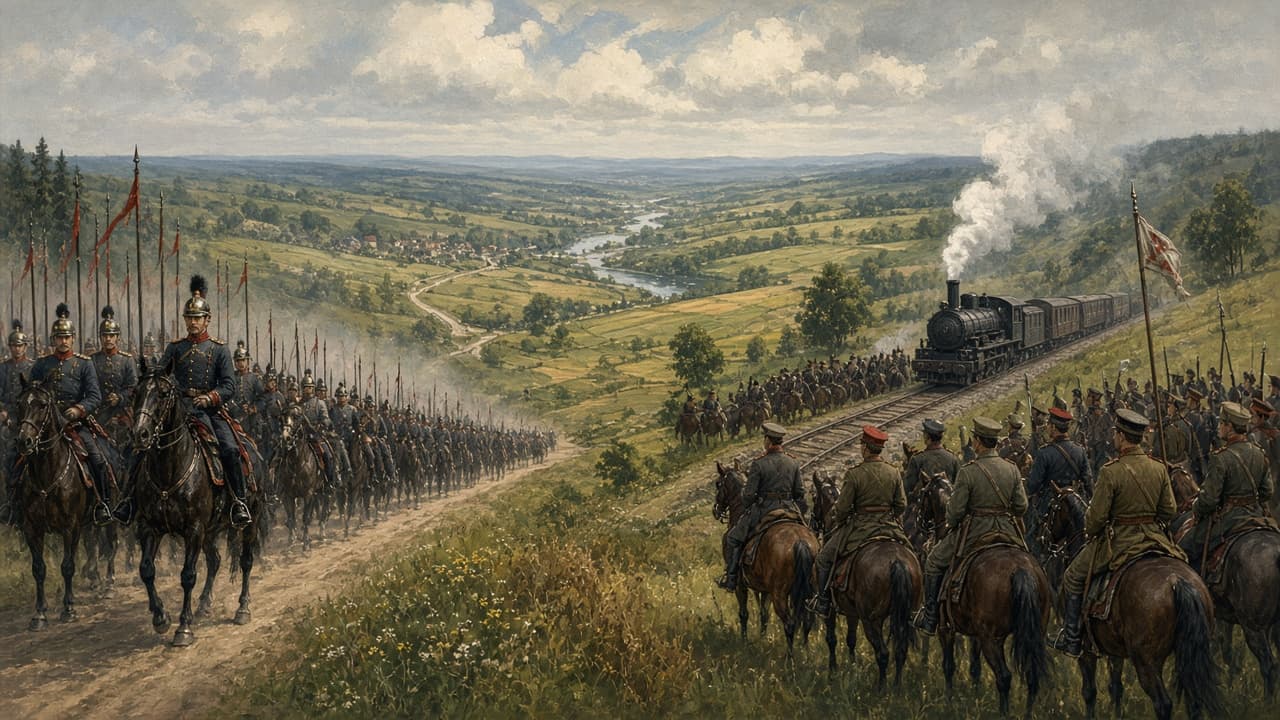
The word mobilization needs explaining, because in 1914 it did not mean what a modern reader assumes. Europe's great powers ran conscript armies. A peacetime force of a few hundred thousand men grew to millions by recalling trained reservists, who were summoned by post and public notice, equipped from depots, formed into units and moved to the frontier by rail on a plan drafted years earlier and rehearsed every year. The German deployment in the west alone required something in the order of 11,000 trains. Once the first ones rolled, halting the sequence meant weeks of chaos and an army that existed on paper but not in the field. Generals in every capital therefore told their politicians the same thing: mobilize late and you lose.
The quarrel that produced this had begun 34 days earlier. Archduke Franz Ferdinand, heir to the Austro-Hungarian throne, and his wife Sophie were shot in Sarajevo on 28 June 1914 by Gavrilo Princip, a 19-year-old Bosnian Serb supplied by officers of a Serbian nationalist network. Vienna wanted to use the killing to break Serbian influence in the Balkans and asked Berlin whether it would be backed. On 5 July Germany gave the assurance historians call the blank cheque. On 23 July Austria-Hungary handed Serbia a ten-point ultimatum with 48 hours to reply. Serbia accepted almost all of it on 25 July, rejected the clause that would have let Austrian officials run the investigation on Serbian soil and called up its army. Austria-Hungary declared war on 28 July and shelled Belgrade the next morning.
Russia's stake was prestige more than kinship. It had presented itself as the protector of Slavic states in the Balkans, had backed down in 1908 when Austria annexed Bosnia and Herzegovina, had been beaten by Japan in 1905 and had watched its influence in the region wobble through the Balkan wars of 1912 and 1913. Sazonov argued that another retreat would finish Russia as a great power. Tsar Nicholas II first ordered a partial mobilization against Austria alone on 29 July, then cancelled it, then reinstated a general one on 30 July. The reversal was not indecision so much as arithmetic. His general staff told him the railways had no partial plan and that improvising one would wreck the general mobilization if it were needed later.
Two of the men at the centre of this were relatives. Wilhelm II and Nicholas II were cousins who corresponded in English and signed their telegrams Willy and Nicky. Between 29 July and 1 August they exchanged a run of messages in which Nicholas asked Wilhelm to restrain Vienna and suggested sending the dispute to arbitration at The Hague, and Wilhelm asked Nicholas to stop the troops. Both appear to have believed they were personally trying to prevent a catastrophe. The telegrams are often quoted as proof that nobody wanted the war. They are better read as proof of how little two autocrats could do once their own general staffs held the timetable.
On 31 July Berlin declared a state of imminent danger of war, the legal step just short of mobilization, and sent two ultimatums. Russia had twelve hours to suspend all military measures. France had eighteen hours to say whether it would stay neutral in a Russo-German war, and the German foreign office had a follow-up ready that would have demanded the fortresses of Toul and Verdun as security if Paris said yes. No answer arrived from St Petersburg. The French premier Rene Viviani replied that France would act in accordance with her interests, which everyone understood as a refusal.
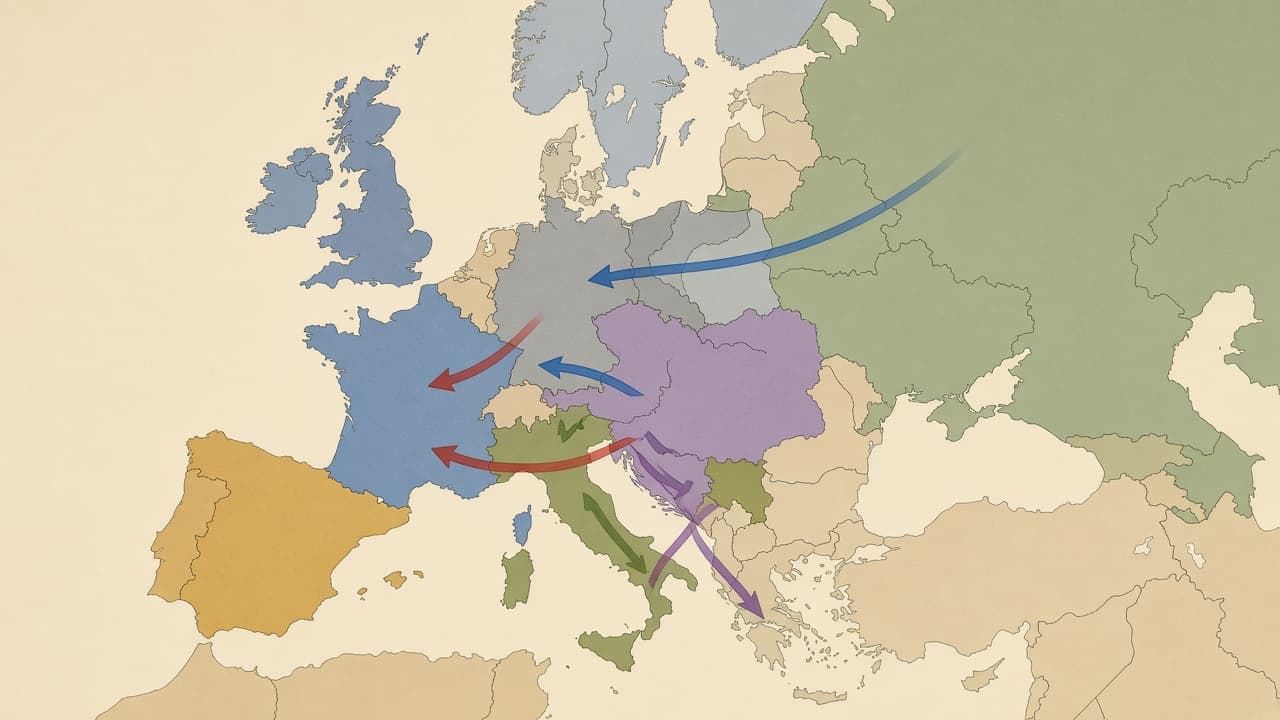
Here is why a declaration against Russia meant an invasion of Belgium. The Franco-Russian alliance of 1894 meant Germany faced enemies on both frontiers. German planning under Alfred von Schlieffen and then Helmuth von Moltke the Younger answered the problem by refusing to divide the army. Roughly seven eighths of it would go west, swing through Belgium to get around the French fortress line, defeat France in about six weeks and then be carried east by rail to meet a Russian army thought to mobilize slowly. The separate eastern deployment plan had been dropped in 1913 and the staff work for it was no longer maintained. That is the single most important fact about 1 August 1914. Germany's declaration of war on Russia committed it to attacking France and Belgium, two countries that had not been party to the quarrel.
The Kaiser tried to change it that evening and discovered he could not. A telegram from Prince Karl Max Lichnowsky, his ambassador in London, appeared to suggest that Britain might be able to keep France neutral. Wilhelm called for champagne and told Moltke to turn the whole army east. Moltke refused, saying the deployment of more than a million men could not be reversed on an evening's notice and that Germany would end up with a disorganized mob rather than an army. He wrote afterwards that he felt something in him break. The Kaiser's reply, as Moltke recorded it, was that his uncle would have given him a different answer, meaning the elder Moltke who had won the wars of German unification. The London telegram turned out to rest on a misunderstanding. A German detachment seized a railway junction in Luxembourg the same night.
The rest went quickly. France ordered general mobilization on 1 August, a quarter of an hour before Germany did. On 2 August German troops occupied Luxembourg and Berlin sent Belgium an ultimatum demanding free passage for its armies. Belgium refused on 3 August. Germany declared war on France that day, crossed the Belgian frontier on 4 August and Britain, a guarantor of Belgian neutrality under a treaty signed in 1839, declared war that night. Austria-Hungary and Russia were formally at war from 6 August. Italy, nominally Germany's ally, declared neutrality and joined the other side in 1915. Also on 1 August, Germany quietly signed a secret alliance with the Ottoman Empire, which brought the Middle East into the war by November.
Who was responsible has been argued about ever since, and the argument is not settled. Article 231 of the Treaty of Versailles assigned the blame to Germany and her allies, a clause German governments of the 1920s and 1930s campaigned against relentlessly. In 1961 the German historian Fritz Fischer used cabinet and staff records to argue that Berlin had deliberately risked a general war to break out of encirclement, which split the profession. Other historians put more weight on Austrian recklessness, on the Russian decision to mobilize first, on French assurances to St Petersburg or on a system of alliances and deployment schedules in which no single capital had to want a war for one to happen. Christopher Clark's account of the July crisis describes the decision makers as sleepwalkers. The evidence supports more than one reading and always has.
The bill is easier to state than the blame. The war ran 51 months. About nine million soldiers were killed and millions of civilians died of violence, hunger and disease, followed by an influenza pandemic that spread along the demobilization routes in 1918 and 1919. Four empires ended: the Russian, the German, the Austro-Hungarian and the Ottoman. Nicholas II abdicated in March 1917 and he and his family were shot in July 1918. Wilhelm II abdicated in November 1918 and lived out his life in the Netherlands until 1941. The map of central Europe and the Middle East drawn after 1918 produced borders and grievances that are still live.
The useful lesson is not that the leaders of 1914 were stupid. Most of them did not want a world war and several worked hard in the last week to avoid one. They had built a system in which the cost of waiting looked higher than the cost of moving, handed the schedules to their general staffs and then set clocks running on twelve-hour and eighteen-hour deadlines. Once the trains had a departure time, the diplomats were negotiating against a machine rather than against each other.
Eagle Frame's takeaway: 1 August 1914 is the day a Balkan assassination became a world war, because Germany's declaration pointed east while its only war plan pointed west. Know the difference between mobilizing and fighting, know the twelve-hour ultimatum to Russia, and know that two emperors exchanging friendly telegrams that week could no longer stop their own railway timetables.