On this day: Germany invades Poland
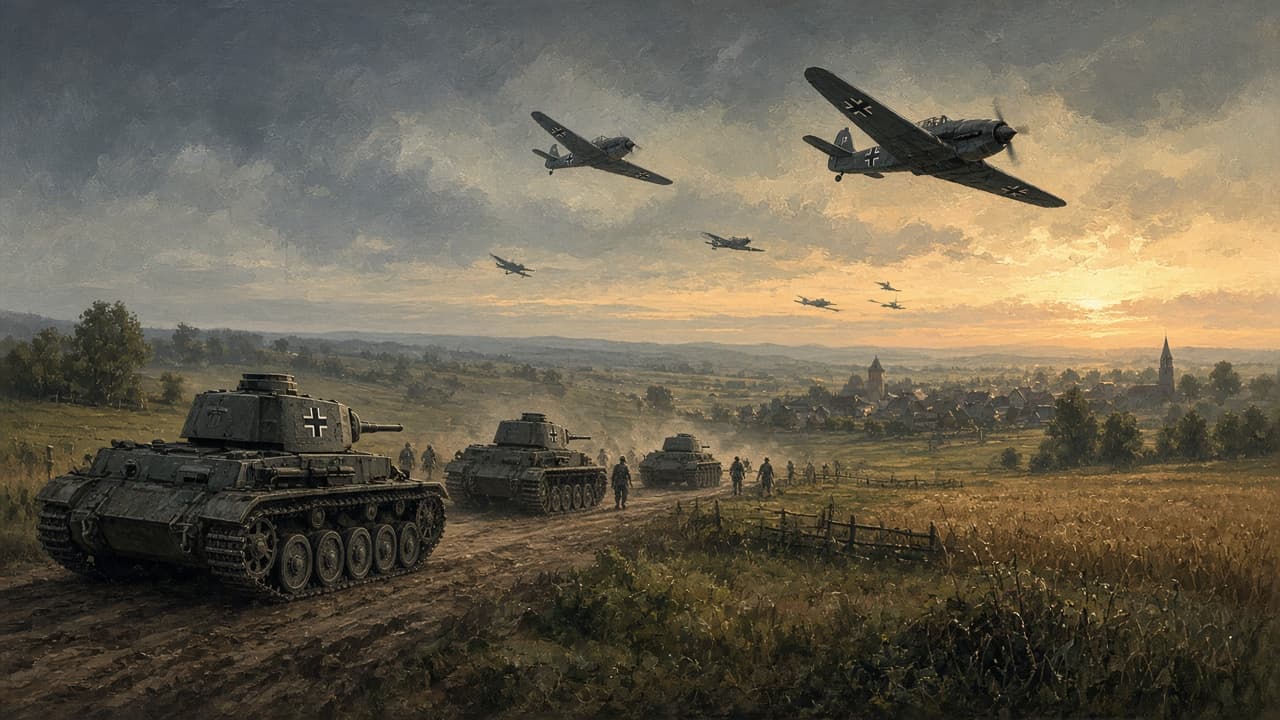
On 1 September 1939, Nazi Germany invaded Poland from the west. Britain and France declared war two days later. The attack opened the European war that became World War II.
On 1 September 1939, German forces crossed into Poland. Aircraft struck Polish cities and airfields. Armored columns pushed from the west and north. Adolf Hitler's government presented the attack as a response to invented border incidents. In truth it was a planned war of conquest. Within days Europe's long crisis of the 1930s became open continental war. Polish cavalry myths later distorted the fighting; the real story was modern combined arms overwhelming a neighbor that expected more help than arrived.
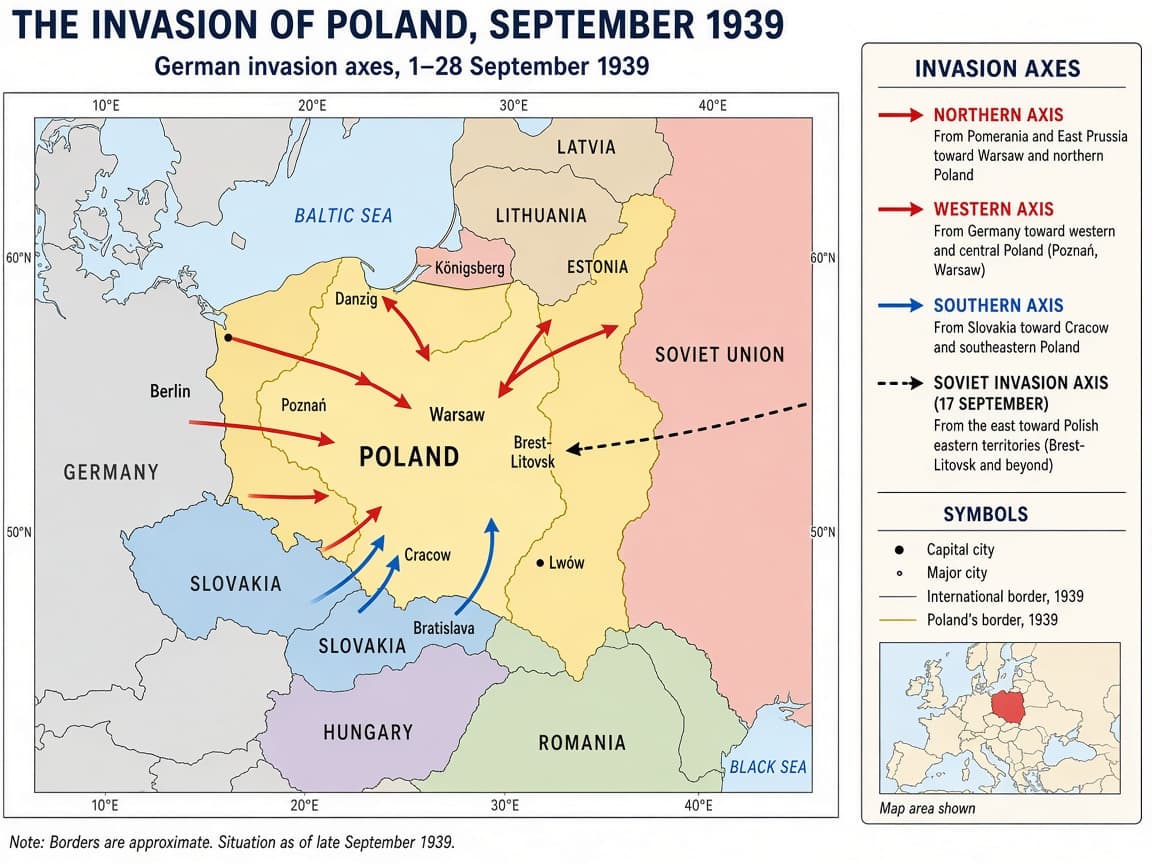
Germany's invasion of Poland on 1 September 1939 opened World War II in Europe with armored thrusts, air attacks and a staged border pretext. An educational map of axes into Poland shows the geographic squeeze that left the Second Polish Republic fighting on multiple fronts before the Soviet invasion from the east on 17 September. Blitzkrieg as popular label can mislead. The campaign still depended on radios, dive bombers and hard fighting, not magic. Borders on the map were the first casualties.
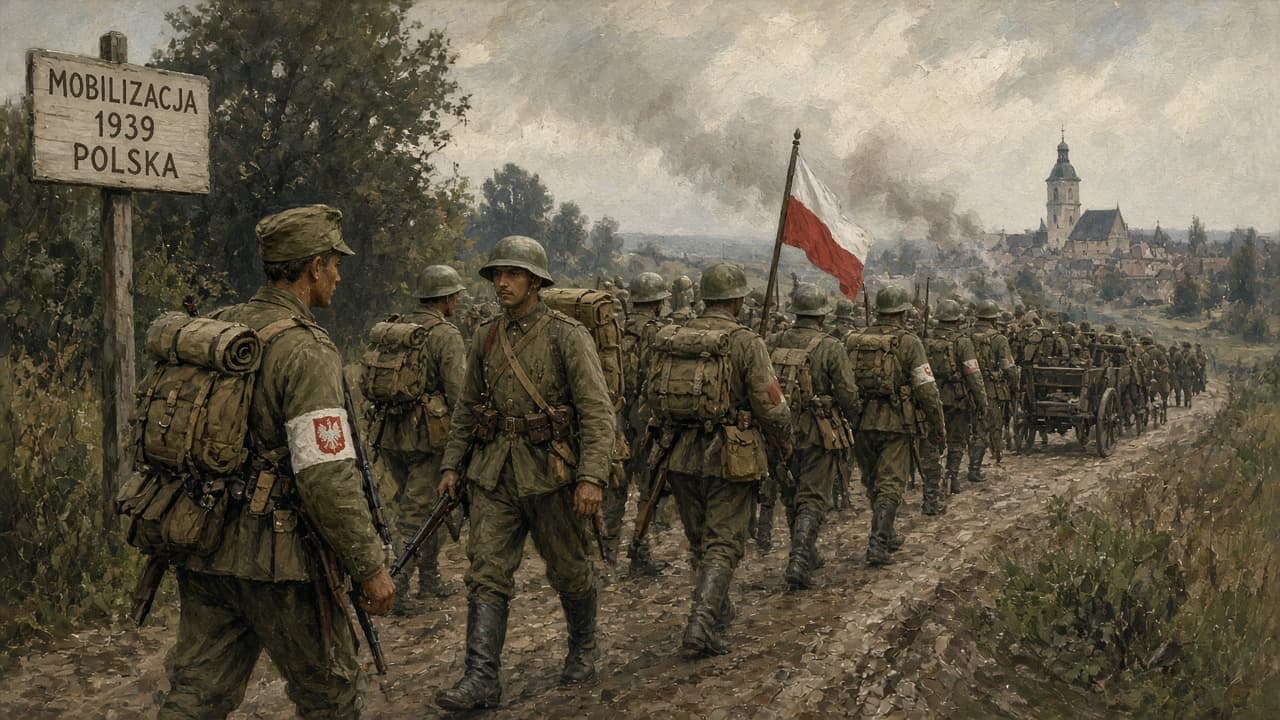
Polish mobilization put infantry, limited armor and an outnumbered air force onto roads under fire while civilians fled. Later myths about cavalry charging tanks caricatured a serious army that also fought modern delaying actions. Defeat came from isolation and two totalitarian neighbors, not from backwardness alone. Holding the mobilization scene beside the invasion map restores dignity to Polish resistance and clarity to how the war's first weeks actually unfolded. Refugee columns on the roads became targets and obstacles in the same chaotic first weeks.
Context matters. After remilitarizing the Rhineland, absorbing Austria and dismantling Czechoslovakia, Hitler's Germany had already torn up the post-1918 settlement. Britain and France had tried appeasement, most famously at Munich in 1938, hoping concessions would buy peace. Poland was the next target. A German-Soviet nonaggression pact signed in late August 1939 secretly divided Eastern Europe into spheres. That deal freed Hitler to strike west against Poland without immediate fear of a two-front war with Stalin.
Blitzkrieg is a later popular label for the methods Germany used: concentrated armor, close air support and fast advances meant to shatter coordination before defenders could stabilize a line. Polish forces fought hard but faced a larger, better-equipped opponent attacking on several axes. On 17 September the Soviet Union invaded from the east under the secret protocol. Poland was crushed between two totalitarian neighbors.
Britain and France had guaranteed Polish independence earlier that year. On 3 September they declared war on Germany. They could not move armies fast enough to save Poland in September. What they could do was end the fiction that Hitler's expansion would stop after one more grab. The declarations turned a regional invasion into the formal start of World War II in Europe for the Western Allies.
Polish civilians paid immediately. Bombing, executions and the machinery of occupation began in the first weeks. Nazi racial ideology treated Poles as people to be ruled and reduced. Jewish communities faced persecution that would escalate into industrialized genocide. Soviet occupation in the east brought its own arrests, deportations and mass killings. The map of Poland was erased and redrawn by force. Military lessons from September 1939 shaped the next years. Combined arms, airpower against logistics and the vulnerability of static defense without depth all became urgent study for every general staff. Germany's early success bred overconfidence that later campaigns would punish. Poland's defeat did not mean Polish resistance ended. Government-in-exile, underground armies and pilots serving with the Allies kept a national war effort alive. Readers sometimes compress the whole war into later dates: Dunkirk, Pearl Harbor, Stalingrad, D-Day. Those chapters matter. They sit on top of 1 September. Without the decision to smash Poland and without the Allied choice to declare war rather than accept another fait accompli, the timeline of the 1940s looks different.
The invasion also exposed the hollowness of collective security when great powers were divided and rearmament lagged. League of Nations diplomacy had already failed smaller states. Guarantees without ready force could not move tanks. That grim arithmetic is part of why the date still appears in textbooks as a hinge rather than a skirmish.
Polish defense plans assumed some Western relief or at least a serious diversion. What arrived instead was limited action while Germany's main effort tore through Polish rail hubs and cities. Refugees clogged roads. Government leaders left Warsaw as encirclement tightened. By early October organized Polish field armies had been destroyed or forced across borders into internment.
Propaganda framed the invasion as protection of German minorities and retaliation for fake incidents such as the Gleiwitz raid. That narrative mattered for domestic German consumption. Abroad it convinced few governments that still doubted Hitler's aims. The speed of the lie matched the speed of the tanks.
Students should also note the occupation toolkit that unfolded after the field armies fell: mass arrests, shootings of elites, forced labor and the first stages of racial war against Jews and Poles. September 1939 is not only a campaign map. It is the opening of a criminal regime's eastern laboratory.
Eagle Frame's takeaway: 1 September 1939 is when Nazi Germany's invasion of Poland, soon joined by the Soviet eastern strike, turned Europe's crisis into world war. Keep the enabling pact and the 3 September Allied declarations in view. Read the occupation's crimes as the war's opening chapter rather than as a side note.