On this day: the Gimli Glider lands without fuel
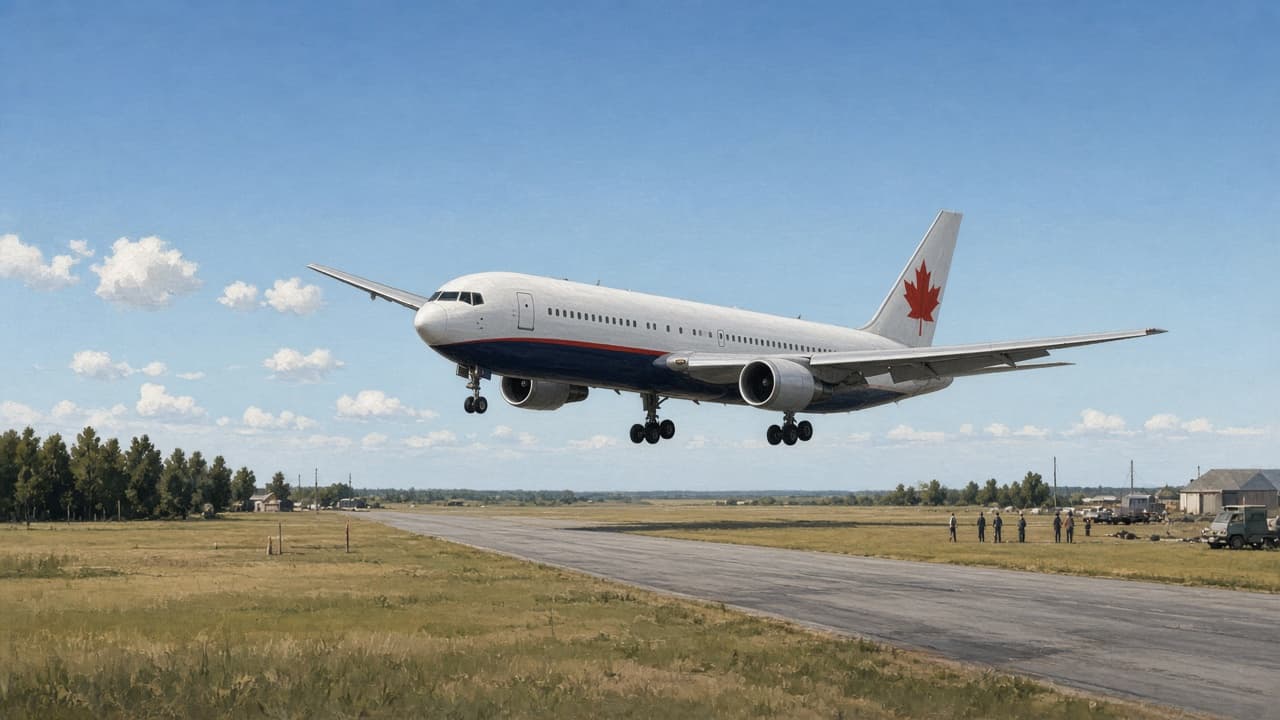
On 23 July 1983, Air Canada Flight 143 ran out of fuel at 41,000 feet because the load had been calculated in pounds instead of kilograms. The crew glided the Boeing 767 to a closed air force base at Gimli, Manitoba, and everyone survived.
On 23 July 1983, Air Canada Flight 143 was cruising at 41,000 feet over Red Lake, Ontario, on its way from Montreal to Edmonton, when a warning tone sounded on the flight deck. Fuel pressure was dropping in the left engine. A few minutes later that engine stopped. Then the right engine stopped. A Boeing 767 with 61 passengers and eight crew aboard had run completely out of fuel at eight kilometres above the ground, with roughly 100 kilometres still to fly to the nearest major airport.
The aircraft was one of the first Boeing 767s in Air Canada's fleet, and it was new in a way that mattered. It was among the first airliners with a glass cockpit and a computerized fuel quantity indicating system, and it was among the first Canadian aircraft measured in metric units rather than imperial. Canada had officially converted to metric in the 1970s. The crossover between the two systems is where the accident came from.
The fuel quantity processor had failed before the flight. A technician in Edmonton had found the fault, and a temporary fix, pulling and tagging a circuit breaker, kept one channel working. Through a misunderstanding during the handover in Montreal, the breaker was left pulled and the gauges showed nothing at all. Under the minimum equipment list the aircraft could still be dispatched, provided the fuel load was confirmed by manual dipstick measurement of the tanks and then calculated on paper.
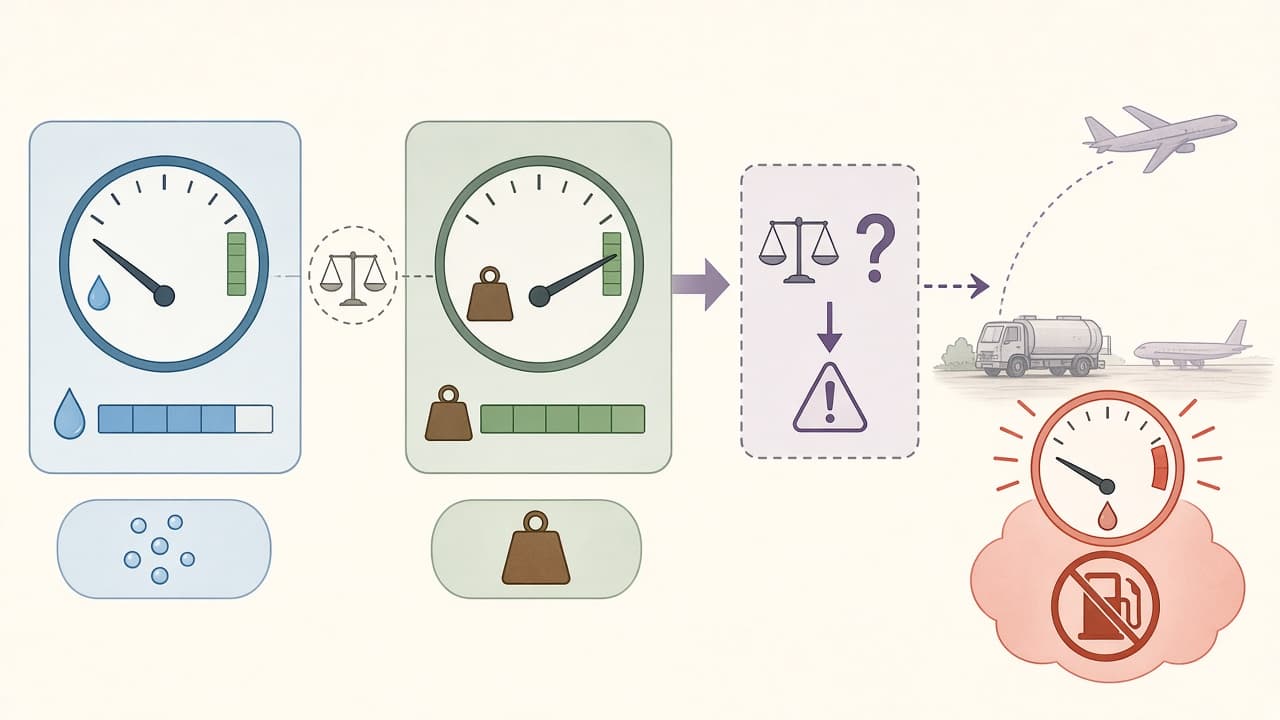
The dipstick gives a volume in litres. To turn litres into a mass of fuel you multiply by density. The correct factor for this aircraft, which was measured in kilograms, was about 0.8 kilograms per litre. The ground crew and flight crew instead used 1.77, the pounds-per-litre figure printed on the paperwork and used across the rest of Air Canada's imperial fleet. That produced a number roughly twice as large as the true mass, so the aircraft was loaded with about 22,300 pounds of fuel when it needed about 22,300 kilograms.
This is the detail people miss when they call it a simple unit mistake. Nobody skipped a step. The dip was done, the maths was done and the answer was checked twice, and every check used the same wrong constant. The aircraft left Montreal with less than half the fuel required and a fuel gauge that was blank, so there was nothing on board to contradict the calculation until the engines stopped.
When both engines quit, the crew lost more than thrust. Electrical generation and hydraulic pressure both come from the engines. Most cockpit displays went dark, leaving a small set of battery-powered standby instruments. A device called a ram air turbine dropped automatically into the airstream, a small propeller that uses the aircraft's forward motion to drive a hydraulic pump, restoring enough pressure to move the primary flight controls. It works only while the aircraft is moving fast, which means control gets weaker as speed decays.
Captain Robert Pearson and First Officer Maurice Quintal had two pieces of luck that were not luck at all but background. Pearson was an experienced glider pilot, so the idea of flying an unpowered aircraft for best distance was familiar rather than terrifying. He found the 767's best glide speed of about 220 knots by feel, since the figure was not in the manual for a total fuel exhaustion case. Quintal had served at Canadian Forces Base Gimli and knew there was a long runway there.
Quintal worked out the glide ratio from the altitude lost between two radar fixes: roughly 12 to 1, meaning about 12 kilometres forward for every kilometre down. That arithmetic showed they could not reach Winnipeg. Gimli, about 20 kilometres closer, was reachable. What nobody on the flight deck knew was that Gimli had been decommissioned and that one of its two parallel runways had been converted into a drag strip. A sports car club event was running that day, with families and vehicles on and beside the strip.
On final approach the aircraft was too high and too fast, and with no engines there is no way to go around and try again. Pearson used a glider technique called a forward slip: crossing the controls so the aircraft flies partly sideways, which massively increases drag and drops altitude without gaining speed. It is a standard manoeuvre in a light aircraft and almost unheard of in a wide-body airliner. It worked.
The nose landing gear, which had been lowered by gravity because there was no hydraulic pressure to drive it, failed to lock. It collapsed on touchdown, dropping the nose onto the runway. The scraping helped brake the aircraft. Flight 143 stopped short of the people on the strip. There were no deaths. Ten passengers suffered minor injuries evacuating down the rear slides, which were steep because the nose was on the ground. A small fire in the nose area was put out by the car club's own extinguishers.
The Canadian inquiry, led by Justice George Lockwood, deliberately declined to hang the accident on individuals. It found faults in Air Canada's maintenance practices, in the incomplete metric conversion, in the minimum equipment list procedures and in the training that had left the crew without a fuel-exhaustion checklist. That approach, looking for the system that allowed the error rather than the person who made it, is now standard in aviation safety and is one reason the case is taught in human factors courses worldwide.
The aircraft was repaired at Gimli within days and flew for Air Canada until 2008, keeping the nickname Gimli Glider on the fleet. Pearson and Quintal were initially disciplined and were later given the first Federation Aeronautique Internationale Diploma for Outstanding Airmanship. Quintal went on to command the type. The airframe now sits in the Mojave Desert.
Eagle Frame's takeaway: 23 July 1983 is the day an airliner ran dry at 41,000 feet because everyone used the same wrong number. Two things saved it: a ram air turbine that kept the controls alive and two pilots whose separate backgrounds, gliding and a posting at Gimli, happened to supply exactly what the situation needed. Checked twice with the wrong constant is still wrong.