
On this day: Google is founded
On 4 September 1998, Larry Page and Sergey Brin filed to incorporate Google in California. Their PageRank idea ranked web pages by link structure and helped turn a research project into the dominant search engine.
On 4 September 1998, Larry Page and Sergey Brin incorporated Google in California. The company grew out of a Stanford graduate research project on how to find information on a rapidly expanding World Wide Web. Their insight was not only to count words on a page. It was to treat links between pages as votes, weighted by how important the linking pages seemed to be.
Larry Page and Sergey Brin formalized Google in September 1998 after developing a search approach in Stanford labs and a rented garage workspace. Early desks, scavenged hardware and relentless indexing looked nothing like later campus campuses. Their bet was that ranking pages by incoming links could beat directories stuffed with keyword tricks. Naming both founders keeps the origin as a partnership of systems thinking, not a lone myth. The garage office image is the humble launchpad of a company that later organized the world's queries.
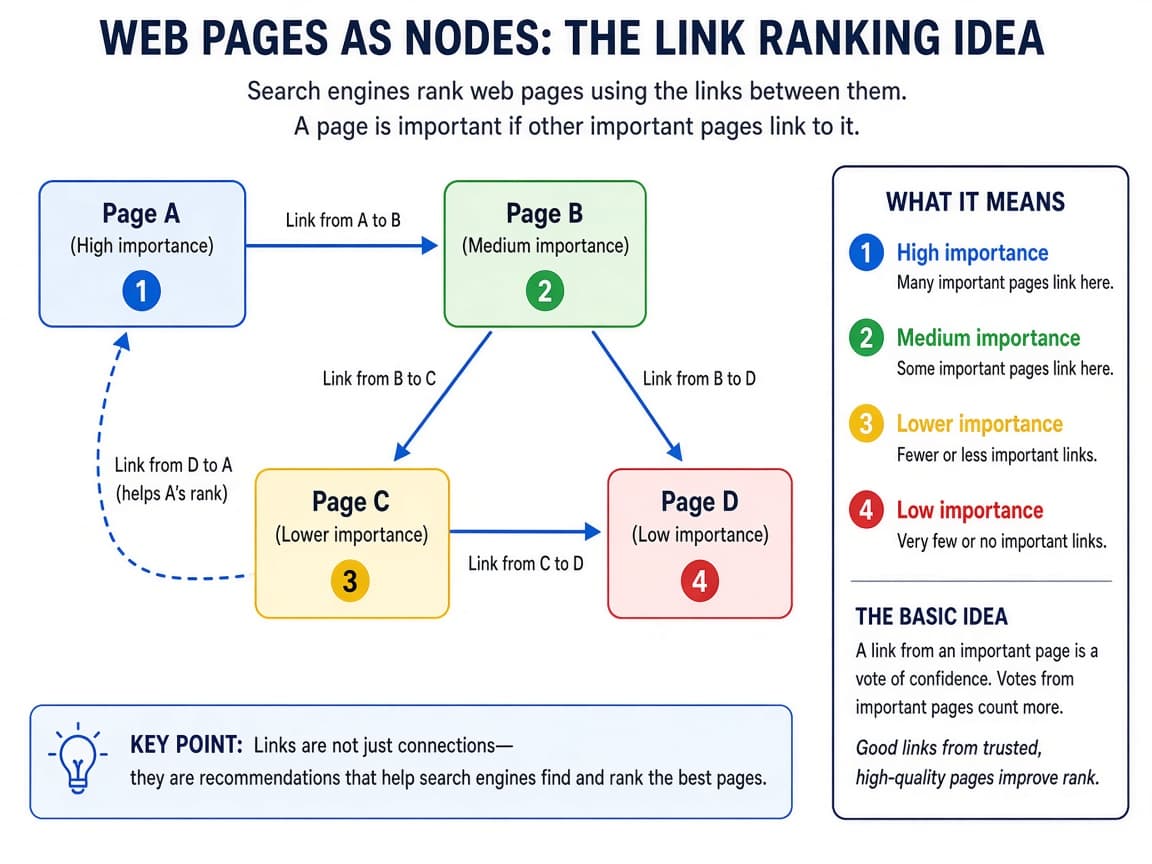
PageRank treated the web as a citation graph: a link from page A to page B counted as a vote and votes from important pages weighed more. The educational node-and-arrow diagram shows why quality could emerge from structure instead of only from on-page word counts. Spammers later tried to game the graph. Engineers kept adjusting signals. The core insight still matters for readers: Google won early because it modeled the web as relationships, not as a pile of unsorted documents.

What is a search engine, in plain language? It is software that crawls the web (or a corner of it), builds an index of what pages contain and then answers a typed query with a ranked list of links. Early engines often leaned on how often keywords appeared. Spammers could stuff pages with repeated words. Users drowned in junk.
PageRank attacked that problem with graph math. Imagine every web page as a point and every hyperlink as an arrow. A page that many respected pages point to rises in rank. A page that only points to itself does not. The algorithm iterates until the scores settle. You do not need to know the linear algebra to use the result: better ordering of blue links on a clean white page.
The young company rented space in a Menlo Park garage belonging to friend and early supporter Susan Wojcicki (later a major YouTube executive). Servers hummed. The interface stayed famously sparse: a logo, a box, a button. Speed and relevance were the product. Advertising would later pay the bills through targeted text ads keyed to queries, a model that made Google enormously profitable without charging users per search.
Competitors already existed: AltaVista, Yahoo directories directory model, Lycos and others. Google's rise was not instant monopoly by decree. It was compounding quality. People told friends that searches "just worked." As the index grew and data centers scaled, the advantage widened. By the mid-2000s Google had become shorthand for search itself, a verb as much as a brand. Teaching the founding date means teaching the web of the late 1990s. Dial-up modems. Homepages built by hand. No modern smartphone app store. Finding anything useful was a chore. A better ranking algorithm was therefore infrastructure for culture, commerce and news, not only a clever thesis. Later Google became Alphabet's core, absorbed YouTube, built Android, fought antitrust cases and faced debates over privacy, copyright and political information. Those chapters matter. They sit on top of a September incorporation that legalized a partnership already running on PageRank and ambition. The garage myth is partly branding. The math and the crawl were the substance.
Brin had been born in Moscow and emigrated as a child; Page grew up around computing and academia in the United States. Their partnership mixed systems obsession with a taste for huge problems. Investors such as Andy Bechtolsheim wrote early checks before the company even had a proper bank account ready. Startup folklore loves that detail because it captures how unfinished the firm still was on paper.
Academic papers on the Anatomy of a Large-Scale Hypertextual Web Search Engine explained the system to peers before the company became a verb. Stanford's computer science culture supplied talent, cheap pizza and a tolerance for servers in odd rooms. The leap from campus to corporation required incorporation papers, equity splits and a willingness to hire beyond the founding pair.
Early users noticed that Google often surfaced the page they meant on the first screen. That feeling of reduced friction is hard to patent yet easy to market by word of mouth. Growth metrics climbed while the homepage stayed almost empty. Restraint became a design signature in an era of portal pages crowded with weather widgets and stock tickers.
Advertising auction systems that came later turned attention into the main revenue engine. Critics would eventually ask whether ranking and ads intertwined too tightly. Those debates are downstream of the 1998 bet that relevance itself was worth building a company around.
Eagle Frame's takeaway: 4 September 1998 is when Page and Brin turned a Stanford link-ranking project into Google the company. Keep PageRank as weighted votes through hyperlinks in view, along with the garage years and the sparse search box. That is why relevance at web scale became one of the central businesses of the internet.