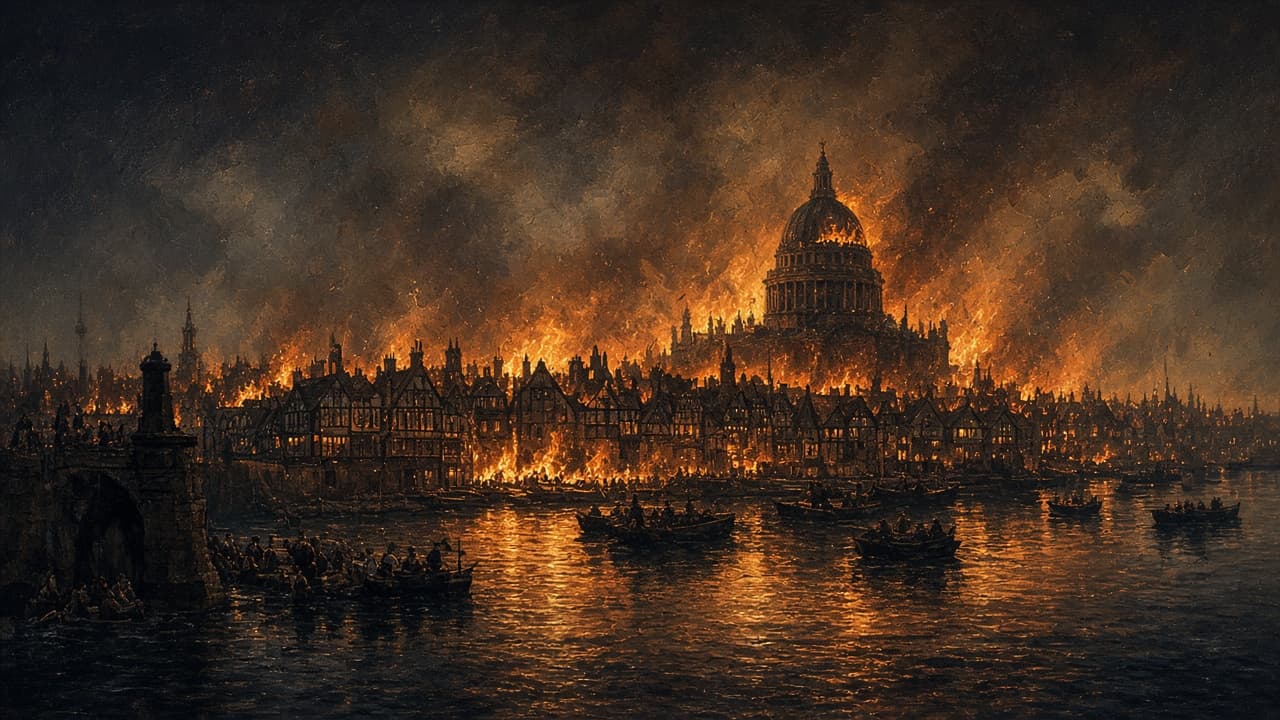
On this day: the Great Fire of London begins
On 2 September 1666, fire broke out at a bakery on Pudding Lane in the City of London. Driven by dry weather and a strong wind, it destroyed much of the medieval City, including old St Paul's Cathedral.
In the early hours of 2 September 1666, fire broke out at a bakery on Pudding Lane, east of London Bridge in the City of London. The summer had been hot and dry. Timber houses stood close together along narrow streets. A strong easterly wind pushed flames westward through the commercial heart of the capital. By the time the fire was under control four days later, much of the medieval City had burned, including the old St Paul's Cathedral. The disaster is remembered as the Great Fire of London.
The bakery belonged to Thomas Farriner, a supplier of ship's biscuit to the navy. Around 1 in the morning a fire was discovered downstairs. The household escaped through an upstairs window. Neighbors fought the first flames with buckets, the standard tool in a city without professional fire brigades. They were too late. Sparks jumped to adjoining roofs. Within hours the blaze was moving through lanes packed with warehouses, shops and homes built of wood and pitch-coated materials that burned easily. Night watchmen and parish officers could slow a chimney fire. They could not hold a wind-driven wall of flame once it owned a street.
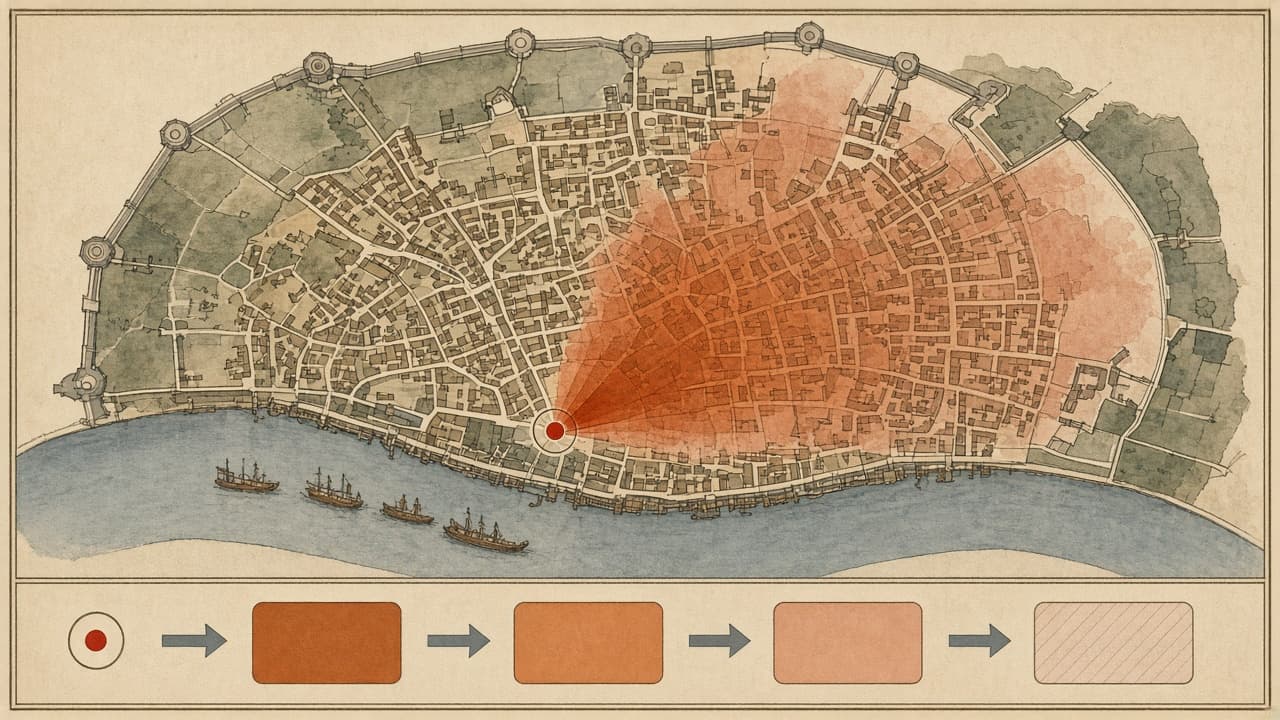
Understanding the spread means understanding the street plan. Seventeenth-century London inside the old walls was crowded. Upper stories jutted over the street so neighbors could almost touch. That made firefighting by bucket line nearly useless once roofs were alight. The Thames offered water but also warehouses full of oil, spirits, hemp and other cargo that fed the fire when it reached the riverfront. London Bridge had houses on it. The fire damaged the north end and sent people fleeing into Southwark with rumors and smoke. From a map, the path is clear: start near the bridge, ride the wind west through the densest commercial blocks and only lose force when open ground or demolished rows finally break the fuel chain.
Lord Mayor Thomas Bloodworth famously underestimated the danger at first, a hesitation later mocked in diaries of the period. King Charles II and his brother James, Duke of York, eventually took a direct role, ordering firebreaks. Crews pulled down houses with hooks and later used gunpowder to blast gaps ahead of the flames. Those clearances, plus a shift in the wind and the sheer consumption of fuel, finally slowed the fire by 5 and 6 September. Roughly 13,000 houses and 87 churches were destroyed. About 80 percent of the City inside the walls was gone. Deaths recorded at the time were surprisingly few, though modern historians suspect the true toll among the poor was higher than the official count. Tens of thousands slept in fields and temporary camps while authorities tried to feed and count them.
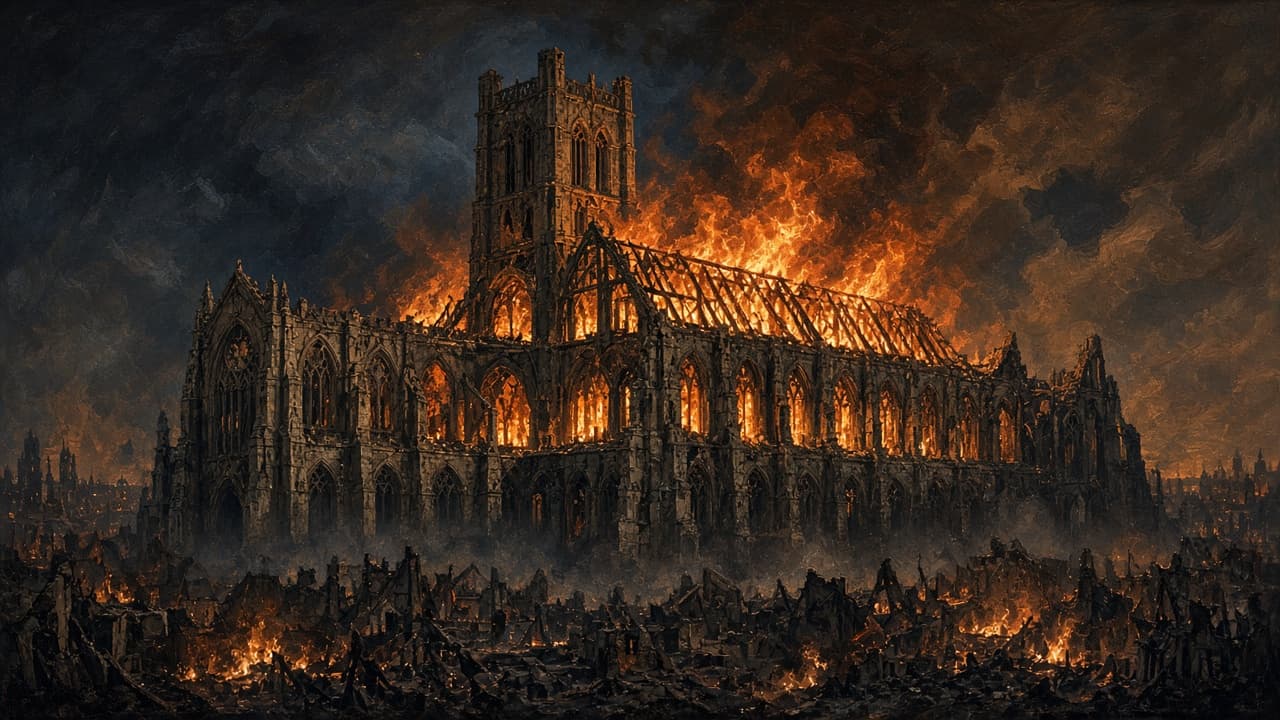
St Paul's Cathedral was the spiritual and visual center of the City. The building that burned was a medieval cathedral with a long choir, a tall tower and centuries of additions. In 1666 scaffolding stood around parts of it for repairs. Embers lodged in the timber works. Samuel Pepys and other diarists described the lead roof melting and streams of molten metal running off the building. Stone cracked in the heat. Books and papers stored in the crypt or nearby churchyards were not all saved. When the cathedral failed, London lost not only a church but a landmark that had oriented the skyline for generations.
Rebuilding St Paul's became the most famous architectural project of the recovery. Christopher Wren, already an accomplished scientist and architect, produced designs for a new cathedral in a classical baroque language far from the Gothic pile that had burned. Construction began in the 1670s and the new St Paul's was declared complete in 1710, with its dome defining the rebuilt City. Wren and his colleagues also shaped parish churches across London, so the fire's aftermath is written into the streetscape still visible today. Visitors who climb to the dome are walking through a rebuild that took longer than many Londoners' working lives.
The wider rebuild changed rules as well as skylines. New building regulations encouraged brick and stone over timber in the City. Streets were to be wider in places. An early fire insurance industry grew in the following decades, along with organized firefighting companies tied to insurers. Socially the fire deepened suspicion toward foreigners and Catholics in a nervous Protestant capital. Scapegoating ran ahead of evidence. Economically, markets and the customs system recovered with royal and civic support. London remained England's commercial center even while rubble still filled lots.
Eyewitness writing makes 1666 unusually vivid. Pepys buried wine and papers in his garden, watched from the river and recorded prices, rumors and exhaustion. John Evelyn described a pillar of smoke and a dazzled night sky. Those diaries are why school lessons can still walk hour by hour through the fire's advance. They also remind readers that catastrophe is lived as logistics: where to sleep, what to save, how to move a cart when every street is blocked. The pedagogy of the fire is mechanical first. Sentiment comes after the map.
The Monument, a tall Doric column near Pudding Lane designed by Wren and Robert Hooke, still marks the disaster's origin zone. Climbing it offers a view over a city that burned and then chose denser commerce in brick rather than abandon the site. The Great Fire sits beside plague outbreaks of the mid-1660s in English memory as a double shock. Together they close one version of medieval London and open the rebuilt capital of the later Stuart age. Pudding Lane remains a small street with a large lesson about fuel, wind and urban design.
Eagle Frame's takeaway: 2 September 1666 is the night a Pudding Lane bakery fire became a citywide inferno. Dry weather, timber density and wind teach the mechanism. The loss of medieval St Paul's and Wren's long rebuild teach the aftermath. The map from lane to cathedral is the clearest way to see how London changed.