On this day: Hawaii becomes the 50th US state
On 21 August 1959, President Dwight Eisenhower proclaimed Hawaii the 50th U.S. state. Decades of annexation, plantation economy and wartime strategy led to that formal admission.
On 21 August 1959, President Dwight D. Eisenhower issued a proclamation confirming Hawaii as the fiftieth state of the United States. The move followed a June referendum in which voters in the Territory of Hawaii approved statehood by a wide margin. Stars on the flag gained one more. Washington gained two senators and several representatives from the Pacific. For many residents it was celebration. For others, especially Native Hawaiians, the date sits inside a longer story of kingdom overthrow, annexation and unresolved sovereignty claims.
Hawaii was an independent kingdom before American and European business interests reshaped its politics in the nineteenth century. American sugar planters grew powerful. In 1893, with U.S. diplomatic and military support in the background, the monarchy was overthrown. The Republic of Hawaii followed, then annexation in 1898 during the Spanish-American War era when Pacific bases mattered to the Navy. For six decades Hawaiians lived as U.S. citizens without full state-level self-government in the same form as the continental states.
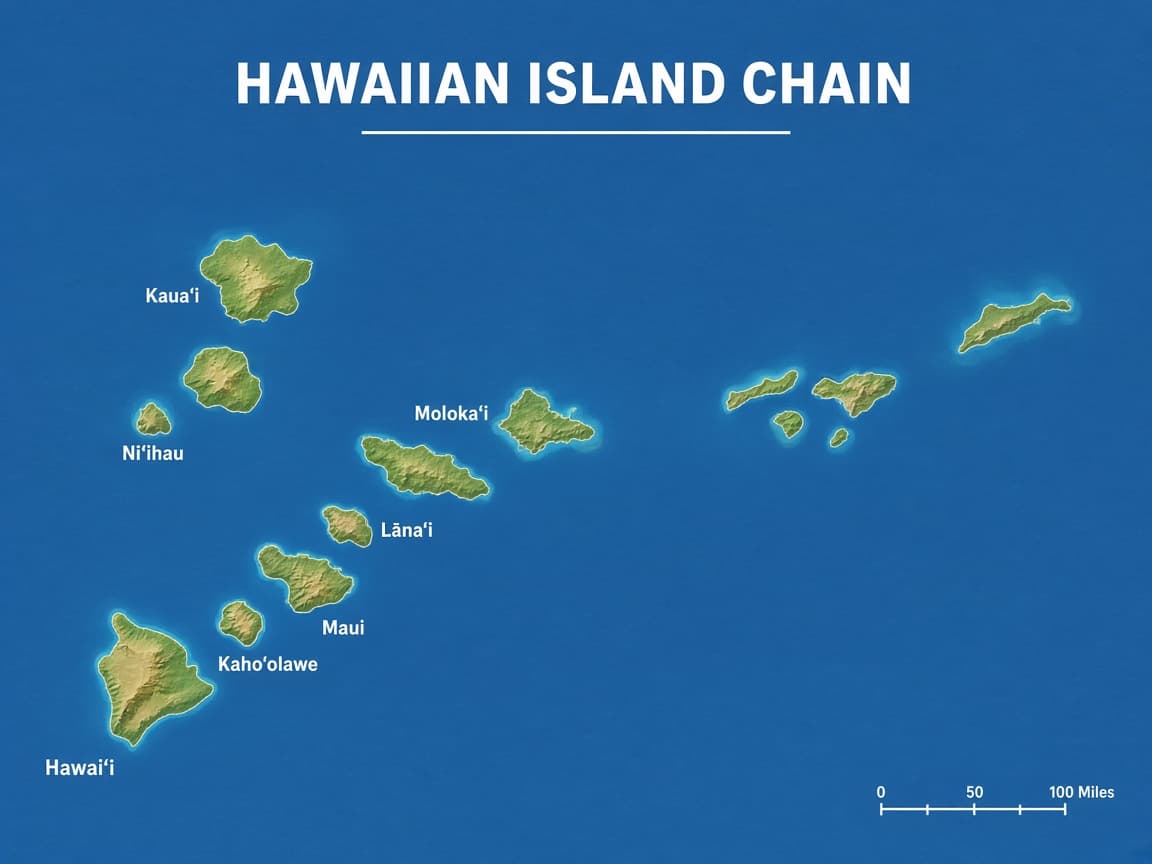
Hawaii's island chain stretches across the central Pacific, a volcanic archipelago whose strategic harbors had already drawn U.S. military power long before statehood. An educational map makes the distance from the mainland visible: admission was not only a political vote but a geographic leap into mid-ocean. Plantation labor histories, Native Hawaiian sovereignty claims and wartime martial law all sat underneath the celebration. On 21 August 1959, Hawaii became the 50th state after a plebiscite and congressional action that closed the territorial chapter.
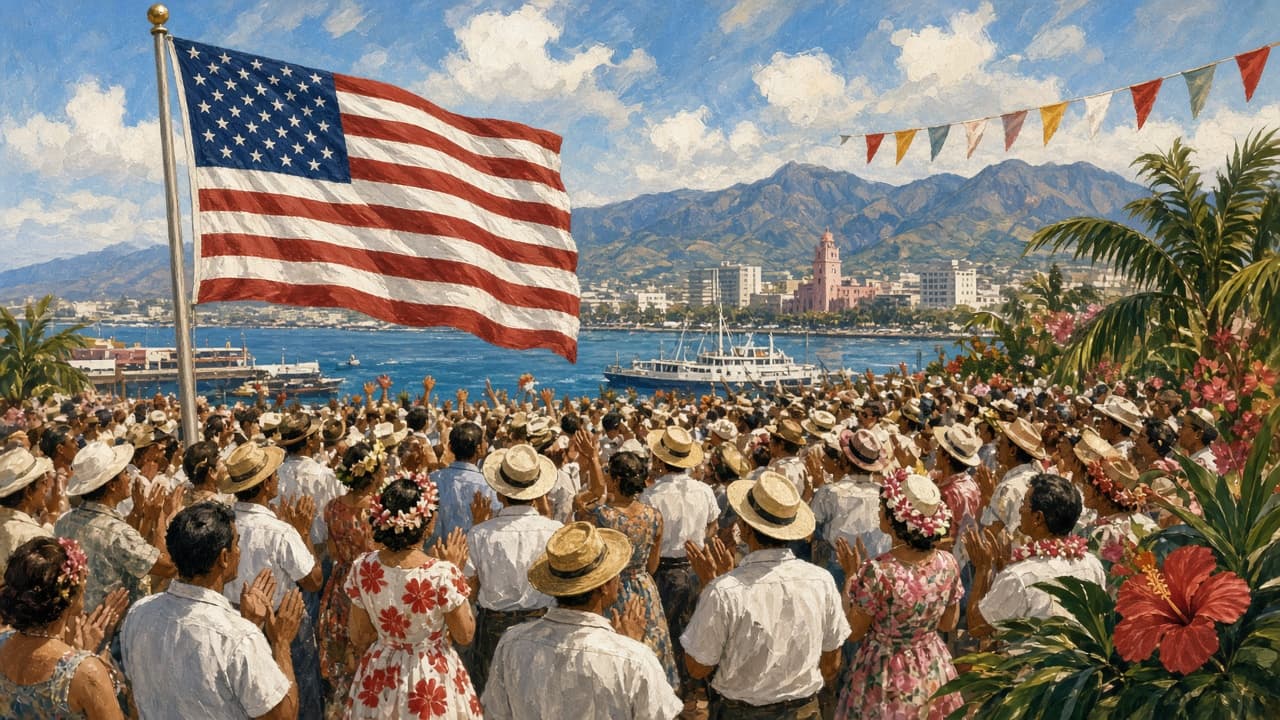
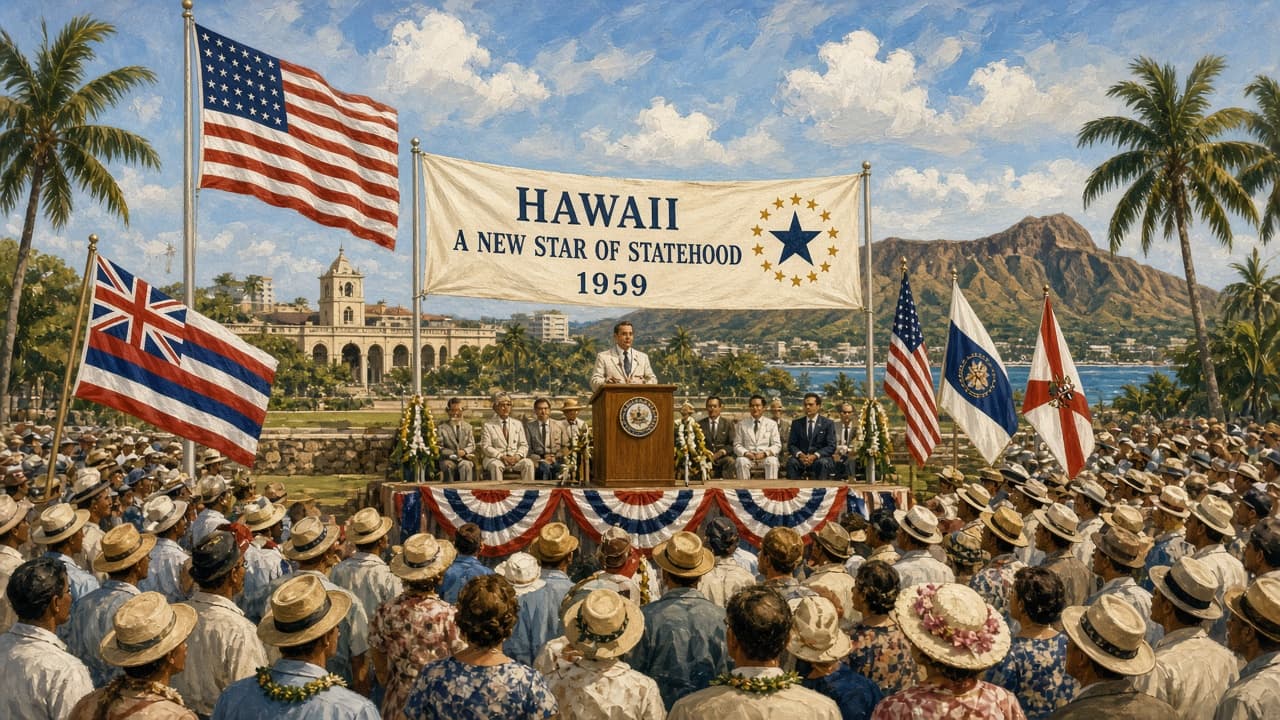
Statehood ceremonies in Honolulu mixed flags, speeches and hopes for equal representation in Congress after decades of territorial limbo. Boosters promised tourism growth and full citizenship symbols. Critics and Native Hawaiian voices continued to question how annexation and statehood treated land, language and self-determination. Military basing remained central to Washington's interest in the islands. The ceremony image captures official joy. The island map keeps the longer story of ocean distance, bases and cultural nations that did not vanish when a star was added to the flag.
Why statehood in 1959? World War II had shown Hawaii's military value vividly after the 1941 attack on Pearl Harbor. The Cold War kept the Pacific strategically hot. Economically, tourism and defense spending were replacing pure plantation dependence. Local political leaders from both major parties pushed for equality in Congress and control of state institutions. Congress passed the Hawaii Admission Act in March 1959. Eisenhower signed it. The public vote in June cleared the path for August proclamation.
Statehood changed daily governance. Hawaii could elect a governor, legislature and congressional delegation with full voting power. Federal programs and infrastructure investment flowed on new terms. Tourism boomed as jet travel made the islands a mass-market destination. The cultural image of Hawaii in American minds (surf, aloha shirts, tiki bars) accelerated, sometimes flattening a complex Polynesian society into marketing wallpaper.
Native Hawaiian activists later challenged the narrative that statehood solved every question. Movements for cultural revival, land rights and political self-determination pointed to the 1893 overthrow and annexation as injuries never fully repaired. The federal government eventually acknowledged the overthrow's role in a 1993 apology resolution. Debates over sovereignty, federal recognition and military land use continue. Statehood is one frame on the wall, not the only one in the room.
Demographically, Hawaii became one of the most diverse states: large Asian American communities from plantation labor migrations, Native Hawaiian and Pacific Islander populations, military families and mainland transplants. That mix shapes food, language, politics and festivals in ways invisible on a simple fifty-star map. Knowing 21 August 1959 without knowing plantation immigration or kingdom history is like knowing a wedding date without meeting the couple.
Legally, admission followed the same constitutional pattern as earlier states: enabling act, local vote, presidential proclamation. Alaska had joined earlier in 1959, reversing the usual pattern of contiguous expansion. Together the two admissions marked the United States as a nation with serious Arctic and Pacific fronts, not only a continental bloc facing the Atlantic.
For travelers, statehood is why Hawaii uses U.S. dollars, U.S. courts and U.S. passports without a separate immigration line. It is also why Honolulu hosts Pacific Command headquarters and why some beaches sit next to military fences. The postcard and the base share an archipelago. Eisenhower's August proclamation made that arrangement formal in the eyes of federal law.
Congressional hearings before admission aired testimony from supporters and opponents, including Native Hawaiian voices who questioned whether statehood equaled justice. Military bases, land leases and tourism investment shaped the economic case alongside democratic representation. The 1959 vote was lopsided in favor of statehood, yet dissenting narratives remained in community memory and later sovereignty movements. Statehood brought federal highway funds, education programs and voting power in Congress. It also locked Hawaii into American trade and defense networks that shaped island economies for decades. Anniversaries on 21 August celebrate stars on the flag. Community conversations about sovereignty ask whether that symbol answered every question from 1893 forward.
Eagle Frame's takeaway: 21 August 1959 is when Hawaii became the 50th state after annexation and decades as a territory. Know the 1893 overthrow, know the 1959 vote and know that Native Hawaiian sovereignty questions did not end with a new star on the flag.