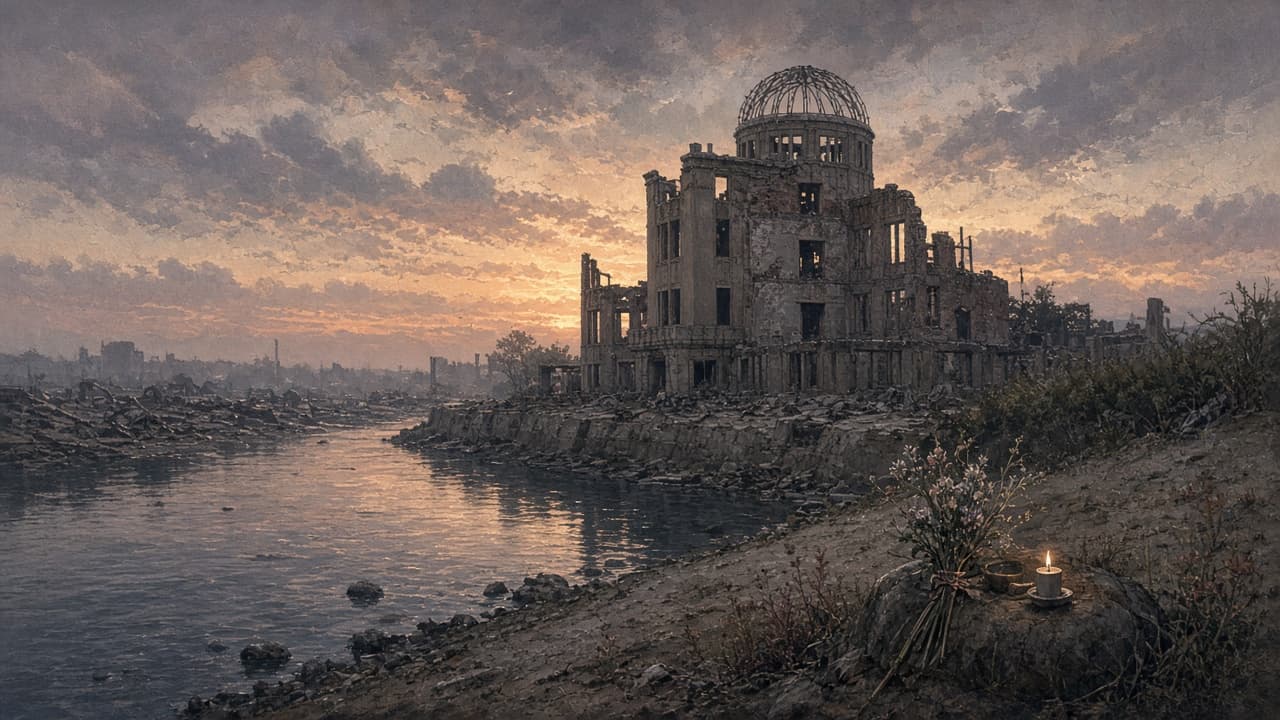
On this day: the atomic bombing of Hiroshima
On 6 August 1945, an American B-29 dropped a uranium bomb called Little Boy over Hiroshima. Tens of thousands of people died that morning and roughly 140,000 by the end of the year, and nuclear weapons stopped being a theory.
At 8:15 on the morning of 6 August 1945, a single bomb fell for about 43 seconds over the center of Hiroshima and detonated roughly 580 meters above the city. The aiming point was the T-shaped Aioi Bridge over the Ota river. The actual burst was a little to the south-east, above the Shima Surgical Clinic. It was a clear, warm Monday. Trams were running, schoolchildren had been mobilised to clear firebreaks, and an all-clear had sounded after an earlier alert, so most people were outdoors or at their desks rather than in shelters. In under a second a city of roughly 350,000 people had its center erased.
Understanding what happened requires understanding what the bomb was, because the physics is what made it different from every weapon before it. Ordinary explosives release energy by rearranging chemical bonds. A fission weapon releases energy by breaking atomic nuclei apart. When a nucleus of uranium-235 absorbs a neutron it becomes unstable and splits into two lighter nuclei, releasing energy and, crucially, two or three fresh neutrons. If those neutrons find other uranium-235 nuclei, the process repeats and doubles, and the number of fissions grows geometrically. That runaway sequence is a chain reaction, and in Little Boy it ran through about 80 generations in well under a millionth of a second.
The engineering problem is that a chain reaction only sustains itself if the fissile material is dense and large enough to keep neutrons from escaping before they hit something. That threshold is called critical mass. A lump of uranium below it sits there harmlessly. So a bomb must store its fuel in safe sub-critical pieces and then slam them together into a supercritical whole faster than the reaction can blow the assembly apart. Little Boy solved this with the simplest possible mechanism, a gun. Inside a steel casing sat a smoothbore artillery barrel. Cordite propellant fired a hollow cylinder of highly enriched uranium down that barrel onto a matching uranium target plug surrounded by a tungsten carbide and steel tamper, which reflected escaping neutrons back inward. The projectile travelled at roughly 300 meters per second. The whole weapon held about 64 kilograms of uranium, and only around a kilogram of it actually fissioned, yielding an explosion equivalent to about 15,000 tonnes of TNT.
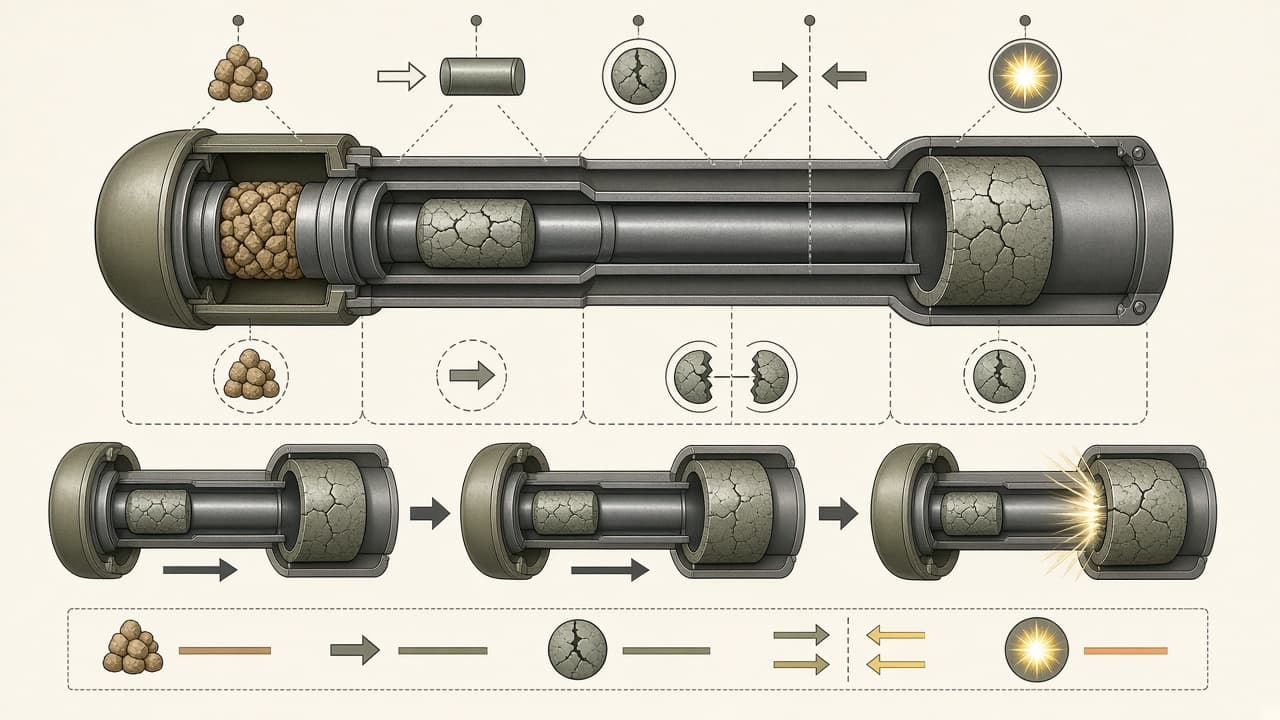
That design only works with uranium, and the reason explains the second bomb three days later. Plutonium produced in reactors contains plutonium-240, which fissions spontaneously often enough that a gun-type assembly would begin reacting while the pieces were still closing and would fizzle. So the Manhattan Project built two entirely different weapons in parallel. The plutonium device used explosive lenses to crush a subcritical sphere inward from all sides in microseconds, an implosion design tested at Trinity in the New Mexico desert on 16 July 1945 and dropped on Nagasaki on 9 August as Fat Man. Little Boy was never tested before use. It was considered simple enough to trust. Its scarce ingredient was the uranium itself, separated atom by atom at Oak Ridge, Tennessee, in vast calutron and gaseous diffusion plants that consumed a significant fraction of American electrical output.
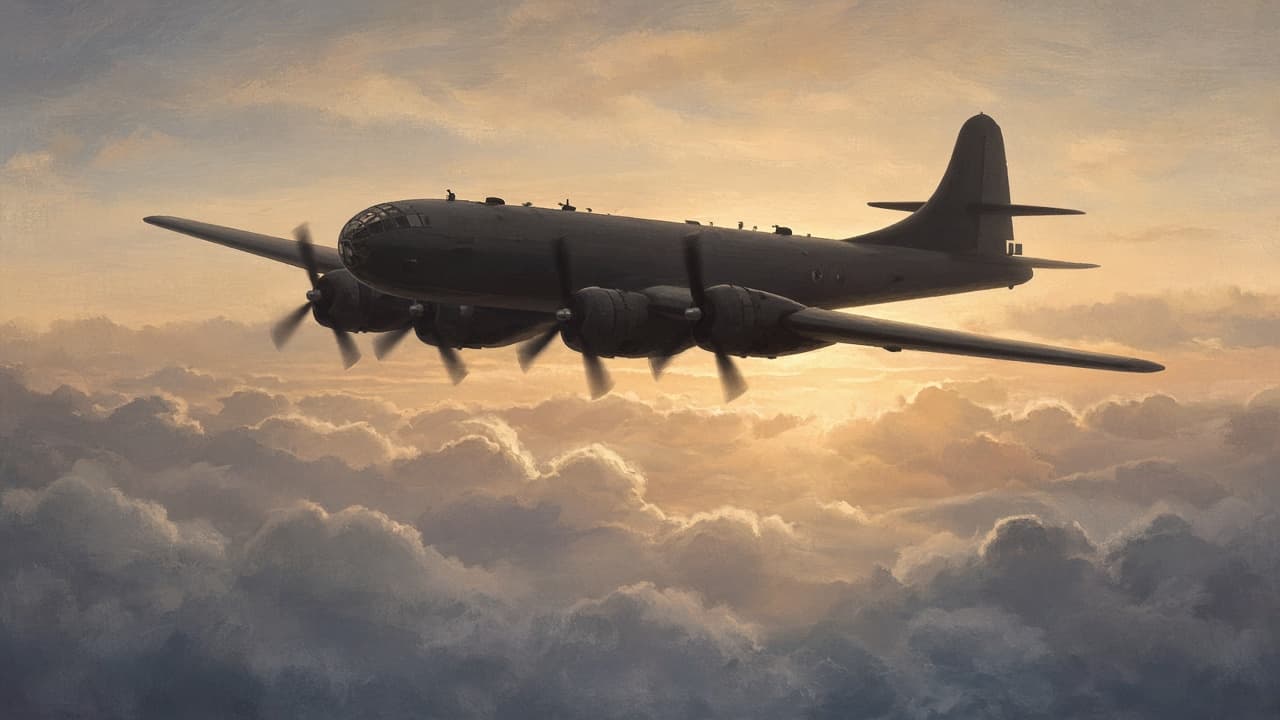
The aircraft that carried it was a modified B-29 Superfortress named Enola Gay after the mother of its pilot, Colonel Paul Tibbets, who commanded the 509th Composite Group. It lifted off from North Field on Tinian in the Mariana Islands at about 2:45 in the morning with a crew of twelve, and the weapon was armed in flight to reduce the risk of a crash on the runway destroying the island. Two observation aircraft flew with it. Weather planes ahead reported clear skies over the primary target, so Hiroshima was confirmed rather than Kokura or Nagasaki. Hiroshima had been largely spared conventional firebombing, it held the headquarters of the Second General Army and its terrain was flat, all of which had kept it on the target list.
On the ground the sequence was light, then pressure, then fire. The flash radiated temperatures at the hypocenter estimated at several thousand degrees Celsius, igniting clothing and charring exposed skin for more than a kilometre and leaving shadow marks where objects shielded stone. The blast wave followed, collapsing wood and plaster buildings across the flat delta and throwing debris through anyone in the open. Then fires merged into a firestorm that burned through the afternoon. A black, radioactive rain fell later in the day, and survivors drank it. Of an estimated 300 doctors in the city, most were dead or injured, and 42 of 45 hospitals were unusable. Help could not come from inside because the inside was gone.
The casualty figures have to be given as ranges because the records of a city burn with it. Most estimates put immediate and same-day deaths at 70,000 to 80,000, and deaths by the end of December 1945 at roughly 140,000, out of a population swelled by military personnel and Korean forced laborers. Thousands of those later deaths came from acute radiation syndrome, which was new to medicine. Survivors who appeared unhurt lost their hair, bled from the gums, developed fevers and died over days or weeks as radiation destroyed bone marrow and gut lining. Leukaemia rates rose sharply from the late 1940s, followed by solid cancers over decades. The long-running study of survivors, run today by the Radiation Effects Research Foundation, remains the basis for most human radiation risk estimates in use worldwide.
Survivors acquired a name and a status. Hibakusha, meaning people affected by the bomb, came to number hundreds of thousands across Hiroshima and Nagasaki, and they faced medical problems, discrimination in marriage and employment, and decades of argument over state support before Japan passed relief laws. Their testimony has done more than any policy paper to keep the human detail attached to the word nuclear. Sadako Sasaki was two years old in 1945, developed leukaemia at eleven and folded paper cranes in hospital until she died, and the Children's Peace Monument in Hiroshima is now surrounded year-round by cranes folded by schoolchildren from around the world.
The historical argument about the decision has never closed, and honest accounts hold several things at once. American planners expected an invasion of Kyushu and Honshu to be extremely costly for both sides, Japan's government had not accepted the Potsdam terms, and the Soviet Union declared war and invaded Manchuria on 8 and 9 August, which some historians consider at least as decisive as the bombs in forcing the surrender announced by Emperor Hirohito on 15 August. Critics then and since have argued that a demonstration, a clarified offer on the emperor's status or simply more time might have worked. What is not in dispute is that the two attacks killed mostly civilians and that no nuclear weapon has been used in war since.
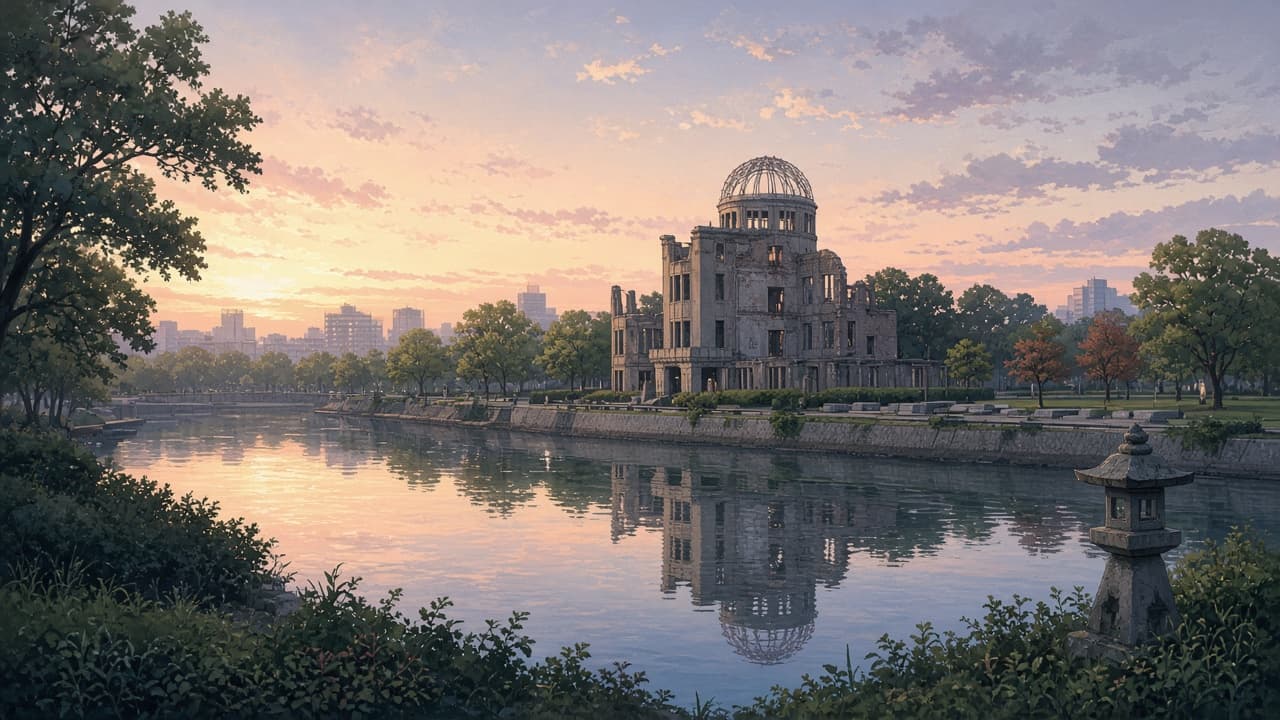
Hiroshima chose to make the ruin permanent rather than tidy it away. The skeletal dome of the old Prefectural Industrial Promotion Hall, one of the few structures near the hypocenter left standing, was preserved after long local debate and is now the Genbaku Dome, a UNESCO World Heritage site. Around it lies the Peace Memorial Park, with a cenotaph holding the register of the dead and a flame that is meant to burn until the last nuclear weapon is dismantled. Every 6 August at 8:15 the city holds a minute of silence. The mayor reads a peace declaration, and the register is updated with the names of hibakusha who died during the year.
Eagle Frame's takeaway: 6 August 1945 is worth understanding mechanically as well as morally. A gun barrel pushed two pieces of uranium together, a chain reaction ran for less than a millionth of a second, and a working city became a place people visit to count names. That distance between how simple the device was and how much it destroyed is the whole reason the date is still marked.