On this day: Japan formally surrenders aboard USS Missouri
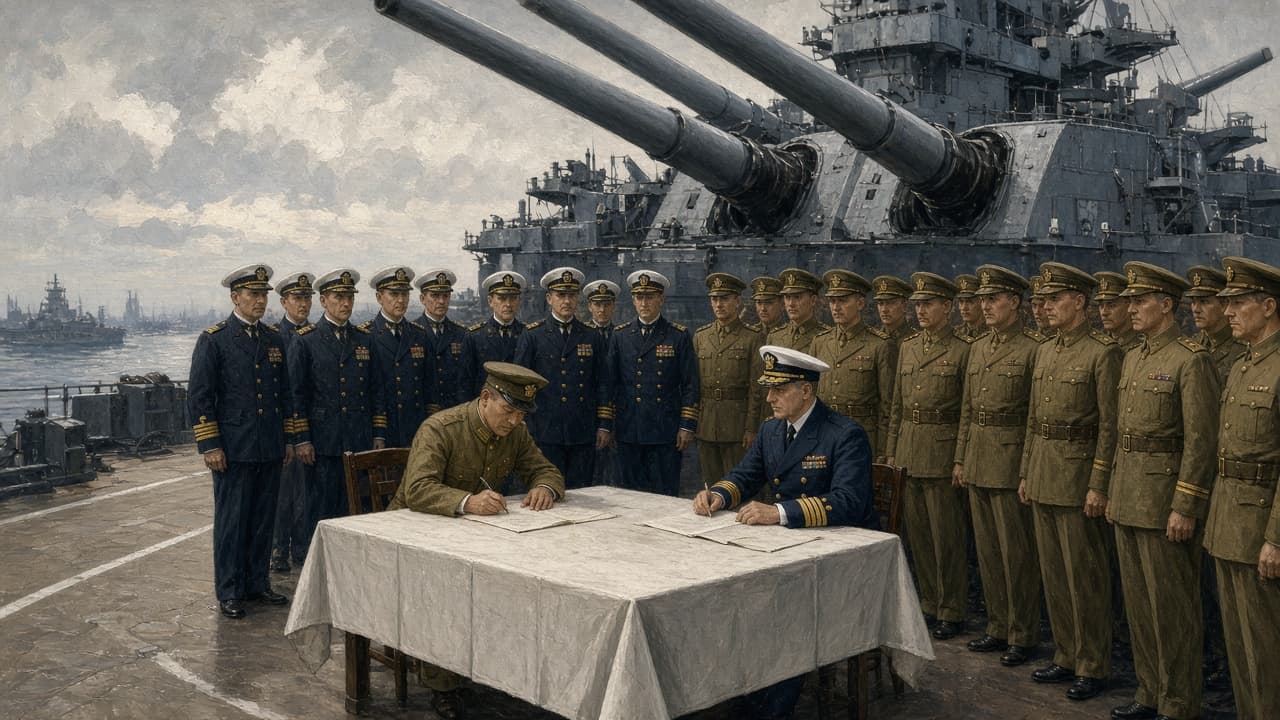
On 2 September 1945 in Tokyo Bay, Japanese representatives signed the Instrument of Surrender on the deck of USS Missouri. General Douglas MacArthur presided for the Allies, ending World War II in formal ceremony.
On 2 September 1945, Japanese officials signed the Instrument of Surrender on the teak deck of the American battleship USS Missouri in Tokyo Bay. Allied officers looked on. General Douglas MacArthur spoke as Supreme Commander for the Allied Powers. The ceremony lasted less than half an hour. It closed the most destructive war in human history with pens, microphones and a row of flags.
Japan's path to that deck had been brutal and short in calendar time after mid-1945. Germany had already surrendered in May. In the Pacific, Allied forces closed in on the home islands after island campaigns, firebombing of cities and a submarine blockade that strangled imports. On 6 and 9 August atomic bombs destroyed Hiroshima and Nagasaki. The Soviet Union declared war on Japan and invaded Manchuria. On 15 August Emperor Hirohito announced acceptance of Allied terms in a radio address. Fighting did not stop everywhere at once, but the political decision for surrender had been made.
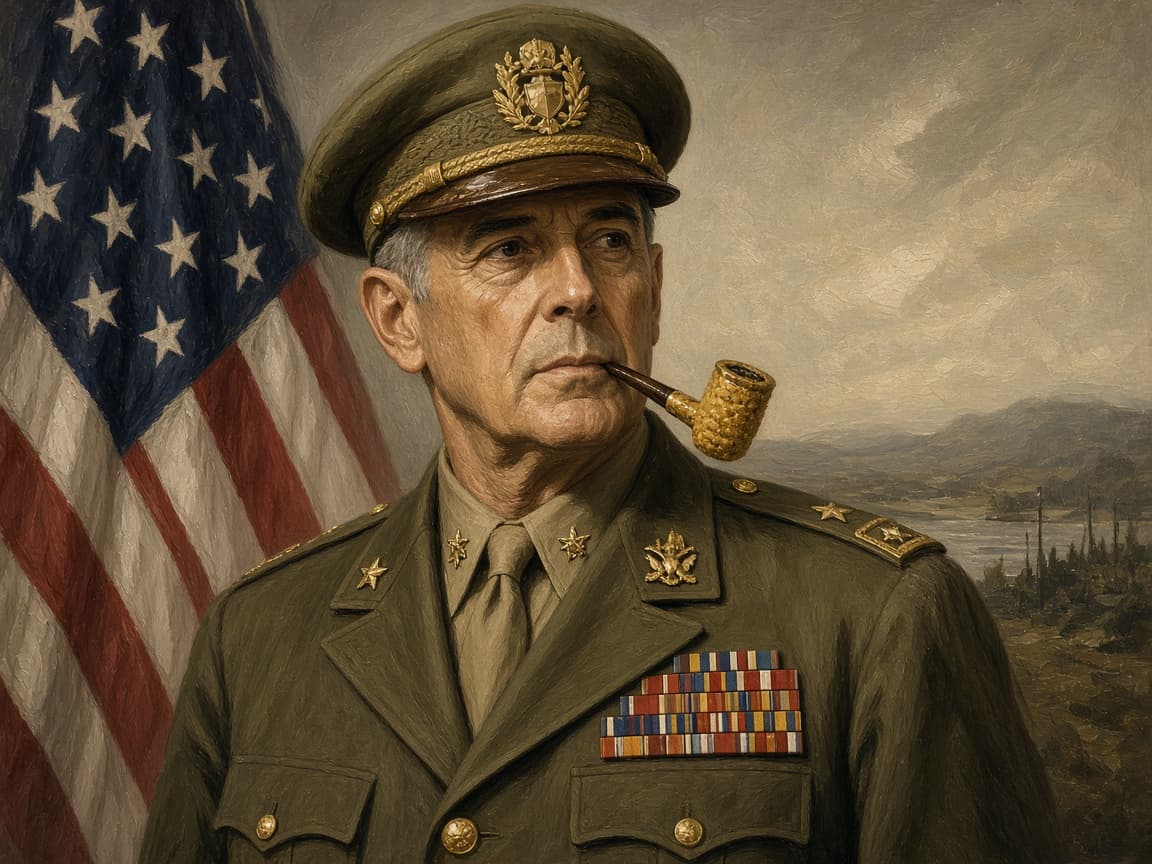
General Douglas MacArthur presided over Japan's formal surrender aboard USS Missouri in Tokyo Bay on 2 September 1945, speaking as Supreme Commander for the Allied Powers. His presence linked battlefield authority to occupation policy that would remake Japan's constitution and politics. The ceremony's choreography (Allied signatures, Japanese delegates, massed ships) was meant to be unmistakable closure after years of Pacific war. MacArthur's portrait anchors the American face of that moment. Delegates boarded Missouri under the eyes of sailors who had fought across the Pacific island chain.
Allied battleships and carriers anchored in Tokyo Bay advertised overwhelming sea power surrounding the surrender stage. Sailors lined rails. Cameras recorded every pen stroke for newsreels. The fleet backdrop told Japanese and world audiences that resistance was finished and occupation had arrived by water. Formality mattered: the 15 August acceptance had stopped the killing. The 2 September signing closed the legal war and opened the occupation chapter under those guns. Occupation directives drafted in advance began to roll out as soon as the signatures dried.
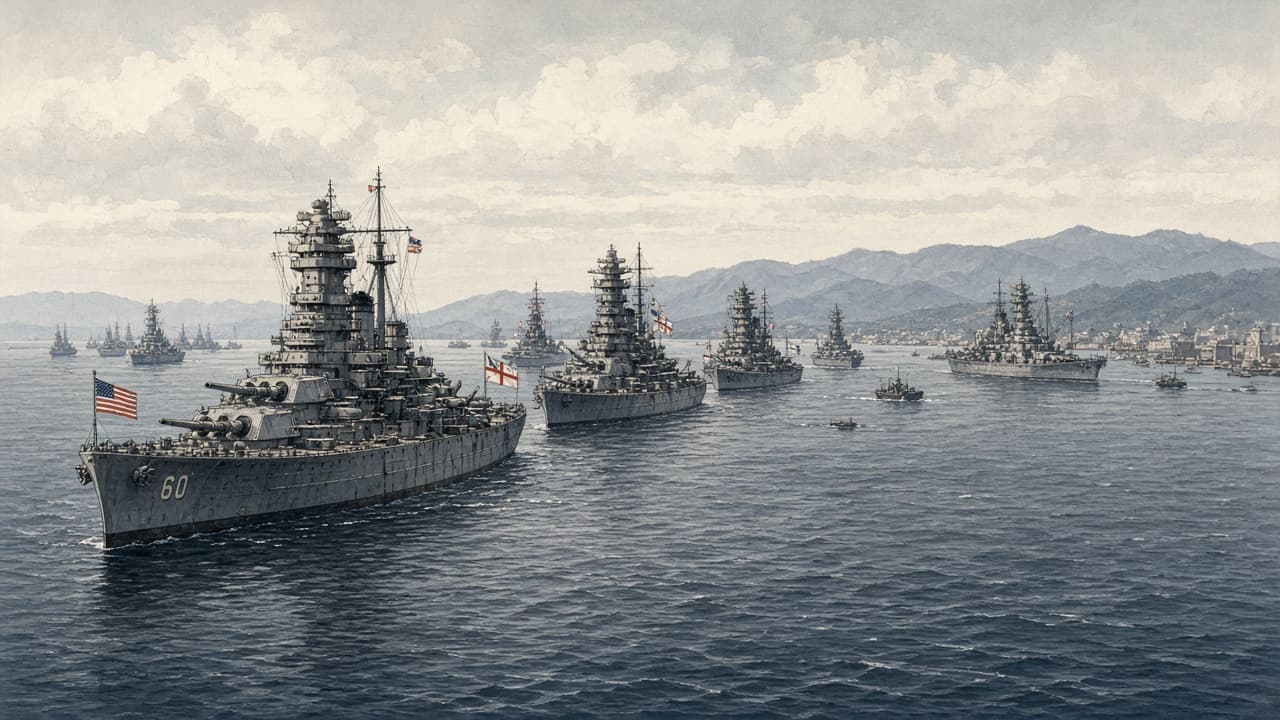
The Missouri ceremony made that decision international law in public view. Foreign Minister Mamoru Shigemitsu and General Yoshijiro Umezu signed for Japan. Representatives of the United States, China, the United Kingdom, the Soviet Union and other Allied nations signed in turn. MacArthur's short speech stressed justice, tolerance and rebuilding rather than revenge theater. Photographs of the table, the skyline of ships in the bay and the Japanese delegation in formal dress became the war's closing icon for millions.
Occupation began under MacArthur's authority. Japan would rewrite its constitution, demobilize, face war crimes trials and receive food and economic direction from the victors. The emperor remained as a symbolic figure under a new political order. For American sailors on the Missouri, the day felt like the end of a long voyage. For Chinese, Korean, Filipino and countless other victims of the Asia-Pacific war, it was one marker in a longer reckoning with loss and empire.
Why a battleship deck? Symbolism and logistics met. Missouri represented U.S. naval power that had crossed the Pacific. Tokyo Bay placed the ceremony inside Japan's maritime approaches without requiring a ruined city street as stage. Allied ships filled the anchorage. The world could broadcast a single, controlled image of ending. V-J Day naming can confuse readers because different countries mark the end on 15 August (the imperial broadcast) or 2 September (the formal signing). Both dates are historically real. One is political acceptance. The other is the legal instrument and Allied choreography. Eagle Frame treats 2 September as the formal close on the Missouri. The document itself committed Japan to surrender unconditionally under the Potsdam terms, to end hostilities and to accept occupation authority. It did not settle every postwar dispute in Asia. Civil war resumed in China. Korea was divided. Colonial empires cracked. The Missouri signing ended the global war between the major Allies and Japan. It did not freeze the region into peace.
MacArthur's later rule in Tokyo became its own contested chapter: land reform, women's suffrage in the new constitution, the pacifist Article 9 and a security relationship with the United States that still shapes East Asia. Those outcomes grew from the occupation that the surrender authorized. The deck ceremony was the hinge between total war and that new order.
Sailors crowded Missouri's rails and neighboring ships to watch history with binoculars. Newsreel cameras recorded every signature. The Japanese delegation boarded under tight protocol after traveling from Yokohama. Their presence on an American battleship in their home waters underlined how complete the defeat was without requiring a street-by-street conquest of Tokyo first.
Chinese representative General Hsu Yung-chang signed for China among the Allied group, a reminder that the Asia-Pacific war had never been only an American-Japanese duel. British, Soviet and other signatures widened the legal circle. The instrument bound Japan to the Allied coalition as a whole.
Food shortages, burned cities and repatriation of millions of soldiers defined daily life after the ceremony more than any single speech. MacArthur's headquarters in Tokyo soon issued directives that touched schools, unions, zaibatsu conglomerates and the press. The Missouri table authorized that administrative revolution.
Eagle Frame's takeaway: 2 September 1945 is the day Japan signed away the war on Missouri's deck under MacArthur's eye. Keep the August atomic bombings and Soviet entry that forced the choice in view. Remember why 15 August and 2 September both matter and read the occupation that followed as the surrender's long second act.