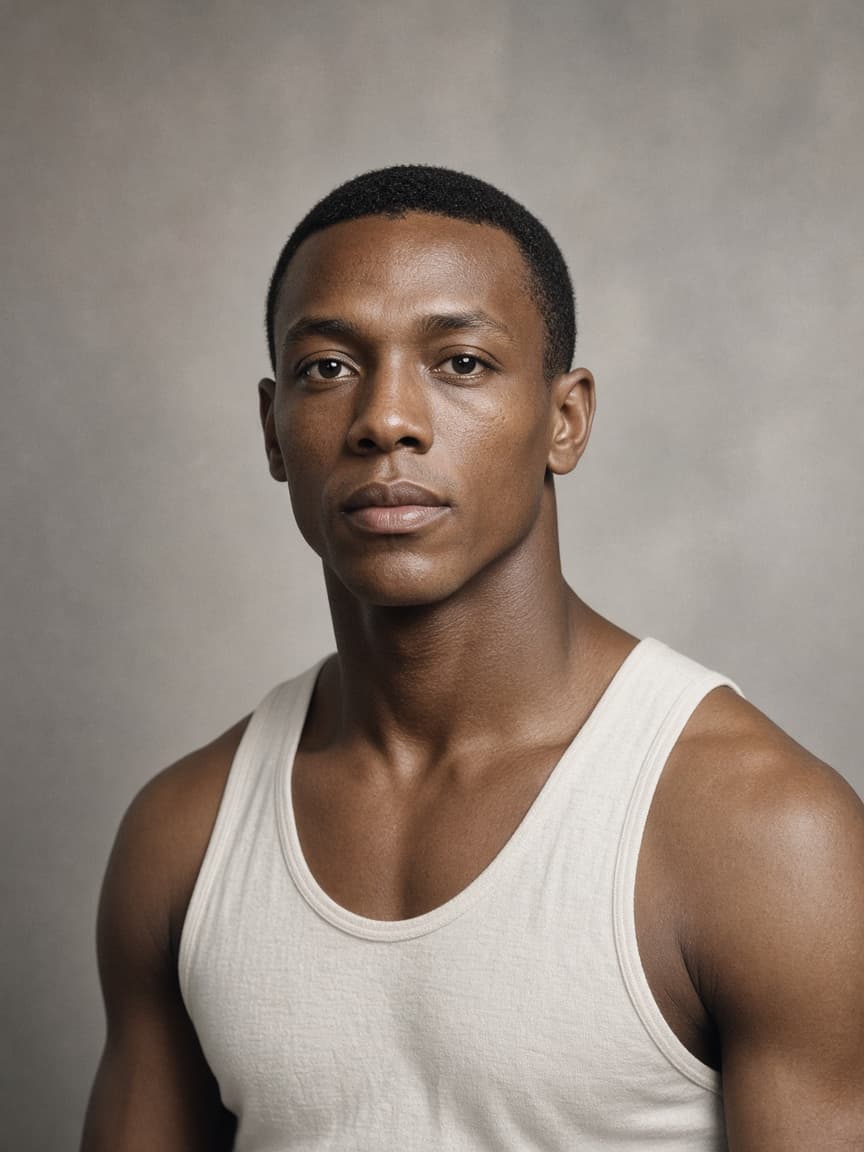
On this day: Jesse Owens wins the Olympic 100 meters in Berlin
On 3 August 1936, Jesse Owens won the Olympic 100 meters final in 10.3 seconds at the Berlin Games. It was the first of four gold medals he took in front of a Nazi government that had staged the event as racial propaganda.
On the afternoon of 3 August 1936, six men crouched into starting holes dug by hand in the cinder track of Berlin's Olympiastadion. Roughly a hundred thousand people were in the stands. Ten and three tenths of a second later, Jesse Owens of the United States was the Olympic champion at 100 meters, equalling the Olympic record. Ralph Metcalfe, also American, took silver in 10.4. Tinus Osendarp of the Netherlands took bronze in 10.5. It was the first of four gold medals Owens would win in a week, at a Games the German government had built as a showcase for its theories about race.
James Cleveland Owens was born in Oakville, Alabama, in September 1913, the youngest of ten children in a sharecropping family and the grandson of people who had been enslaved. When he was nine the family joined the Great Migration north to Cleveland, Ohio. A teacher there misheard the initials J.C. in his Alabama accent as Jesse, and the name stuck. He ran for Cleveland East Technical High School, then for Ohio State University, where he was not allowed to live on campus with white students and often ate and slept apart from his own team on road trips.
The performance that made him famous came before Berlin. At the Big Ten championships in Ann Arbor on 25 May 1935, competing with a back injury, Owens broke three world records and tied a fourth inside about forty-five minutes: the 100 yards, the long jump, the 220 yards and the 220-yard low hurdles. His long jump mark of 8.13 meters stood for twenty-five years. Track historians still call it the greatest single day any athlete has had in the sport.
The Berlin Games themselves were contested politics before anyone ran a heat. The International Olympic Committee had awarded the 1936 Games to Germany in 1931, before the Nazi party took power. Once Adolf Hitler became chancellor in 1933, campaigns in the United States, Britain and elsewhere pushed for a boycott over the treatment of Jewish athletes and citizens. The American Athletic Union vote to participate was close. Germany made cosmetic concessions, removed anti-Jewish signs from Berlin streets for the duration and spent heavily on the stadium, the torch relay and Leni Riefenstahl's filming, building a template for state propaganda through sport that later governments copied.
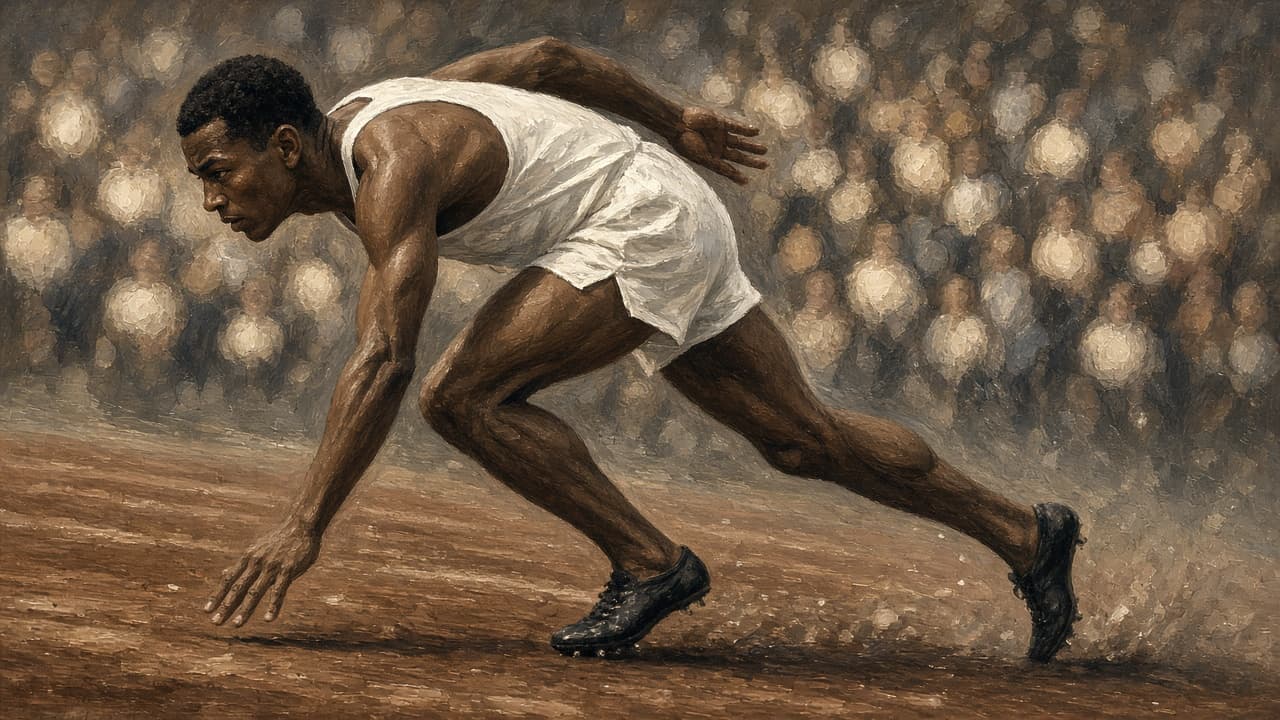
Owens ran on a surface nothing like a modern track. Cinder is loose and slow, and it absorbs energy with every stride. Sprinters carried a trowel to dig their own starting holes because starting blocks were not yet standard. Times from 1936 therefore cannot be compared directly with times run today on polyurethane. He had won his semi-final in 10.2, which would have been a world record, but the wind reading was over the legal limit so the mark was not ratified. In the final he simply repeated the performance inside the rules.
Three more golds followed. On 4 August he won the long jump at 8.06 meters, after fouling twice in qualifying. The German long jumper Luz Long, who took silver, talked with him between rounds and the two were photographed walking off the field arm in arm, a friendship Owens spoke about for the rest of his life. On 5 August he won the 200 meters in 20.7, an Olympic record. On 9 August he ran the first leg of the winning 4x100 meter relay, a place he was given after the only two Jewish athletes on the American track squad, Marty Glickman and Sam Stoller, were pulled from the team in a decision that has been argued about ever since.
The story that Hitler refused to shake Owens' hand deserves care. On the first day of competition Hitler congratulated some German winners in his box, and the IOC told him he must either receive every medallist or none. He chose none, which means no athlete of any nationality was greeted publicly after day one. Owens himself said repeatedly that Hitler had waved to him from the box and that he had not felt personally snubbed in Berlin. What stung came later. There was no White House invitation, no congratulatory telegram from President Franklin Roosevelt. Owens put it plainly: he had ridden at the front of the bus in Germany and came home to a country where he could not.
The homecoming was bleak in practical terms. Amateur rules of the era barred athletes from earning money from their sport, and when Owens took paid appearances the American Athletic Union suspended him. There were no sponsorship contracts for a Black sprinter in 1936. To pay bills he ran exhibition races against horses, motorcycles and baseball players, worked as a playground janitor, ran a dry-cleaning business that failed and later filed for bankruptcy. He eventually built a career as a public speaker and goodwill ambassador. President Gerald Ford awarded him the Presidential Medal of Freedom in 1976. He died of lung cancer in 1980 at sixty-six.
Why the 100 meters final still matters is not only that a Black American beat the field in a stadium decorated with swastikas. It is that the whole architecture of the event, the theory that some people were born superior and could prove it in front of cameras, was tested in public under measured conditions and failed inside eleven seconds. That is the rare case where sport actually settles an argument, because the clock does not care about ideology. The uncomfortable companion fact is that the country Owens represented was still segregated, and it stayed that way for decades after he stopped running.
Berlin also changed what the Olympics were for. The torch relay from Olympia, invented for these Games, is now treated as ancient tradition. Riefenstahl's film techniques shaped sports broadcasting. Every host government since has weighed the same trade that Germany made in 1936: spend enormous sums, invite the world and hope the cameras record the version of the country you built for them. Sometimes an athlete records something else instead.
Eagle Frame's takeaway: 3 August 1936 is the day a sharecropper's son from Alabama won the Olympic 100 meters on a cinder track in Berlin and began dismantling a racial theory in front of its authors. Know the 10.3, know the four golds and know that the applause in Germany did not follow him home to Ohio.