On this day: NASA announces Kepler-452b
On 23 July 2015, NASA announced Kepler-452b, a planet slightly larger than Earth orbiting a Sun-like star in the zone where liquid water could exist. The press called it Earth 2.0. Astronomers were more careful, and later work questioned whether it is confirmed at all.
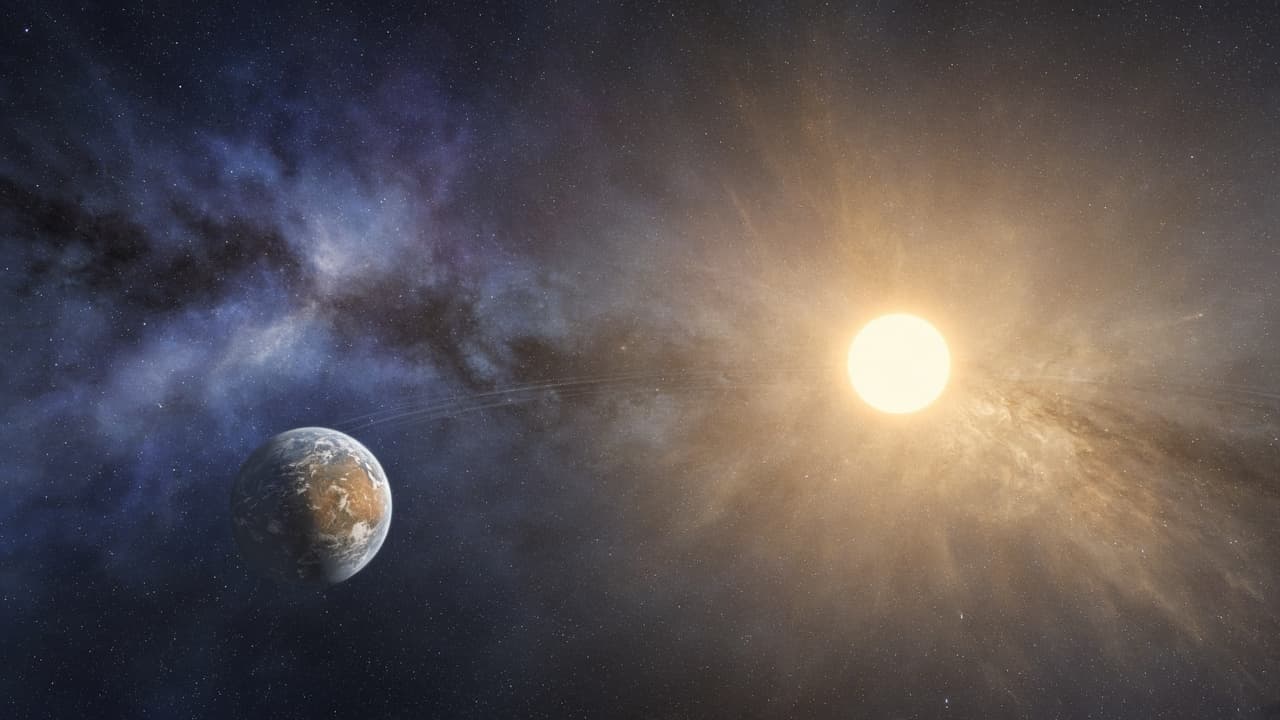
On 23 July 2015, NASA held a briefing to announce Kepler-452b, a planet found by the Kepler space telescope roughly 1,400 light years away in the constellation Cygnus. Two things about it were unusual together. It circles a star very similar to our Sun, and it does so at a distance where liquid water could exist on a solid surface. Its year is 385 days. Headlines went with Earth 2.0 and Earth's cousin. The science was more modest and more interesting.
Start with how a telescope in space finds a planet it cannot see. Kepler used the transit method. It stared at about 150,000 stars in one patch of sky continuously and measured their brightness. When a planet passes in front of its star from our viewing angle, the star dims very slightly. An Earth-sized planet crossing a Sun-sized star blocks roughly one part in ten thousand of the light, which is like noticing a flea crawling across a car headlight from several kilometres away.
The transit gives you two numbers directly. How often the dip repeats tells you the orbital period, and therefore the orbital distance. How deep the dip goes tells you the planet's size relative to the star. It does not tell you the mass, the composition, the atmosphere or the temperature. Everything beyond size and orbit is inference, and that gap between what is measured and what is reported is where most exoplanet headlines go wrong.
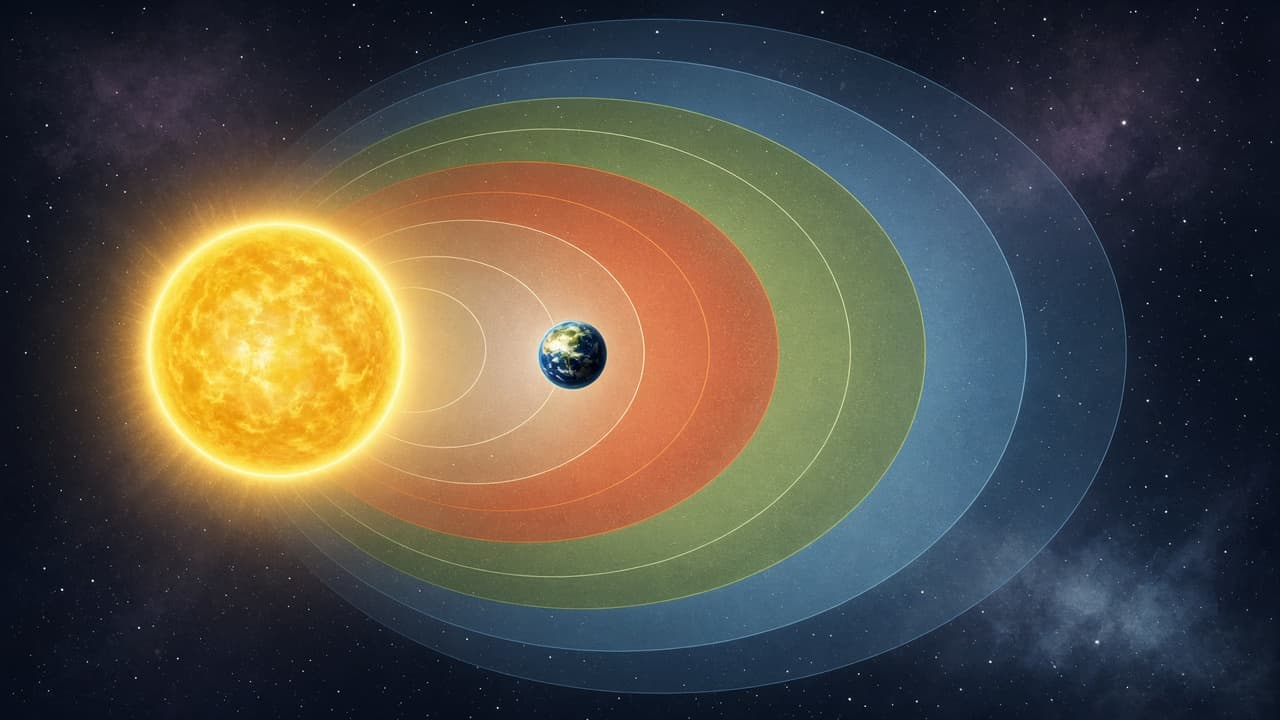
The habitable zone is a specific and limited idea. It is the band of orbital distances where a rocky planet with a modest atmosphere could hold liquid water on its surface: close enough that water does not freeze, far enough that it does not boil off. It is sometimes called the Goldilocks zone. It says nothing about whether a planet actually has water, an atmosphere, a magnetic field or life. Venus sits at the inner edge of the Sun's habitable zone and has a surface hot enough to melt lead.
What made Kepler-452b stand out was the star, not the planet. Most habitable-zone candidates found before it orbited red dwarfs, small cool stars where the habitable zone is very close in. Planets that close get tidally locked, with one face permanently toward the star, and they are exposed to violent flares. Kepler-452 is a G2 star, the same class as the Sun, about ten percent larger, twenty percent brighter and around six billion years old, which is roughly 1.5 billion years older than the Sun.
That age gives the planet a role as a preview. A star brightens slowly as it ages, which pushes the habitable zone outward. Kepler-452b has been in its star's habitable zone for perhaps six billion years and is now near the inner edge, receiving about ten percent more energy than Earth does. If it has water and an atmosphere, it may be entering a runaway greenhouse phase, which is what astronomers expect to happen to Earth in roughly a billion years.
The size is also a problem rather than a selling point. At about 1.6 times Earth's radius, Kepler-452b sits near a boundary called the radius valley. Below roughly 1.5 Earth radii, planets tend to be rocky. Above about 1.6, they tend to have retained thick hydrogen and helium envelopes and are better described as mini-Neptunes. Without a mass measurement, nobody can say which side of that divide this planet falls on. Statistical modelling at the time suggested a rocky composition was more likely than not, which is a long way from established.
Then the claim got weaker. Kepler-452b was announced as a confirmed planet, validated statistically because no plausible false-positive scenario could be found. In 2018, a reanalysis by researchers using improved treatment of instrument noise concluded that the signal did not meet the threshold for confirmation and reclassified it as a candidate. At 1,400 light years the star is too faint for the radial velocity follow-up that would settle the question by measuring the star's wobble.
None of that diminishes what Kepler achieved. Launched in 2009 and operating until 2018, the mission confirmed more than 2,600 planets and transformed the field from a handful of oddities into a statistical science. Its central finding is that planets are common: most stars have at least one, and small rocky planets are more abundant than giants. Estimates derived from Kepler data suggest billions of Earth-sized planets in habitable zones in our galaxy alone.
The work has moved on to better targets. TRAPPIST-1, announced in 2017, has seven Earth-sized planets around a star only 40 light years away. TESS, launched in 2018, surveys bright nearby stars precisely because they can be followed up. The James Webb Space Telescope can now analyse starlight filtered through a planet's atmosphere during transit and identify gases in it, which is the step that turns a dot in a brightness curve into a world with chemistry.
Eagle Frame's takeaway: 23 July 2015 is the day NASA presented the closest match yet to an Earth-and-Sun pairing, and the day a careful announcement became Earth 2.0 in print. The measured facts are a 385-day orbit, a radius about 1.6 times Earth's and a Sun-like host. Everything else, including whether the planet is rocky and whether it is confirmed, is still open.