On this day: Nixon and Khrushchev hold the Kitchen Debate
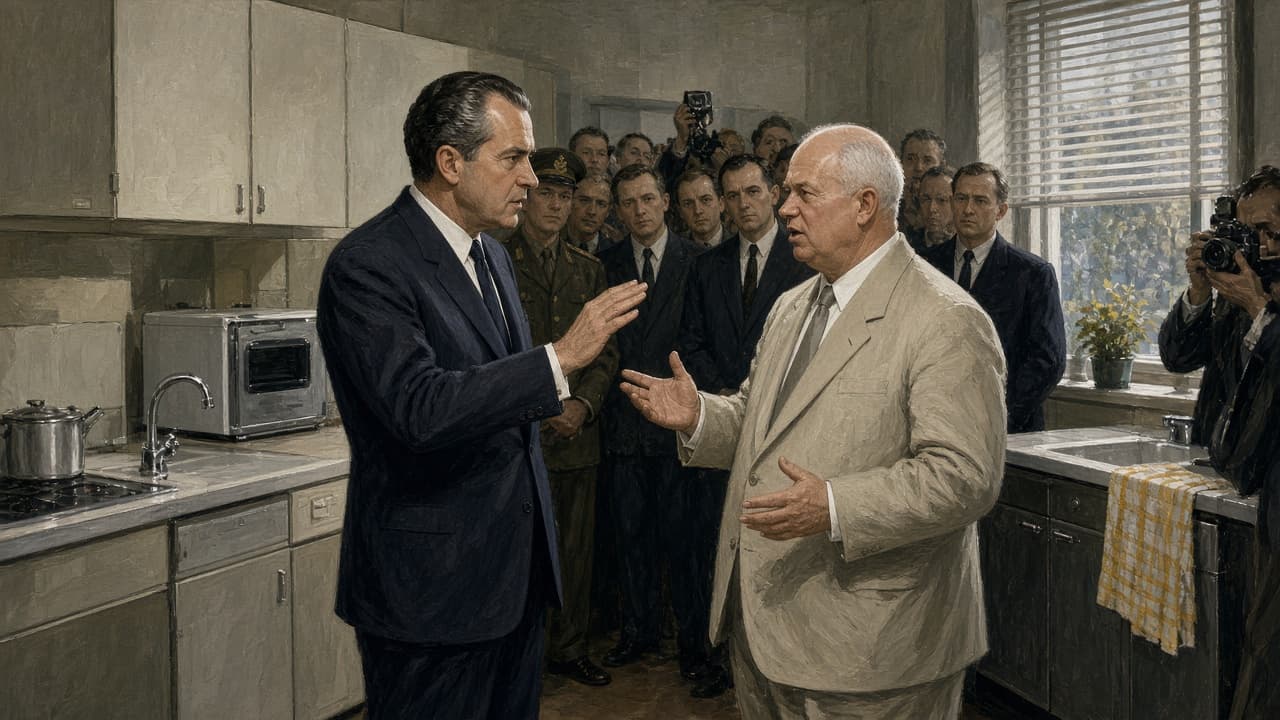
On 24 July 1959, Richard Nixon and Nikita Khrushchev argued about capitalism and communism beside a model American kitchen in Moscow. The Cold War contest over living standards had found its stage.
On 24 July 1959, in Sokolniki Park in Moscow, the vice president of the United States and the leader of the Soviet Union stood in front of a yellow model kitchen and argued about which system fed and housed its people better. Richard Nixon was 46 and had come to open the American National Exhibition. Nikita Khrushchev was 65 and had come to inspect it. Neither had planned a debate. Cameras and reporters followed them from display to display, the exchanges grew sharper, and the encounter has been known ever since as the Kitchen Debate.
The exhibition existed because of a swap. A 1958 cultural agreement between Washington and Moscow allowed each country to mount a show in the other, and a Soviet exhibition had already run in New York that summer. The timing was tense. The Soviet Union had launched Sputnik in October 1957 and put the first satellite over American heads. Khrushchev had issued an ultimatum on Berlin in November 1958 demanding Western troops leave the city. Both governments were building missiles. Both were also making a quieter argument that ordinary people found easier to judge, about who could deliver a better daily life.
The centrepiece was a house. Builders had shipped over a six-room ranch home and cut it down the middle so crowds could walk past and see into every room, which prompted Soviet journalists to nickname it Splitnik. American guides said it cost about 14,000 dollars and that a steelworker could buy it with a mortgage of roughly 100 dollars a month over 25 years. Khrushchev rejected the claim flatly. He said Soviet citizens had a right to housing rather than a debt, and that American houses were built to last 20 years so that builders could sell replacements.
In the kitchen the argument turned to appliances. There was a dishwasher, a washing machine, a built-in oven and a food mixer, and Khrushchev asked whether the Americans also had a machine that put food in your mouth and pushed it down. He said Soviet factories would build the same things and better, that the Soviet Union would catch up and then wave goodbye as it passed. Nixon pressed the point that the variety itself was the argument, that a thousand builders competing produced choices no ministry could plan. Then came the line that made the meeting famous. Both men agreed it was better to compete over washing machines than over rockets, although Khrushchev also mentioned his rockets more than once.
The medium was part of the message. The confrontation was recorded in colour on Ampex videotape at an RCA studio inside the exhibition, technology so new that the recording itself was one of the exhibits. Khrushchev noticed and turned it into a demand, insisting his words be broadcast in the United States without cuts. Nixon agreed and asked for the same treatment in the Soviet Union. The tape aired in America on 25 July and in the Soviet Union on 27 July, late at night, with a translation that critics said trimmed the sharpest American points.
The rest of the exhibition made the same case in different ways. An IBM RAMAC computer answered visitors' typed questions about life in America. Donald Kendall of Pepsi-Cola arranged for Khrushchev to be handed a paper cup of Pepsi in front of photographers, a stunt that helped Kendall become chief executive and eventually put Pepsi into Soviet shops. There were cars, cosmetics counters, supermarket shelves and a modern art display including Jackson Pollock that several members of Congress complained about before the show even opened. Around 2.7 million Soviet visitors passed through over six weeks. Guides who spoke Russian fielded questions for hours, and many visitors asked whether the goods were real or staged for foreigners.
At home Nixon got exactly what a politician wants from a foreign trip. Americans saw their vice president standing in Moscow telling the Soviet leader he was wrong, and the photograph of the finger near Khrushchev's chest travelled further than any of the words. It strengthened his claim to the Republican nomination in 1960, which he won before losing narrowly to John F. Kennedy. Khrushchev had his own audience. Standing up to an American in front of Soviet cameras suited a leader whose position depended on looking both confident and modern.
The thaw the meeting seemed to promise lasted about nine months. Khrushchev toured the United States that September, visited an Iowa corn farm, held talks with Dwight Eisenhower at Camp David and was refused a trip to Disneyland on security grounds, which annoyed him publicly. A Paris summit was scheduled for May 1960. It collapsed after a Soviet missile shot down an American U-2 spy plane over Sverdlovsk on 1 May and the pilot Francis Gary Powers was captured. The Berlin Wall went up in 1961 and the Cuban missile crisis followed in 1962.
The kitchen argument still gets quoted because it captured a real shift. For most of the Cold War the two systems were compared through weapons, but the competition that eventually decided public opinion inside the Soviet bloc was about consumer goods, housing and the queue at the shop. Khrushchev promised in 1961 that the Soviet Union would out-produce the United States within 20 years. It did not, and the gap between the promise and the shelf became one of the standing complaints that eroded the system from within.
Eagle Frame's takeaway: 24 July 1959 looks like a photo opportunity and reads better as a forecast. Two rivals stood beside a dishwasher and agreed that living standards were the real contest, and that turned out to be the argument the Soviet Union lost.