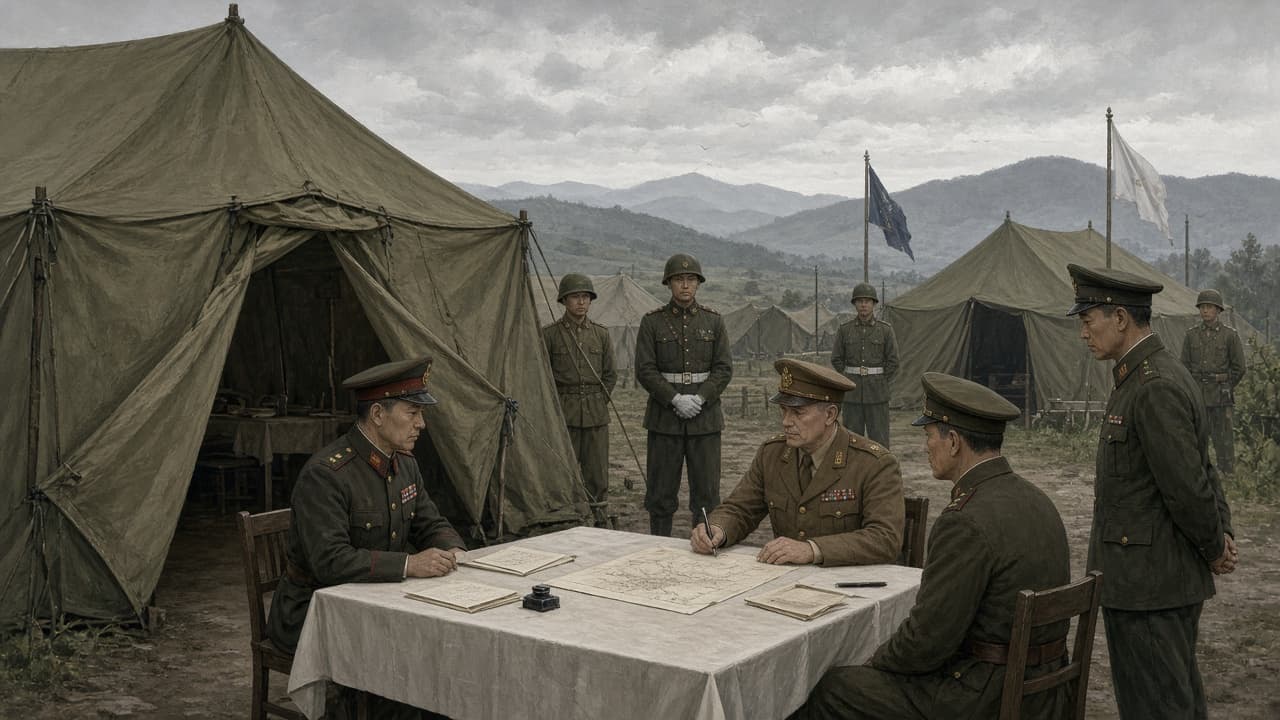
On this day: the Korean War armistice is signed
On 27 July 1953, commanders signed an armistice at Panmunjom that stopped the fighting in Korea after three years. It was a ceasefire, not a peace treaty. The Demilitarized Zone it created still divides the peninsula.
At ten in the morning on 27 July 1953, in a hall built for the occasion at Panmunjom, Lieutenant General William K. Harrison Jr. signed for the United Nations Command and General Nam Il signed for the Korean People's Army and the Chinese People's Volunteers. There were no handshakes and no speeches. The two men signed, stood and left by separate doors. Twelve hours later, at 22:00, the guns were supposed to stop along the entire front. Mostly they did.
The document they signed is an armistice, which is an agreement to suspend fighting. It is not a peace treaty. No treaty has ever been signed. In strict legal terms the Korean War has never been formally ended, which is why the phrase "technically still at war" keeps appearing in news coverage more than seventy years later. South Korea's president, Syngman Rhee, refused to sign at all because he opposed accepting a divided peninsula, though his government agreed not to obstruct the terms.
The war had started on 25 June 1950 when North Korean forces crossed the 38th parallel, the line the United States and the Soviet Union had drawn in 1945 to divide the surrender of Japanese forces. That line was meant to be administrative. It hardened into two states in 1948: the Republic of Korea in the south and the Democratic People's Republic of Korea in the north, each claiming the whole peninsula. The invasion was the attempt to settle that claim by force.
The first year of the war swung wildly. North Korean forces drove south until United Nations troops held only the Pusan perimeter. General Douglas MacArthur's amphibious landing at Incheon in September 1950 reversed the map and UN forces pushed almost to the Chinese border. China then entered in force in late 1950 and drove them back below Seoul, which changed hands four times in all. By mid-1951 the front had stabilized close to where it started, roughly along the middle of the peninsula.
Armistice talks opened in July 1951 and then dragged for two full years while men kept dying on hills with numbers for names. The sticking point was not territory. It was prisoners of war. Thousands of Chinese and North Korean prisoners did not want to be repatriated. The communist side insisted on the automatic return of all prisoners under the Geneva Conventions. The UN Command insisted on voluntary repatriation. That single disagreement cost roughly two more years of fighting.
The compromise was a neutral commission. Prisoners who refused repatriation were handed to a body chaired by India, given a period for interviews from their own side and then released to the destination they chose. About 22,000 Chinese and North Korean prisoners declined to go home; a much smaller number of South Korean and UN prisoners, including 21 Americans and one Briton, chose to stay with the communist side. Talks also sped up after Stalin died in March 1953, which loosened Soviet backing for holding out.
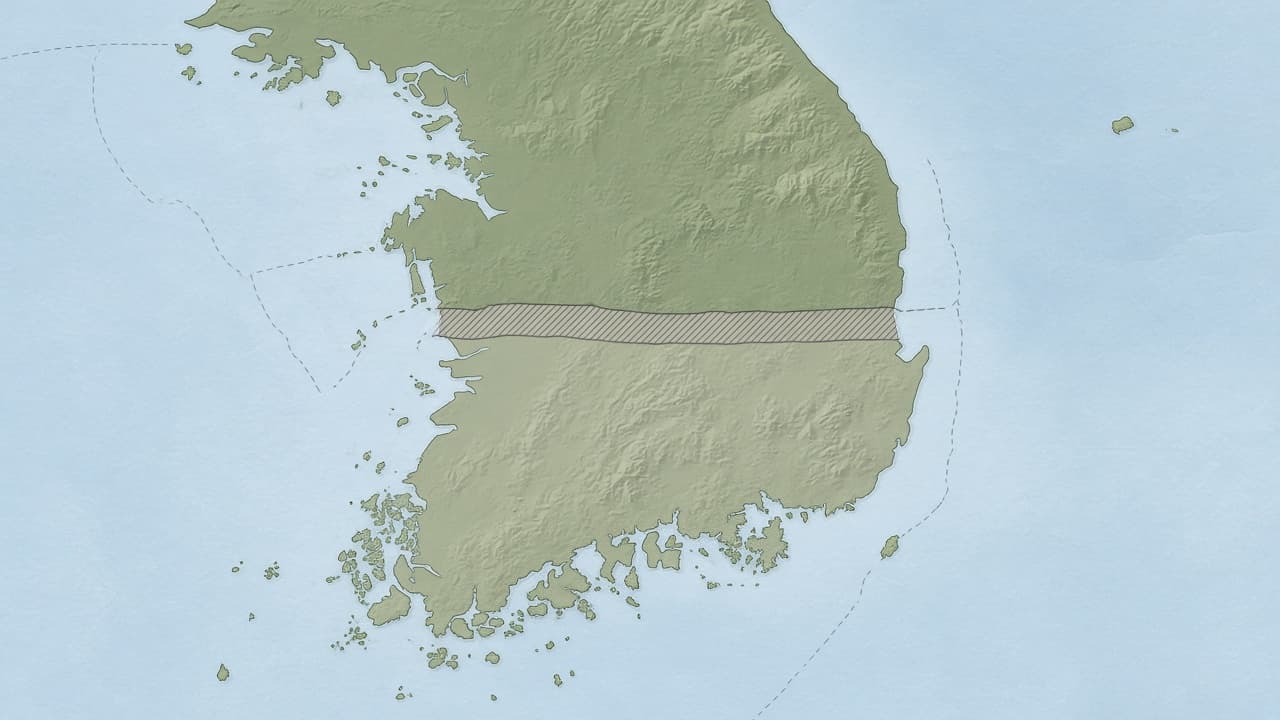
The armistice drew a Military Demarcation Line along the front as it stood and pulled both armies back two kilometres from it. That buffer is the Demilitarized Zone: about four kilometres wide, roughly 250 kilometres long, cutting diagonally across the peninsula from the Han River estuary to the east coast. The name is misleading. The DMZ itself is lightly manned under the agreement, but the land immediately behind it on both sides is among the most heavily fortified ground on Earth.
The human cost is hard to state precisely and every figure carries a range. Estimates for total deaths run to roughly three million, the majority Korean civilians. American military deaths are recorded at about 36,500. Chinese losses are usually put in the hundreds of thousands. Seoul and Pyongyang were both largely destroyed. Around ten million Koreans were separated from family members, and reunion meetings arranged in later decades have only ever reached a small fraction of them, most of them now elderly or dead.
The armistice created machinery that still operates. The Military Armistice Commission and the Neutral Nations Supervisory Commission were set up to handle violations. The Joint Security Area at Panmunjom became the one place where the two sides meet face to face, and it has hosted family reunion talks, defections and, in 1976, a fatal axe attack on American officers during a tree-trimming dispute. Incidents along the line have recurred for decades without either side restarting general war.
Everything about modern Korea flows from that line. South Korea went from one of the poorest countries in the world to a top-tier industrial democracy, though it spent decades under military rule first. North Korea built a closed state around dynastic rule and, from the 2000s, nuclear weapons. Around 28,500 American troops remain in South Korea. Talk of converting the armistice into a peace agreement has surfaced repeatedly, most visibly in the 2018 inter-Korean and 2018-2019 United States talks, without result.
Eagle Frame's takeaway: 27 July 1953 stopped the shooting in Korea and settled nothing else. The line the two armies happened to hold that summer became a border, a fortified zone and a permanent condition. When you read about the DMZ or about the war being unfinished, this is the document behind it: an armistice that has outlasted almost everyone who signed it.