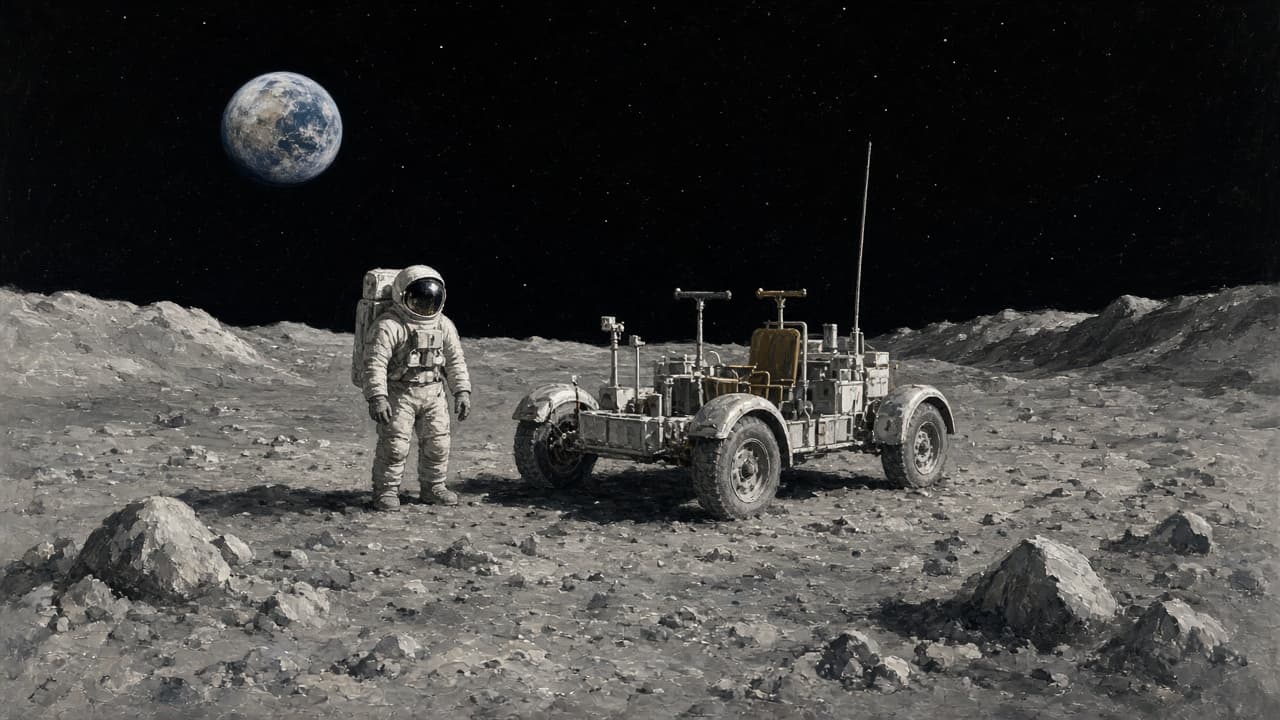
On this day: astronauts drive the first lunar rover
On 31 July 1971, David Scott and James Irwin unfolded a battery-powered car on the Moon and drove away from their lander. The lunar roving vehicle turned each remaining Apollo landing from a walk into a field expedition.
Apollo 15 touched down at the foot of the Apennine mountains late on 30 July 1971. The next morning, 31 July, David Scott and James Irwin pulled a pair of lanyards on the side of their lander, watched a folded aluminium frame swing out and drop onto the dust, locked its wheels into place and sat down in it. A few minutes later they drove away. No human being had ever operated a vehicle on another world. Over the next three days the two men covered about 27.8 kilometres in that machine, roughly the distance from central London to Heathrow and back, and brought home samples from places no walking crew could have reached.
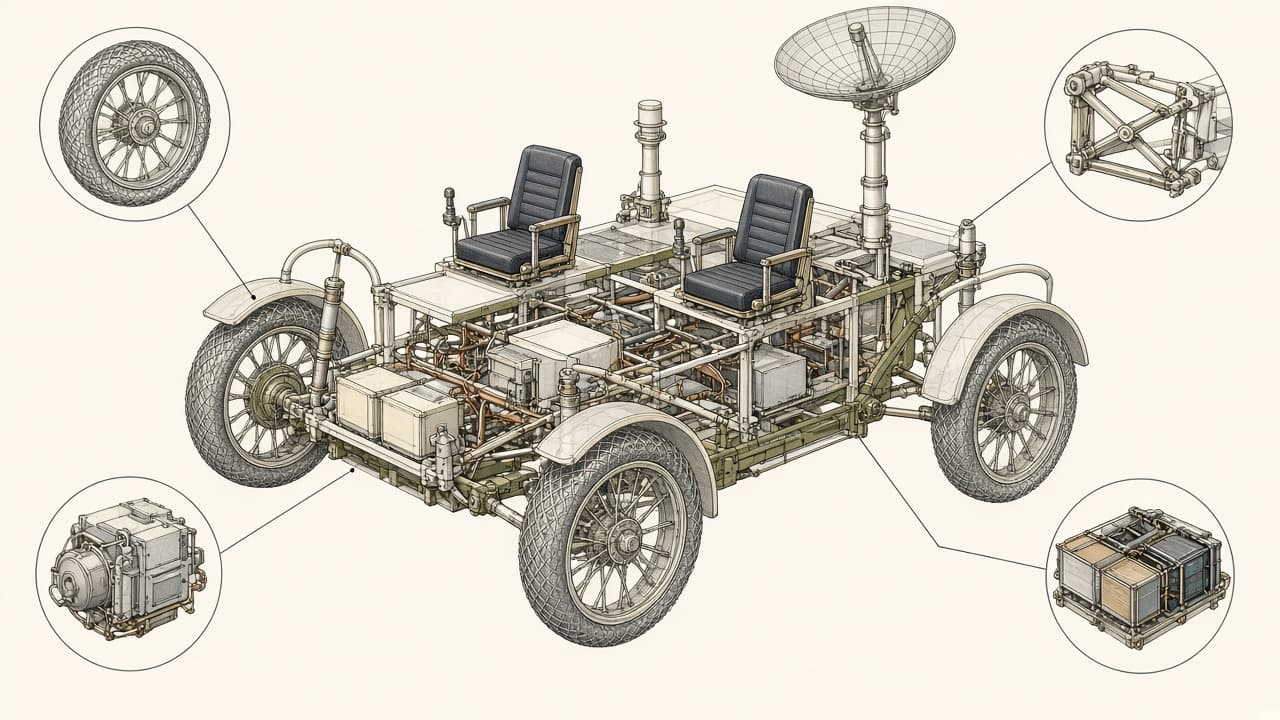
It helps to be clear about what the lunar roving vehicle actually was, because it was not a scaled-down car. It weighed about 210 kilograms empty on Earth and could carry roughly 490 kilograms of astronauts, tools, cameras and rock boxes, more than twice its own mass. It had no engine in the normal sense and no fuel tank. Instead each of its four wheels held its own small electric motor, rated at about a quarter of a horsepower, spinning at around 10,000 revolutions per minute and geared down eighty to one so the wheel itself turned slowly with a lot of force. Power came from two non-rechargeable silver-zinc batteries of 36 volts each. There was no battery charging on the Moon. Whatever the rover left with was all it would ever have.
The wheels were the hardest part to solve. Rubber tyres would have frozen brittle in shadow and cooked in sunlight, and the Moon has no air to inflate them with. Engineers instead wove each 82-centimetre wheel out of zinc-coated piano wire in an open mesh, then riveted titanium chevrons across half the surface for grip. The mesh flexed over rocks like a tyre, let dust fall straight through and could not be punctured. Steering used separate motors at the front and the back, so the rover could crab around obstacles with a very tight turning circle. Crucially, each end steered independently, which meant a failure at one end still left a driveable vehicle. Scott and Irwin needed that redundancy on the first day.
Navigation mattered more than speed. The Moon has no magnetic field a compass can use, no roads and no landmarks a first-time visitor can trust, and distances are badly misjudged because there is no haze to soften far objects. So the rover carried a dead reckoning system: a gyroscope held a fixed reference direction, odometers counted the turns of each wheel and a small processing box added the two together to display the straight-line bearing and distance back to the lander at all times. That readout was a survival instrument. Mission rules set a walkback limit, meaning the crew could never drive further from the lander than they could walk in the oxygen and cooling water left in their backpacks if the rover died. Knowing the exact range home is what allowed controllers to let them go anywhere at all.
Getting it there took its own engineering. The rover folded like a deckchair into a wedge-shaped bay in the side of the lander's descent stage, a space about 1.5 metres across. Boeing won the contract in October 1969 and delivered the first flight unit in March 1971, a build of roughly seventeen months for a vehicle that could not be repaired or recalled. General Motors' Delco division designed the wheels and drive train, with Hungarian-born engineer Ferenc Pavlics behind the mesh wheel. The programme ran heavily over its original estimate and finished at about 38 million dollars for the flight and test units. Measured against what it returned, that is one of the better bargains in the history of the space programme.
The first drive did not go perfectly. Scott reported that the front steering would not respond, so he drove the opening excursion on rear steering alone, which made the rover wander and forced him to work the T-shaped hand controller between the seats constantly. The front steering came back the next day after a power cycle and was never explained. They headed south along the edge of Hadley Rille, a sinuous canyon about 1.5 kilometres wide and 300 metres deep that was almost certainly a collapsed lava channel, and stopped at Elbow crater to collect. Riding was rough. At eight to eleven kilometres per hour on one-sixth gravity the rover pitched and floated, and both wheels on one side sometimes left the ground at once.
The science justified everything. Because the rover let them reach the mountain front and the rille edge on separate days, Apollo 15 returned 77 kilograms of samples from genuinely different geological settings. On the second excursion, at Spur crater, Scott and Irwin picked up a pale fragment of anorthosite later catalogued as sample 15415 and nicknamed the Genesis Rock, a piece of the Moon's original crust dated to roughly four billion years. Apollo 16 and Apollo 17 carried rovers of their own and pushed the totals further, to 26.7 and 35.7 kilometres driven, with Apollo 17's Gene Cernan and Harrison Schmitt working up to 7.6 kilometres from their lander. John Young recorded the unofficial lunar speed record of about 17 kilometres per hour on a downslope.
One underrated feature was the camera. From Apollo 15 the rover carried a colour television camera on a motorised mount that flight controllers in Houston could aim themselves, with a signal relayed straight to Earth through the umbrella-shaped high-gain antenna. That is why the later missions produced footage of astronauts working in the middle distance rather than a fixed view of a lander leg, and why, in December 1972, controllers were able to tilt the camera up and film the ascent stage of Apollo 17 lifting off the Moon. Nobody was left on the surface to hold it. The rover did the filming and then sat still.
All three rovers are still parked where their crews left them, along with the tracks, which have no weather to erase them. Their descendants went robotic. Soviet Lunokhod machines had already been remotely driven on the Moon from 1970, and the wheeled Mars rovers from Sojourner in 1997 through Curiosity and Perseverance inherited the same basic problem set of traction, dust, power and navigation without a compass. NASA is now contracting a new crewed lunar terrain vehicle for the Artemis landings, and the requirements documents read remarkably like the 1969 ones: fold it small, make it light, make it repairable by two people in stiff gloves and never let the crew get further out than they can walk back.
Eagle Frame's takeaway: 31 July 1971 is the day exploration of another world stopped being limited by how far a person could walk in a pressure suit. The rover was a modest machine by any Earth standard, slower than a bicycle and powered by batteries it could not recharge, and it roughly quintupled how much of the Moon a crew could study before the oxygen ran out.