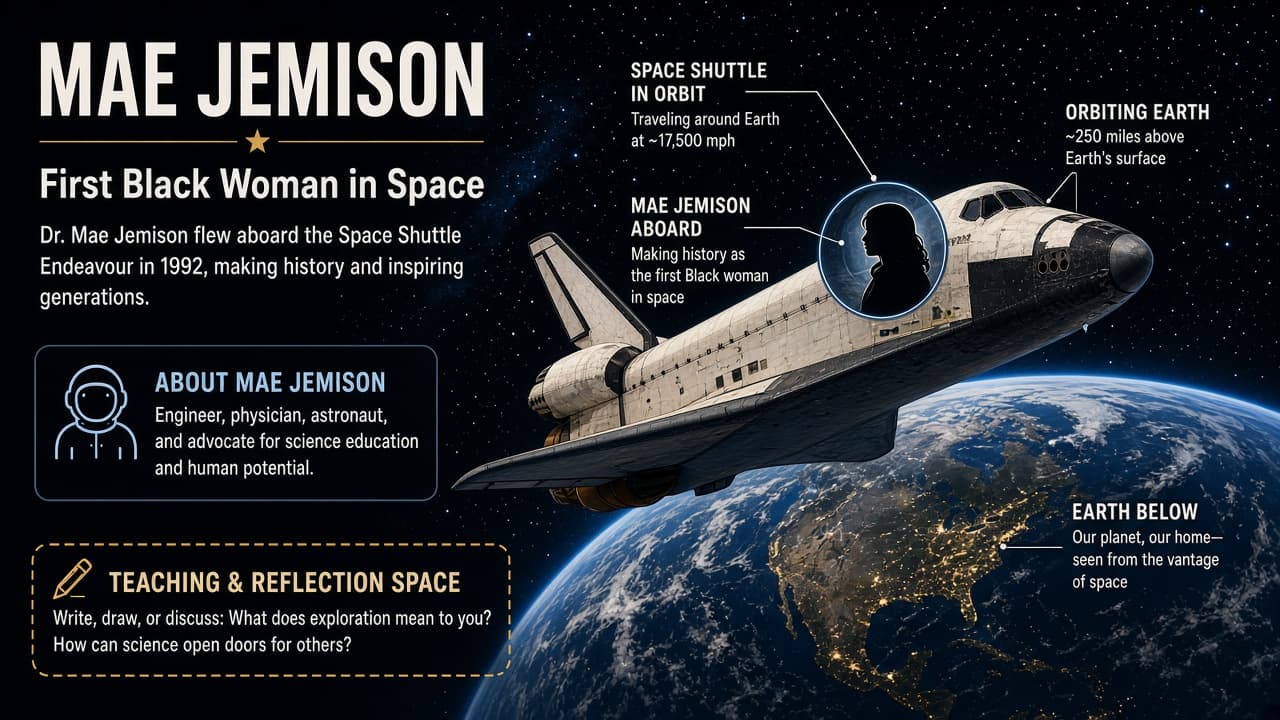
On this day: Mae Jemison becomes the first Black woman in space
On 12 September 1992, physician-astronaut Mae Jemison launched on Endeavour’s STS-47 Spacelab-J mission. Here is what the flight was and how a shuttle crew works.
On 12 September 1992, Space Shuttle Endeavour lifted off from Kennedy Space Center on mission STS-47. Among the seven-person crew was Dr. Mae C. Jemison, a physician and mission specialist. She became the first Black woman to fly in space. The flight lasted nearly eight days, completed more than 120 orbits and carried Spacelab-J, a pressurized laboratory in the shuttle’s cargo bay.
If the anniversary headline is all you know, start with the machine. A Space Shuttle orbiter is a reusable spacecraft that launches like a rocket, works in low Earth orbit and lands on a runway. The crew lives in the forward cabin. Behind them, a large payload bay can carry satellites, experiments or a Spacelab module—an enclosed lab with racks, power and room for researchers to work in shirtsleeves while circling Earth.
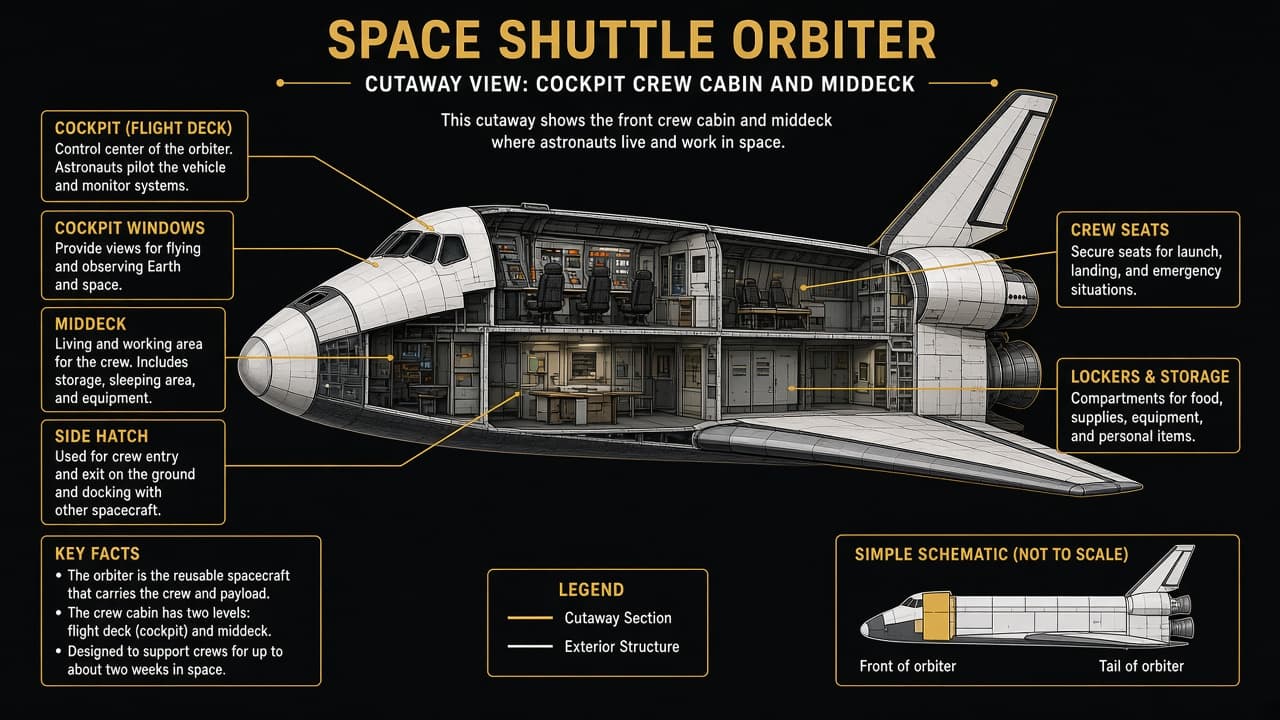
STS-47 was a joint NASA and Japanese NASDA mission. The crew ran materials-science and life-science experiments around the clock on red and blue shifts. Jemison’s role as science mission specialist meant overseeing and taking part in that research: motion sickness and feedback training, fluid therapy tests and bone-cell work among them. The lab also included biology studies with frogs, fish and other organisms to see how development and physiology change when gravity almost disappears.
Jemison’s path mattered as much as the mission patch. Born in 1956, she trained as a chemical engineer and physician, served in the Peace Corps and entered NASA astronaut training in 1987 from a large applicant pool. On the flight she carried personal symbols including an Alpha Kappa Alpha banner and an Organization of African Unity flag. Representation was not a side note. It was part of what the day changed for students who had never seen someone like her on a crew roster.
The mission also flew Mamoru Mohri, the first Japanese astronaut on the shuttle, and Mark Lee and Jan Davis, then the first married couple cleared to fly together after a policy change. International labs, shared shifts and mixed expertise were the working model: science first, national firsts recorded beside the data.
Jemison left NASA in 1993 and later founded technology and education ventures aimed at STEM access. The anniversary is not only a milestone plaque. It is a reminder that human spaceflight is both engineering and who gets invited into the cabin.
Eagle Frame’s takeaway: on 12 September 1992 a physician from Chicago helped run a microgravity lab while Earth turned below. Know the shuttle, know Spacelab-J and know why her seat on Endeavour still teaches.