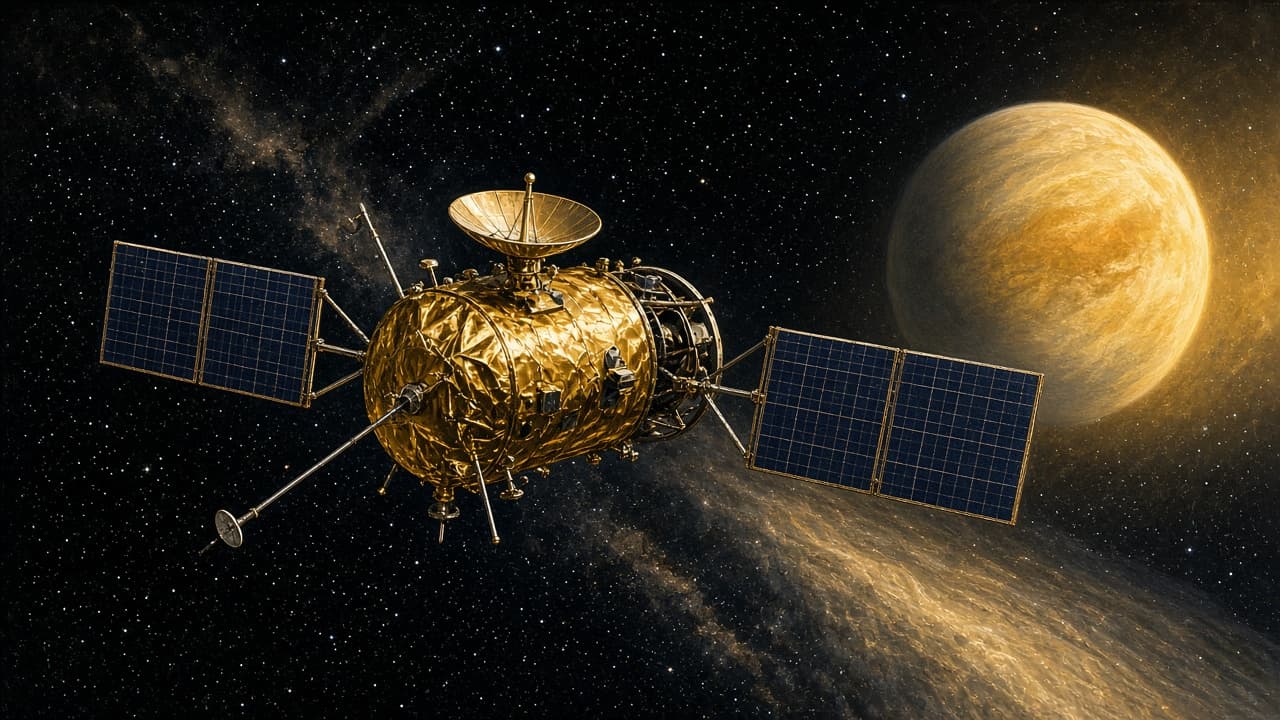
On this day: Mariner 2 launches toward Venus
On 27 August 1962, NASA launched Mariner 2 on an Atlas-Agena rocket. The spacecraft completed the first successful planetary flyby, scanning Venus in December.
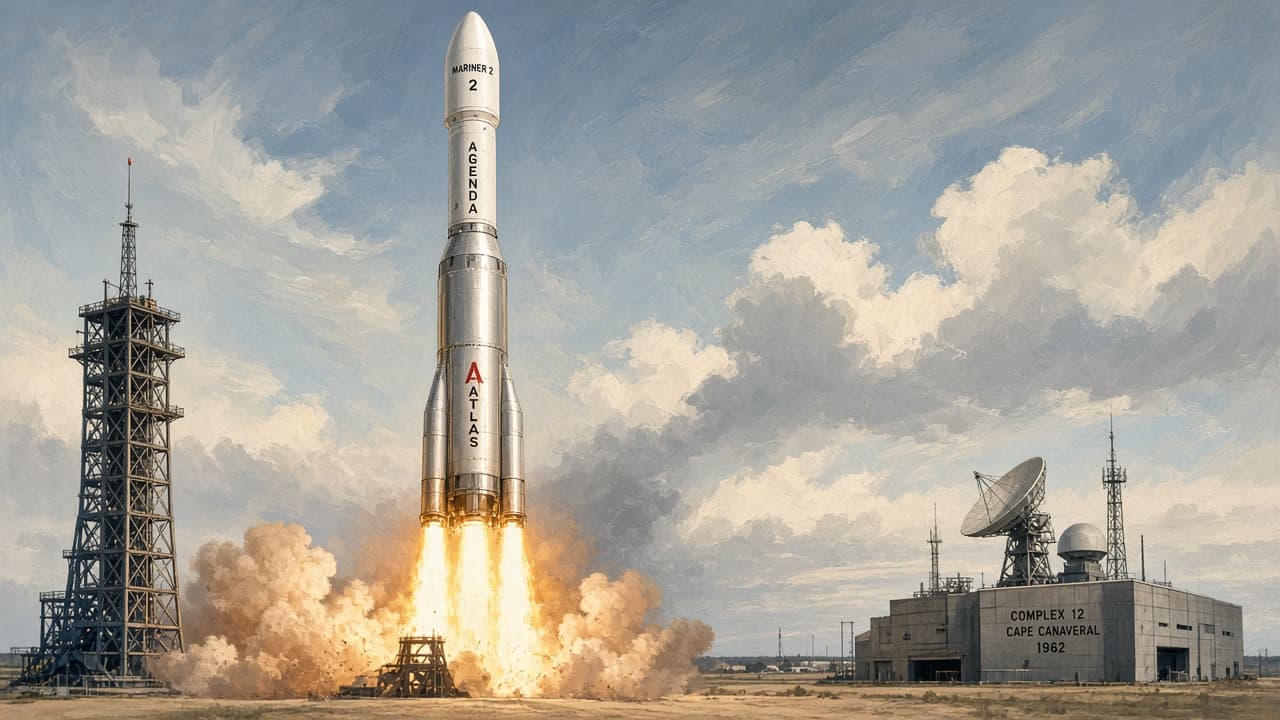
On 27 August 1962, NASA launched Mariner 2 from Cape Canaveral on an Atlas-Agena B rocket. The mission's goal was a flyby of Venus, the nearest planet inward from Earth. Earlier U.S. attempts had failed. Mariner 2 survived the coast through interplanetary space, returned engineering and science data and passed Venus on 14 December 1962. It became the first spacecraft to complete a successful planetary encounter.
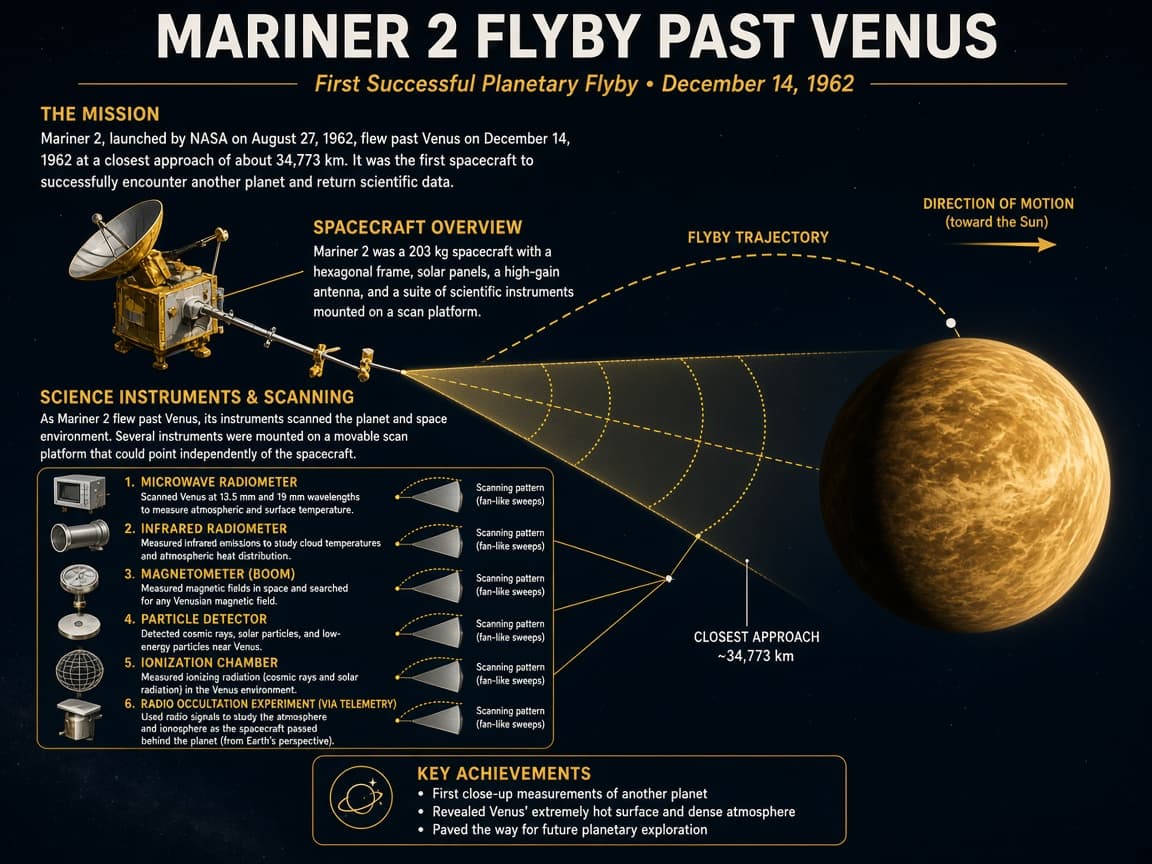
What is a planetary flyby? Instead of orbiting or landing, the craft follows a path that swings close enough for instruments to measure the target, then continues into a solar orbit. Flybys demand precise launch timing (a launch window), navigation corrections and antennas that can talk across tens of millions of kilometers. Mariner 2 carried radiometers, a magnetometer, solar plasma sensors and dust detectors. It was a small metal package asked to answer big questions: How hot is Venus? Does it have a strong magnetic field like Earth's?
Mariner 2 flew past Venus in December 1962 as a scan platform on a free trajectory, measuring temperature, magnetic field and particles without entering orbit. The flyby diagram shows why a brief encounter can still rewrite a planet's reputation: instruments sample the environment along a carefully aimed path, then the craft continues into solar orbit. Data confirmed a searing hot world beneath clouds, ending hopes of a temperate sister planet. Planetary science became measurement, not only telescope guessing. Controllers celebrated when the first calibrated readings contradicted cooler science-fiction hopes for Venus.
An Atlas-Agena rocket lofted Mariner 2 from Cape Canaveral in August 1962, continuing NASA's early interplanetary learning curve after prior failures. Launch vehicle reliability and deep-space radio tracking were as experimental as the spacecraft itself. Success made the United States the first to return data from another planet. The pad flame and the flyby schematic belong to one story: chemical stages to escape Earth, then silent instruments talking across millions of kilometers. Later missions built on Mariner's proof that interplanetary cruise and flyby pointing could work.
Venus had teased astronomers for centuries with thick clouds that hid the surface. Some hoped for a watery or temperate world. Mariner 2's microwave and infrared radiometer data showed a very hot planet beneath the clouds, with high temperatures inconsistent with mild Earth-like conditions. It did not find a Earth-strength magnetic field. Those results steered science toward the modern picture of Venus as a scorching, greenhouse-dominated world and killed romance faster than any novel could.
How the trip worked, in steps. Launch put Mariner and its Agena stage on an escape path. After separation, solar panels powered systems. Midcourse thruster burns corrected the trajectory. Heat, cold and vacuum stressed electronics; engineers at Jet Propulsion Laboratory tracked telemetry and sent commands. At Venus encounter, instruments scanned while the radio link returned numbers. After the pass, Mariner 2 continued outward until contact faded months later. No soft landing was attempted. Knowledge was the payload.
The mission sat inside Cold War space competition. The Soviet Union had reached toward Venus with mixed results; prestige attached to any clean planetary first. Mariner 2's success bolstered NASA's unmanned program between early Mercury flights and later Mars craft. It proved that deep-space navigation and long-distance radio could support real science, not only flags and speeches. Later Venus missions orbited, landed and mapped with radar, refining the greenhouse story and surface geology. Mariner 2's instruments look crude beside modern orbiters, yet the logical chain remains: measure radiation from the planet, infer temperature and environment, revise textbooks. Every glossy Venus animation still owes a debt to that 1962 coast.
For readers who think of spaceflight only as astronauts, 27 August is a useful counter-anniversary. Robots did the first serious planetary fieldwork. A launch on a late summer day sent a quiet machine to ask whether Earth's sister was hospitable. The answer reshaped how we think about climates, including our own.
Communication was half the mission. The Deep Space Network's dishes had to lock onto a faint signal and extract engineering health alongside science packets. A flyby that cannot phone home is only a silent rock on a curve. Mariner 2's success trained people and procedures for Mariner Mars flights and for every later probe that phones across the solar system.
Public reaction mixed triumph with the chill of the data. Science fiction had rented Venus to jungle fantasies for decades. A hot, dry reading from a radiometer is less cinematic and more useful. Planetary science matured when instruments were allowed to spoil romantic settings. 1962 was one of those spoiling, clarifying years.
Trajectory design used Venus as a moving target in a three-body dance with the Sun. Launch a few days late and the spacecraft misses the corridor that cameras and radiometers need. The August window was therefore a calendar fact with orbital teeth. Mission planners who sweat launch windows today are repeating a discipline Mariner made famous. Mariner 1 had failed weeks earlier on a guidance error, so Mariner 2's clean launch also proved that teams could learn from a public miss and still reach Venus on schedule.
Eagle Frame's takeaway: 27 August 1962 is when Mariner 2 left Earth to make the first successful planetary flyby at Venus. Know what a flyby is, know the hot-radiometer result and you see how a small probe rewrote a neighboring world.