On this day: Medicare and Medicaid become law
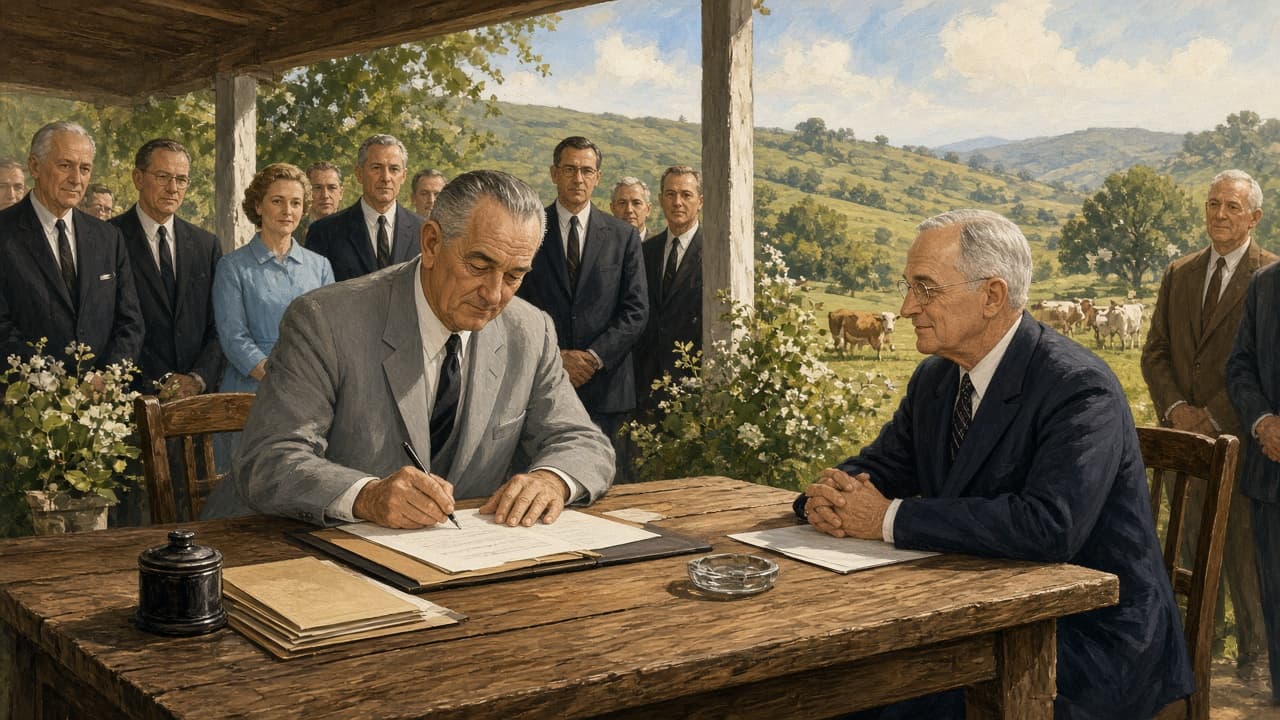
On 30 July 1965, Lyndon Johnson flew to Missouri to sign Medicare and Medicaid into law in front of Harry Truman. Roughly half of older Americans had no health insurance at the time, and within a year almost all of them did.
Lyndon Johnson could have signed the Social Security Amendments of 1965 at the White House. Instead, on 30 July, he flew to Independence, Missouri, and signed them at the Harry S. Truman Library with the 81-year-old former president sitting beside him. Truman had asked Congress for national health insurance in November 1945 and been beaten by the American Medical Association, which spent heavily to kill the idea. Johnson handed him Medicare card number one and enrolled Bess Truman as the second beneficiary. The gesture was about lineage. Johnson wanted the law read as the completion of something started twenty years earlier, and not as an invention of 1965.
The problem the law addressed was concrete. Private health insurance in the United States had grown up through employers, so it largely disappeared when people stopped working. Insurers were reluctant to cover older customers at any affordable price, for the obvious actuarial reason that older people get ill. Estimates from the period put the share of Americans aged 65 and over with no hospital insurance at somewhere around half. A serious illness could take a lifetime of savings, and adult children absorbed the cost when it could be absorbed at all. Poverty among older Americans ran near 30 percent in the mid-1960s, far above the rate for the population as a whole.
Opposition had defeated every previous attempt. The AMA ran a long campaign against what it called socialised medicine, including a 1961 operation in which Ronald Reagan, then an actor, recorded a warning album that doctors' wives played at coffee mornings and followed with letters to Congress. The argument was that federal payment would mean federal control of the examining room. Business groups and much of the Republican party agreed, and southern Democrats had their own reason to resist, because federal money came with federal civil rights conditions attached.
The 1964 election changed the arithmetic. Johnson won 61 percent of the popular vote, and Democrats took roughly two-thirds of both chambers, which made the House Ways and Means Committee winnable for the first time. Its chairman, Wilbur Mills of Arkansas, had blocked earlier bills and now switched. His contribution was a piece of legislative carpentry usually called the three-layer cake. Rather than choose among the competing proposals, he stacked all three. The administration's hospital insurance plan became Medicare Part A, funded by payroll taxes. A Republican alternative offering voluntary doctor-visit coverage became Part B, funded by premiums and general revenue. The AMA's own suggestion of expanded state aid for the poor became Medicaid.
The two programmes work differently, and the distinction still confuses people. Medicare is federal, national and based on age or disability rather than income. Anyone who qualifies gets the same benefit in Florida as in Montana. Medicaid is a joint federal and state programme for people with low incomes, with Washington matching state spending and states setting much of the eligibility and scope within federal rules. That design decision is why Medicaid coverage varies enormously between states to this day, and why it becomes a live political fight in state capitals in a way Medicare rarely does.
Implementation was a genuine logistical feat. Coverage began on 1 July 1966, eleven months after signing, and the Social Security Administration had to find, verify and enrol about 19 million people without computers in any modern sense. Post offices distributed forms. Officials went door to door in rural counties. Enrolment ran above 90 percent of the eligible population by the start date.
There was a second effect that was not advertised at the time. The Civil Rights Act of 1964 barred discrimination by any institution receiving federal funds, and Medicare meant nearly every hospital in America suddenly wanted federal funds. Inspectors were sent out through 1966 to verify that wards, waiting rooms and staff had been desegregated before payments could flow. Thousands of southern hospitals that had resisted for a decade complied within months. Historians of the period regard Medicare as one of the most effective desegregation tools of the era, precisely because it worked through money rather than litigation.
The programmes kept growing. Coverage was extended in 1972 to people under 65 with long-term disabilities and to patients with end-stage kidney disease, which remains the only disease-specific national entitlement in American law. The Children's Health Insurance Programme arrived in 1997 and was built onto the Medicaid framework. A prescription drug benefit, Part D, was legislated in 2003 and started in 2006. The Affordable Care Act in 2010 expanded Medicaid eligibility to more low-income adults, though a 2012 Supreme Court ruling made that expansion optional for states and a number declined it for years.
The measurable results are large and the costs are too. Poverty among Americans over 65 fell from roughly 29 percent in the mid-1960s to under 10 percent within a few decades, with Social Security and Medicare together doing most of the work. Medicare now covers about 68 million people and Medicaid and CHIP together cover tens of millions more, making the federal government the largest purchaser of health care in the country. That purchasing power also made Washington the referee of hospital prices, physician payment rates and drug coverage, which is a role nobody in the 1965 debate fully anticipated and which drives most American health policy arguments now.
Eagle Frame's takeaway: 30 July 1965 closed a twenty-year fight by refusing to pick a side. Wilbur Mills stacked three rival proposals into one bill, and the compromise that looked untidy is the reason the law passed and the reason American health coverage still runs on separate, mismatched systems for the old, the poor and everyone else.