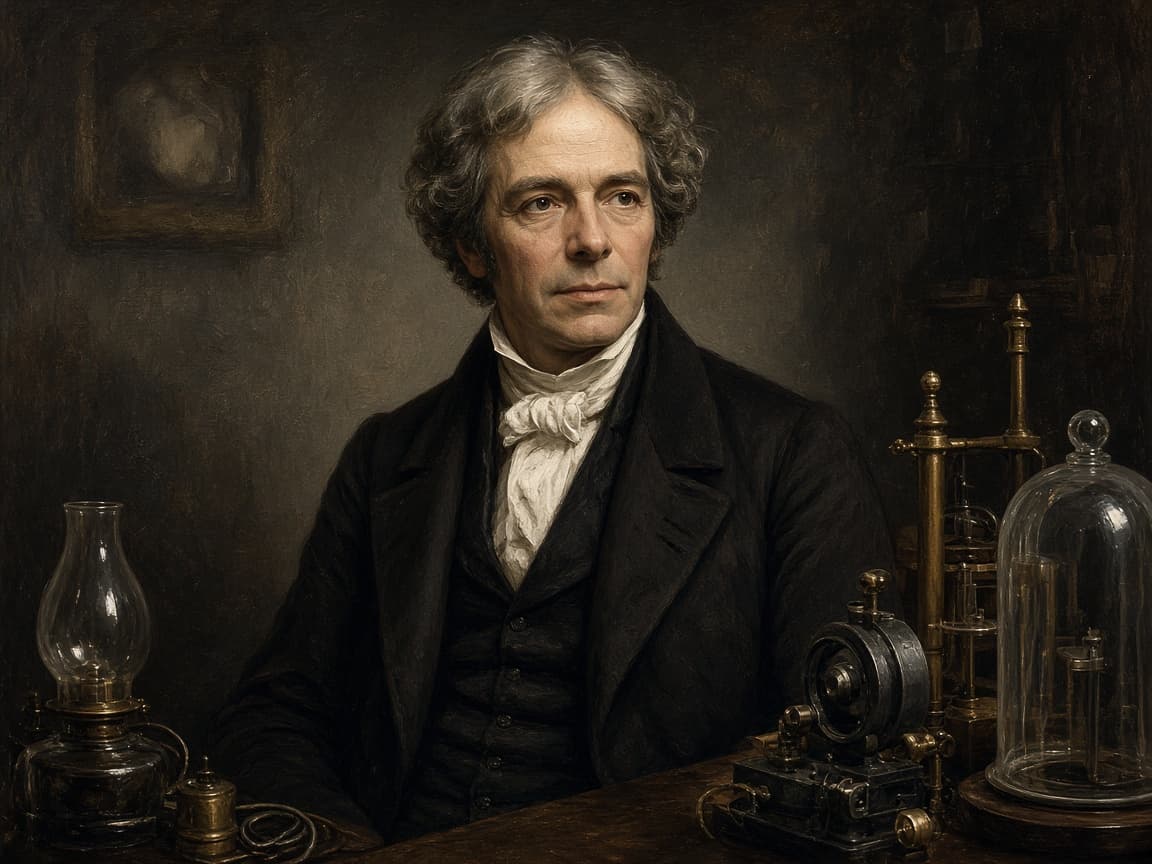
On this day: Faraday discovers electromagnetic induction
On 29 August 1831, Michael Faraday showed that a changing magnetic field can induce an electric current in a circuit. The insight underlies generators, transformers and much of modern power.
On 29 August 1831, Michael Faraday recorded experiments at the Royal Institution in London that demonstrated electromagnetic induction: a changing magnetic influence can drive an electric current in a nearby wire circuit. He moved magnets and switched electromagnets while watching a galvanometer needle twitch. The effect looks modest on a bench. It is the principle behind generators that feed cities and transformers that step voltage up and down on power lines.
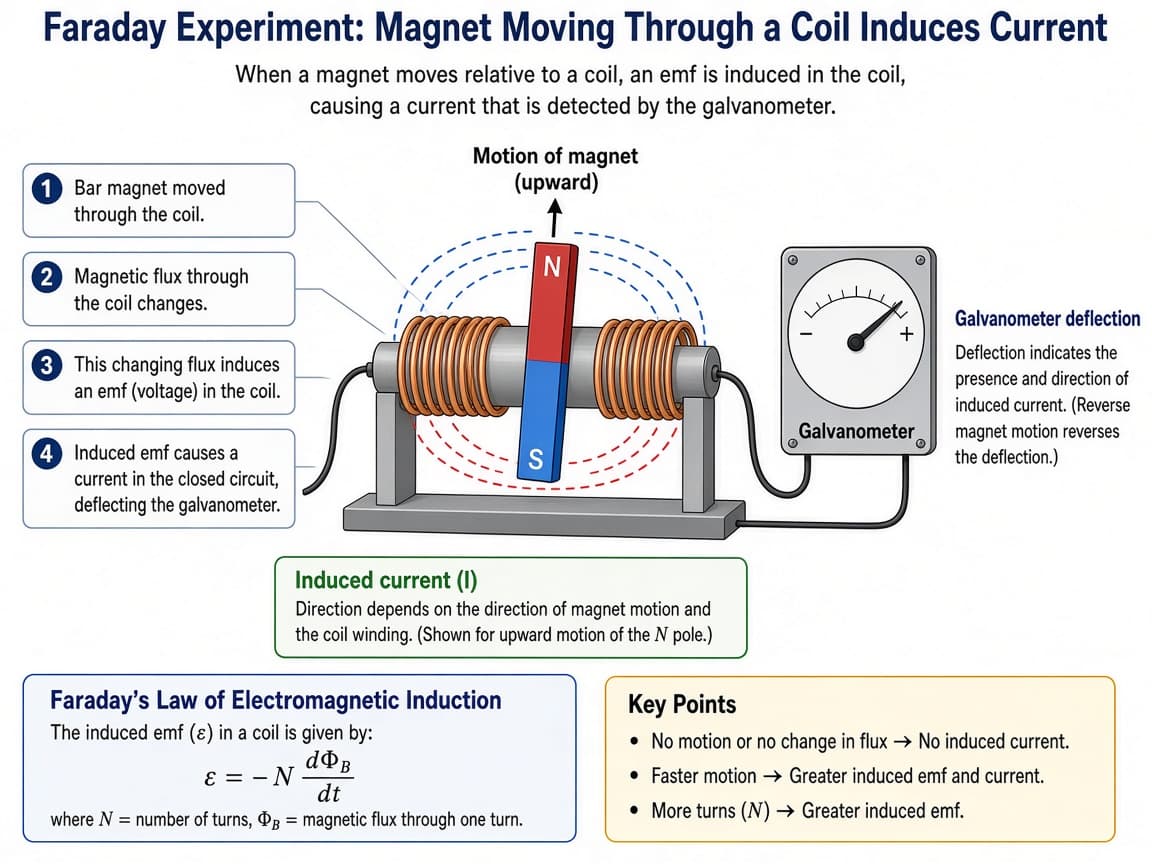
Faraday's induction experiment is easiest to picture as motion making electricity. A magnet slid in or out of a wire coil kicks a galvanometer needle because the magnetic field through the loop is changing. A steady magnet at rest does nothing useful to the closed circuit. That single distinction (change versus stillness) underpins transformers, generators and wireless charging ideas centuries later. The labeled coil-and-magnet diagram is still the clearest classroom door into electromagnetic industry. Notebook sketches of lines of force helped Faraday explain results before equations caught up.
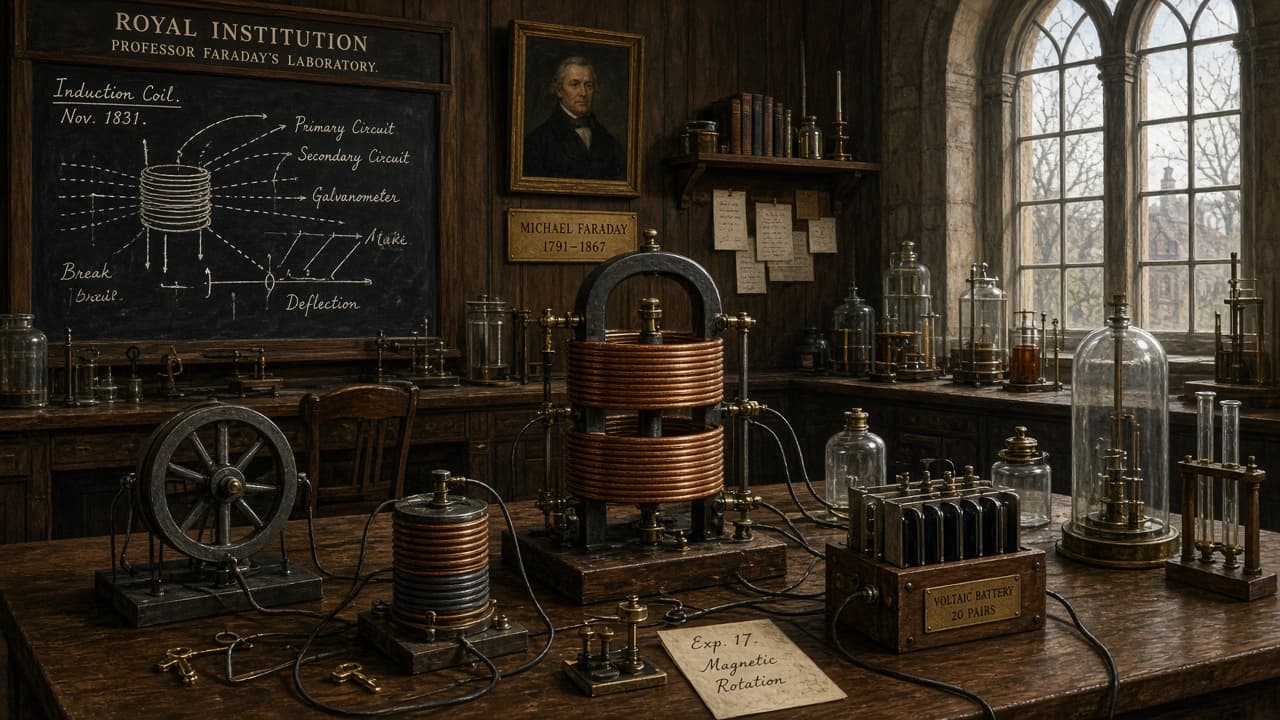
The Royal Institution laboratory gave Faraday bench space, audiences and a culture of public demonstration in London. Coils, batteries and iron cores looked humble beside later power stations, yet the lab notebooks of late August 1831 record the hinge. Faraday's lack of formal mathematics did not block discovery. It pushed him toward visual experiments others could repeat. Seeing the RI bench beside the induction schematic keeps the discovery human: a room of instruments, not an abstract law floating in air.
Who was Faraday? He began as a bookbinder's apprentice, taught himself science from the volumes he bound and entered Humphry Davy's orbit as a laboratory assistant. He lacked formal elite schooling and became one of the century's greatest experimental physicists and chemists. Clear notes, careful instruments and refusal to hide behind jargon marked his style. Induction was not his only triumph (benzene, electrochemistry and field ideas also bear his mark), yet 29 August is the date induction entered his diary as a secured result.
Explain the mechanism without mystique. A steady magnet sitting still beside a closed wire loop does not push a continuous current. Motion or change matters. When Faraday thrust a magnet into a coil, the needle kicked; when the magnet stopped, the kick stopped. When he powered an electromagnet on or off near a second coil, the second circuit showed a pulse. In modern language, a time-varying magnetic flux through a circuit induces an electromotive force. Batteries make current with chemistry. Induction makes current with changing magnetism.
Why generators follow. Spin a coil in a magnetic field (or spin magnets past coils) and you continually change the flux, so you continually induce voltage. Prime movers (steam turbines, water wheels, wind turbines) supply the spin; induction converts mechanical motion into electrical current. Transformers use alternating current in one coil to create a changing field that induces voltage in another coil without moving parts. Faraday did not install a national grid in 1831. He found the rule grids later obey.
Joseph Henry in the United States explored related induction effects around the same era; history credits a shared frontier rather than a cartoon of lone genius. Faraday's publications and public lectures spread the result through Europe. James Clerk Maxwell later cast electric and magnetic fields into mathematical laws that folded induction into a wider theory of light and electromagnetism. The bench twitch became a pillar of physics. Everyday life hides the discovery in plain sight. Phone chargers, power stations and induction cooktops all depend on changing fields and coils. Students still repeat Faraday's magnet-and-coil demo because the needle's jump is believable in a way abstract equations are not. Seeing the kick is how many people first trust that invisible fields do work.
For readers anxious about "hard science," 29 August is an encouraging anniversary. A self-taught experimenter with wire, iron and patience revealed a law that still lights cities. You do not need to solve Maxwell's equations to understand the moral of the day: change the magnetism through a loop and electricity answers.
Faraday thought in lines of force: visual curves filling space between magnets and wires. That picture language helped him invent experiments before equations caught up. Later mathematicians cleaned the prose into symbols; engineers kept the pictures on whiteboards. Both habits descend from his insistence that fields are real enough to push currents.
Classroom kits still sell coils and bar magnets because the discovery is democratic. A student with no Latin and little money, as Faraday once was, can reproduce the kick of the needle. 29 August honors a result and a pathway into science that did not require an aristocratic education.
Industry did not electrify overnight after the diary entry. Decades of dynamos, meters, lighting contests and utility finance stood between Faraday's needle and a switched-on street. Still, every later inventor who spun a coil owed the August result a citation. Pure research on a basement bench set the tariff for an energy civilization.
Eagle Frame's takeaway: 29 August 1831 is when Faraday pinned down electromagnetic induction on the laboratory bench. Know that changing magnetism drives current, know how generators use that rule and you hold a key to the powered world.