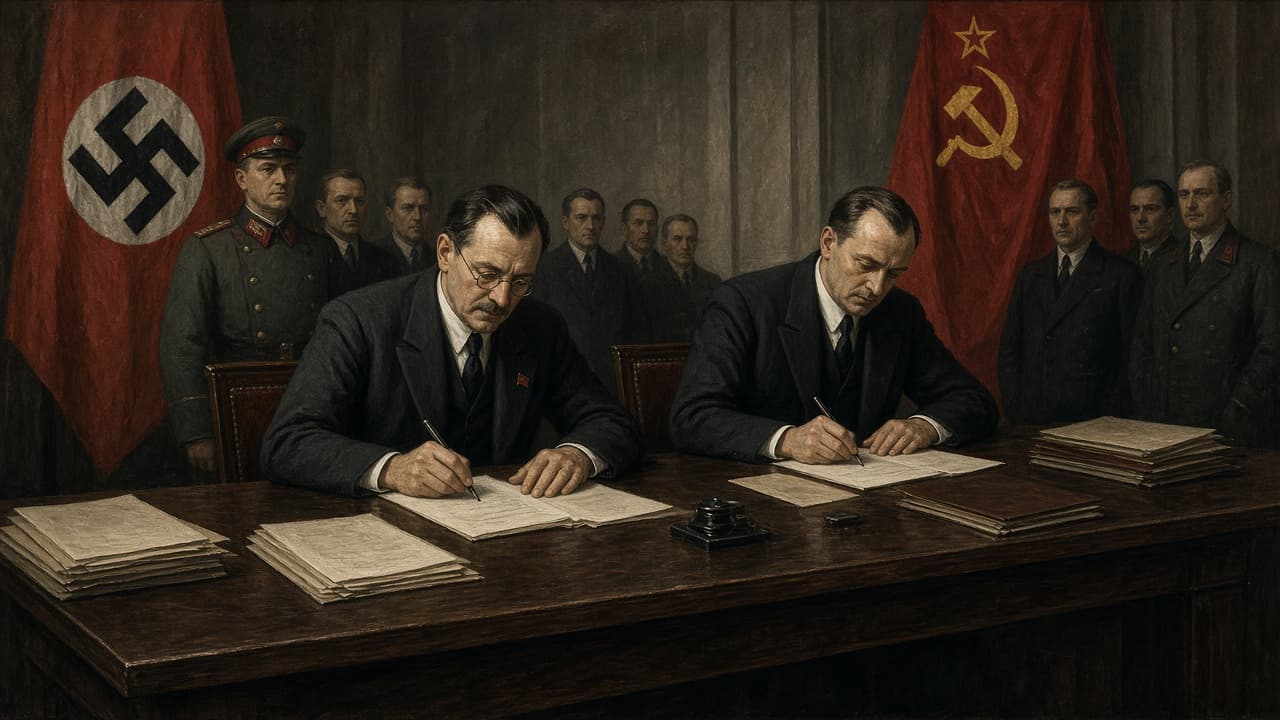
On this day: the Nazi-Soviet pact is signed
On 23 August 1939, Nazi Germany and the Soviet Union signed a nonaggression pact with a secret protocol dividing Eastern Europe. The deal cleared Hitler's path to invade Poland.
On 23 August 1939, Nazi Germany and the Soviet Union signed a nonaggression treaty in Moscow. Foreign ministers Joachim von Ribbentrop and Vyacheslav Molotov put their names to a public agreement not to attack each other and to consult on disputes. A secret protocol divided Eastern Europe into spheres of influence: Poland, the Baltic states, Finland and parts of Romania were carved on paper between Berlin and Moscow. Eight days later Germany invaded Poland. World War II in Europe began.
The pact shocked outsiders because Adolf Hitler's regime and Joseph Stalin's USSR had spent years denouncing each other as mortal ideological foes. Nazi propaganda painted Bolshevism as a Jewish conspiracy; Soviet rhetoric painted fascism as capitalism's death throes. Trade and diplomacy still moved in the background. By summer 1939 Hitler wanted a free hand against Poland without fear of a two-front war. Stalin wanted time to rebuild his military after purges, secure borders and gain room in Eastern Europe if war came.
The Nazi-Soviet nonaggression pact signed in Moscow on 23 August 1939 included secret protocols dividing Eastern Europe into spheres of influence. An educational map of those zones explains why Poland was invaded from two directions within weeks and why the Baltic states faced Soviet pressure soon after. Publicly the deal looked like peace between ideological enemies who had spent years insulting each other. Privately it was a carve-up that cleared the path for Germany's war timetable. Diplomacy here was a weapon, not a brake on aggression.
At the Kremlin signing table, foreign ministers Vyacheslav Molotov and Joachim von Ribbentrop performed cordiality for cameras while military plans matured in parallel. Stalin sought time and territory. Hitler sought a free hand in the west without an immediate two-front crisis. The partnership shattered in 1941 when Germany invaded the Soviet Union. Remembering the table scene beside the sphere map keeps the cynicism concrete: smiles in a hall, borders rewritten on paper and populations soon under occupation. Occupied populations learned the map's meaning as arrests, deportations and new borders arrived.
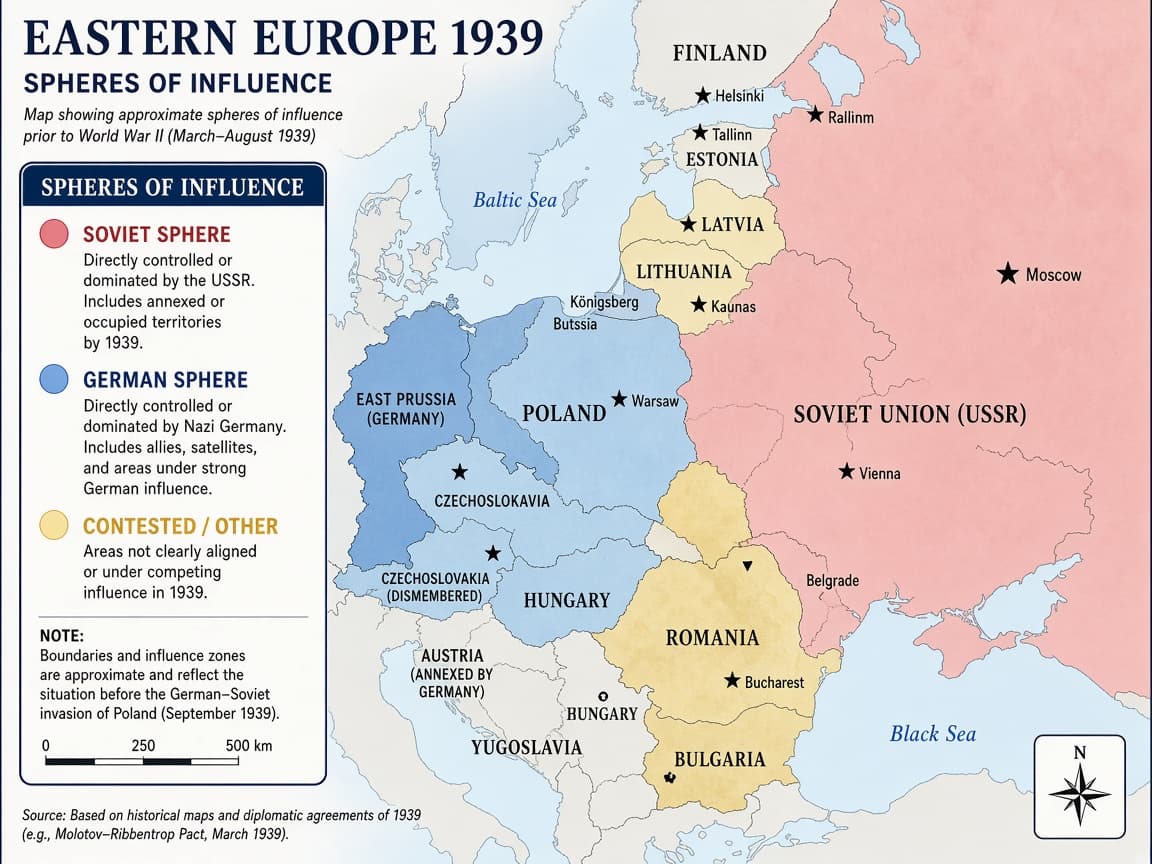
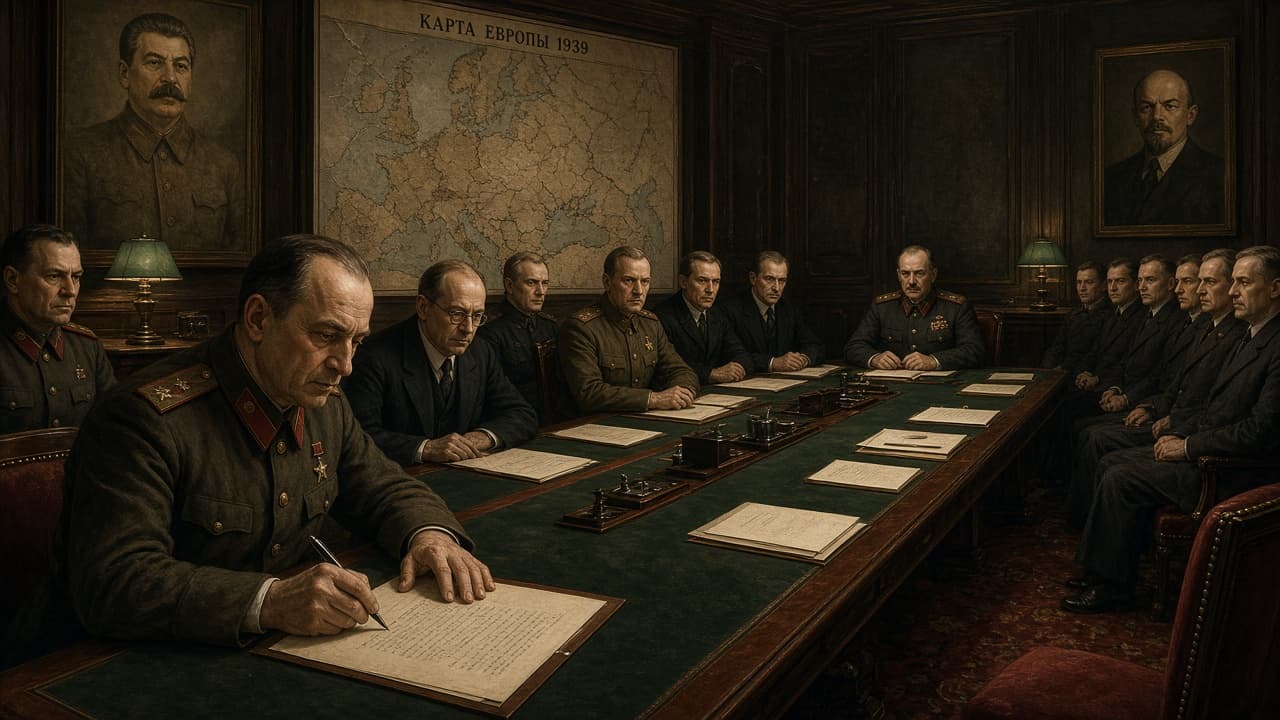
The secret protocol was not published at the time. It assigned eastern Poland and the Baltic republics to Soviet influence and western Poland to Germany, among other lines. When Germany attacked Poland on 1 September, Britain and France declared war on Germany. The Soviet Union invaded eastern Poland on 17 September, citing collapse of the Polish state and the need to protect compatriots. The two dictatorships had coordinated outcomes without advertising their partnership to the world.
For Poles and Balts, the pact was not a distant diplomatic curiosity. It meant partition, occupation, deportations and mass killing in the years that followed. The Katyn massacre of Polish officers and intellectuals by Soviet security forces belongs to the same brutal chapter. Nazi and Soviet occupations alternated and overlapped in ways that made postwar memory politically explosive for decades.
The public pact lasted until Germany broke it with Operation Barbarossa, the invasion of the Soviet Union on 22 June 1941. Stalin had received warnings; the attack still inflicted catastrophic losses in the opening months. After the war, Soviet historiography tried to erase the pact's secret clauses. Archives that emerged in the late 1980s and 1990s forced a reckoning in Russia and among neighbors who had lived the consequences.
Historians debate Stalin's exact motives: fear of fighting Germany immediately, opportunistic imperial expansion or both. What is clear is that 23 August 1939 gave Hitler a green light in Poland and handed Moscow territorial gains until the alliance shattered. Anti-fascist rhetoric from Moscow in the late 1930s suddenly looked hollow to communists abroad who had been told to oppose Nazism at all costs.
In modern Europe, 23 August is marked in some countries as a day of remembrance for victims of totalitarian regimes. Baltic states tie the date to loss of independence. Poland places it at the start of the catastrophe of 1939. Debates over monuments and school curricula show the pact is not settled history but living argument.
For readers who treat World War II as a simple story of Allies versus Axis from day one, the Molotov-Ribbentrop Pact is the corrective. Two enemies shook hands, split a map and made small nations pay first. The handshake failed, but the map's violence outlasted the treaty.
Communist parties outside the USSR struggled to explain the handshake between Hitler and Stalin. Some followed Moscow's line that the pact bought time. Others quit in disgust. Newspapers in Warsaw and Tallinn read the secret map before the public did, through intelligence leaks and dread. The pact's collapse in 1941 did not erase the memory of 1939 for nations assigned on paper. German and Soviet trade agreements moved oil, grain and metals across borders even as their ideologies claimed enmity. Economists later studied how the pact funded Hitler's war machine before Barbarossa. The handshake was secret diplomacy with public consequences measured in occupied towns, not only in embassy cables.
Eagle Frame's takeaway: 23 August 1939 is the Nazi-Soviet pact with its secret partition of Eastern Europe. Know Ribbentrop and Molotov's signatures, know Poland's September invasions from both sides and know why the date still angers neighbors who were assigned on paper.