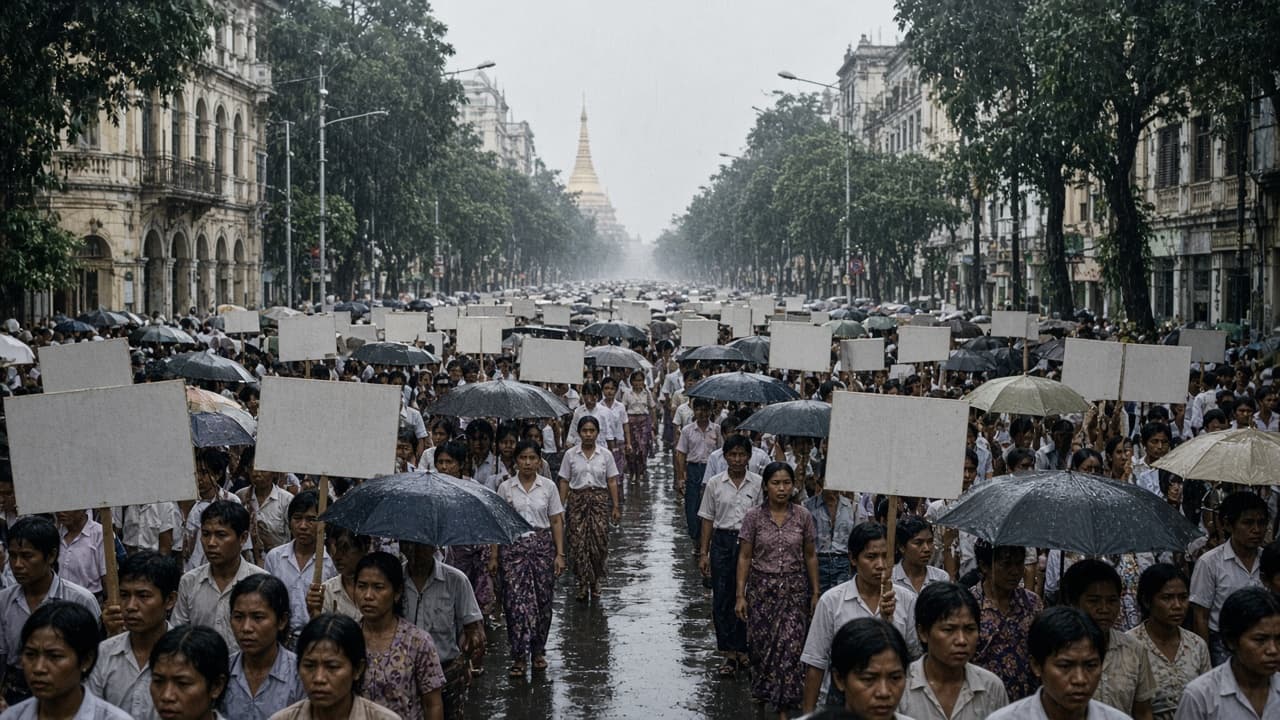
On this day: Myanmar's 8888 Uprising peaks
On 8 August 1988, a general strike swept Burma and brought months of protest against military rule to its peak. Soldiers fired on crowds in Rangoon and other cities, and the crackdown shaped the country's politics for decades.
The date was chosen for its digits. Activists in Burma, the country now called Myanmar, called a nationwide general strike for the eighth day of the eighth month of 1988, and dockworkers in Rangoon walked out at eight minutes past eight in the morning. Eight is an auspicious number in Burmese astrology, and the repetition gave a scattered protest movement a single rallying point. By midday, crowds filled streets in Rangoon, Mandalay, Sittwe, Taunggyi and dozens of smaller towns. By nightfall, soldiers were shooting into them. The events of that week are known in Burmese history simply as 8888.
The grievance underneath was 26 years old. General Ne Win had seized power in a 1962 coup and governed through the Burma Socialist Programme Party, a one-party system that nationalized industry, isolated the country and ran what had been one of Asia's richest rice exporters into the ground. Two moves in 1987 lit the fuse. In September the government cancelled large-denomination kyat banknotes without compensation, erasing the savings of anyone who kept cash at home, which in a country with little banking meant almost everyone. In December, Burma applied for United Nations least-developed-country status to qualify for debt relief. The humiliation of that application was widely understood.
Students moved first. In March 1988 a brawl at a teashop near the Rangoon Institute of Technology escalated when police released the son of a local party official. Protests followed, and a student named Phone Maw was shot dead on 13 March. Days later, riot police trapped fleeing students at a causeway beside Inya Lake in an episode remembered as the White Bridge incident, where dozens died and many women were assaulted in custody. The government closed the universities and sent students home to every town in the country, which spread the anger rather than containing it.
Then the regime flinched in public. On 23 July 1988 Ne Win told a party congress he was resigning and suggested a referendum on multi-party politics, an offer the party promptly buried. His replacement on 26 July was Sein Lwin, the security chief associated with both the March killings and an earlier assault on student protesters in 1962. Appointing him was read as a promise of force. Organizers responded by naming the date. The two weeks between that appointment and 8 August are what turned a student grievance into a general strike involving monks, nurses, customs officers, railway staff and even some police units.
What happened next is documented mainly through diplomatic cables, foreign journalists who slipped in and survivors who later testified from exile. Troops of the 22nd Light Infantry Division fired on marchers in Rangoon on the night of 8 August and again over the following four days. Protesters in some districts fought back, and there were lynchings of suspected informers. Estimates of the dead between 8 August and the end of September commonly reach around 3,000, though the figure is contested and the government has always claimed far fewer. No independent count was ever permitted. Sein Lwin resigned on 12 August after 17 days in office.
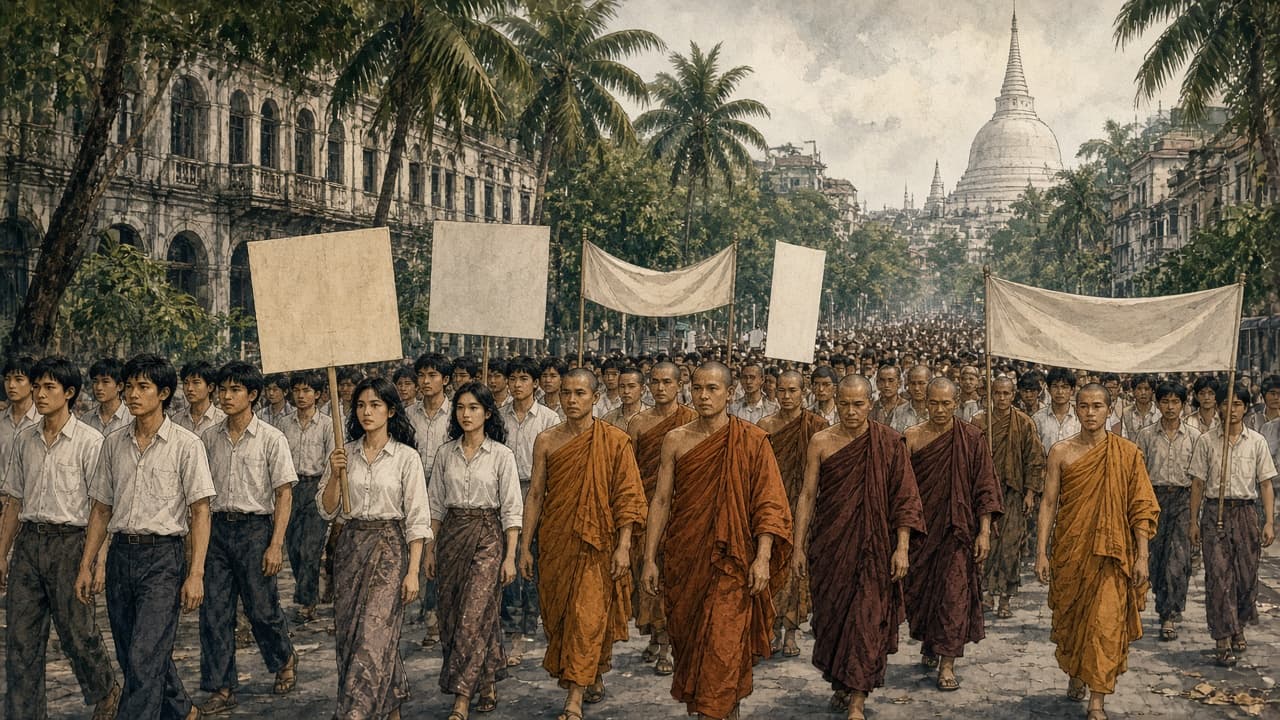
For about a month the country was close to open. Maung Maung, a civilian legal scholar, took over on 19 August, lifted martial law and promised elections. Independent newspapers appeared. Neighbourhood committees organized rubbish collection and local security where the state had withdrawn. On 26 August, Aung San Suu Kyi addressed a crowd estimated at several hundred thousand on the west slope of the Shwedagon Pagoda. She was 43, had been living in Britain and had come home in April to nurse her dying mother. As the daughter of Aung San, the independence leader assassinated in 1947, her name carried authority no other opposition figure could match. She founded the National League for Democracy on 27 September.
The window shut on 18 September. The armed forces staged a formal coup, installed the State Law and Order Restoration Council under General Saw Maung, and cleared the streets again with more shooting. Thousands of students fled to the border areas controlled by ethnic armed organizations, where some joined insurgencies that had been fighting since the 1940s. In 1989 the council renamed the country Myanmar and Rangoon became Yangon, a change many exiles and some foreign governments refused to use for years because of who ordered it. Aung San Suu Kyi was placed under house arrest in July 1989.
The council then made a mistake it spent 20 years correcting. It held the promised election in May 1990. The National League for Democracy won roughly 392 of 492 seats. The military annulled the result, jailed winning candidates and stayed in power. Aung San Suu Kyi spent about 15 of the next 21 years in detention and received the Nobel Peace Prize in 1991 while confined. The activists of 1988, known collectively as the 88 Generation, served long prison terms. Min Ko Naing, one of the student leaders of that August, was imprisoned for most of the following two decades.
The story did not resolve. A managed opening began in 2011, the National League for Democracy won elections in 2015 and 2020, and Aung San Suu Kyi's international standing then collapsed over her government's defence of the military campaign that drove more than 700,000 Rohingya into Bangladesh in 2017. On 1 February 2021 the army seized power again and detained her. The protest movement that followed, called the Spring Revolution, borrowed tactics, songs and organizers directly from 1988, and veterans of the earlier uprising found themselves advising a generation born after it.
Eagle Frame's takeaway: 8 August 1988 shows how fast an entrenched government can wobble and how quickly it can recover if nobody outside is watching closely. Burma produced a general strike, a moral leader and a landslide election within two years, and the military kept power through all three. The unfinished business explains the country today.