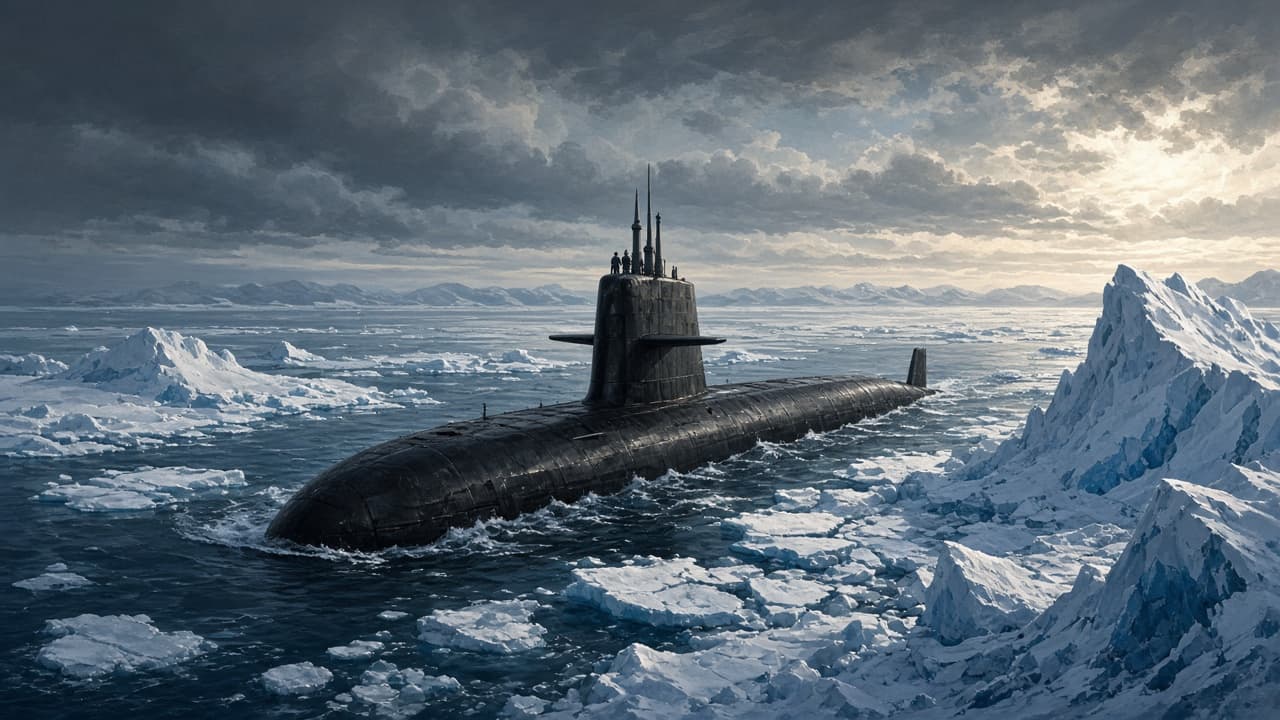
On this day: USS Nautilus reaches the North Pole underwater
On 3 August 1958, the nuclear submarine USS Nautilus passed beneath the geographic North Pole while submerged. Here is how a reactor let a ship stay under the Arctic ice for four days and why the voyage was a Cold War answer to Sputnik.
At 2315 Eastern Daylight Time on 3 August 1958, Commander William R. Anderson spoke over the intercom of USS Nautilus: for the world, our country and the Navy, the North Pole. There was nothing to see. The submarine was roughly a hundred meters down, running under a lid of sea ice, with more than four kilometers of black water beneath the keel. No ship had ever reached ninety degrees north. Nautilus did it without surfacing once in the crossing, and the reason it could is worth understanding before the Cold War politics.
Start with what a submarine actually is and what had always limited it. A diesel-electric submarine runs on batteries when submerged, because a diesel engine needs air. Batteries drain in hours, so the boat must return to the surface or to snorkel depth to run its diesels, recharge and take in oxygen. Under a permanent ice cap that is not an option, because there may be no opening for hundreds of kilometers. Every earlier attempt to push far under the Arctic ice therefore ran into the same wall: a conventional boat can only go as far as one battery charge will carry it and still get back to air.
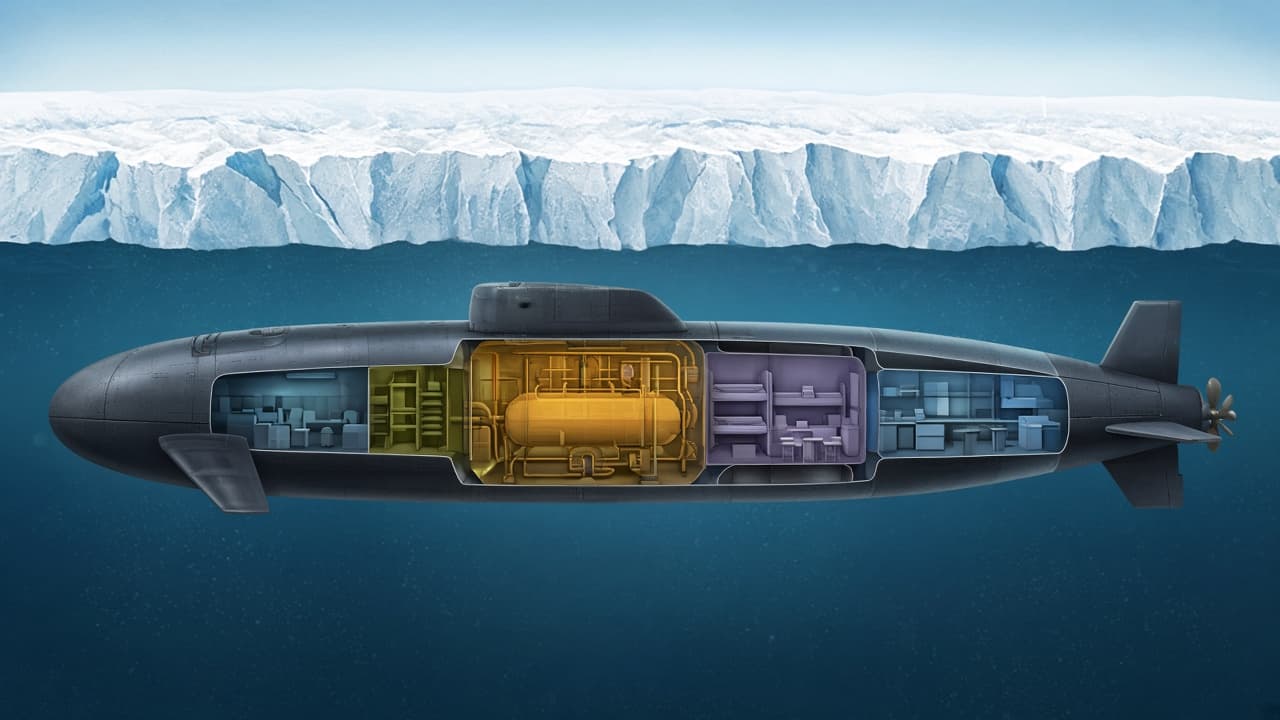
A nuclear submarine removes that wall. Inside the reactor compartment, uranium fuel sustains a controlled fission chain reaction, splitting heavy atoms and releasing heat. Pumped water carries that heat away in a sealed high-pressure loop and passes it through a heat exchanger to a second loop, where the water is allowed to boil. The resulting steam spins turbines connected to the propeller shaft and to generators. No combustion, no exhaust, no air. The same electricity runs equipment that makes breathable oxygen by splitting seawater and scrubbers that strip carbon dioxide out of the cabin air. Fuel consumption is so small that the boat's real endurance limit becomes food and crew morale rather than energy. Nautilus was the first ship in the world built this way, launched in 1954 and driven largely by the insistence of Admiral Hyman Rickover.
The Arctic mission had a political trigger. The Soviet Union launched Sputnik 1 in October 1957 and the United States spent the following months absorbing the fact that it looked technologically second. President Dwight Eisenhower wanted a visible American first that was ready now rather than in five years. A submerged transit of the Pole qualified. The operation was given the name Sunshine and kept secret, partly because nobody could promise it would work.
It did not work the first time. Nautilus tried in 1957 and turned back. In June 1958 the boat left Seattle, entered the Chukchi Sea and was blocked again: north of the Bering Strait the water is shallow, sometimes only forty or fifty meters, and the pack ice above sends keels of ice plunging down. A submarine caught between a shoal bottom and a deep ice keel has nowhere to go. Anderson withdrew to Pearl Harbor and waited for the summer melt to open more room.
Navigation was the second hard problem. Magnetic compasses become useless near the magnetic pole, where the field lines dive almost straight down. Celestial navigation needs a view of the sky. Under ice there is no sky and no radio fix. Nautilus carried an inertial navigation system, a device adapted from cruise missile work that uses gyroscopes and accelerometers to track every change of speed and heading and calculate position from dead reckoning alone. It also carried upward-looking sonar to read ice thickness and find any open leads overhead. Dr. Waldo Lyon of the Navy Electronics Laboratory sailed as ice pilot and chief scientist.
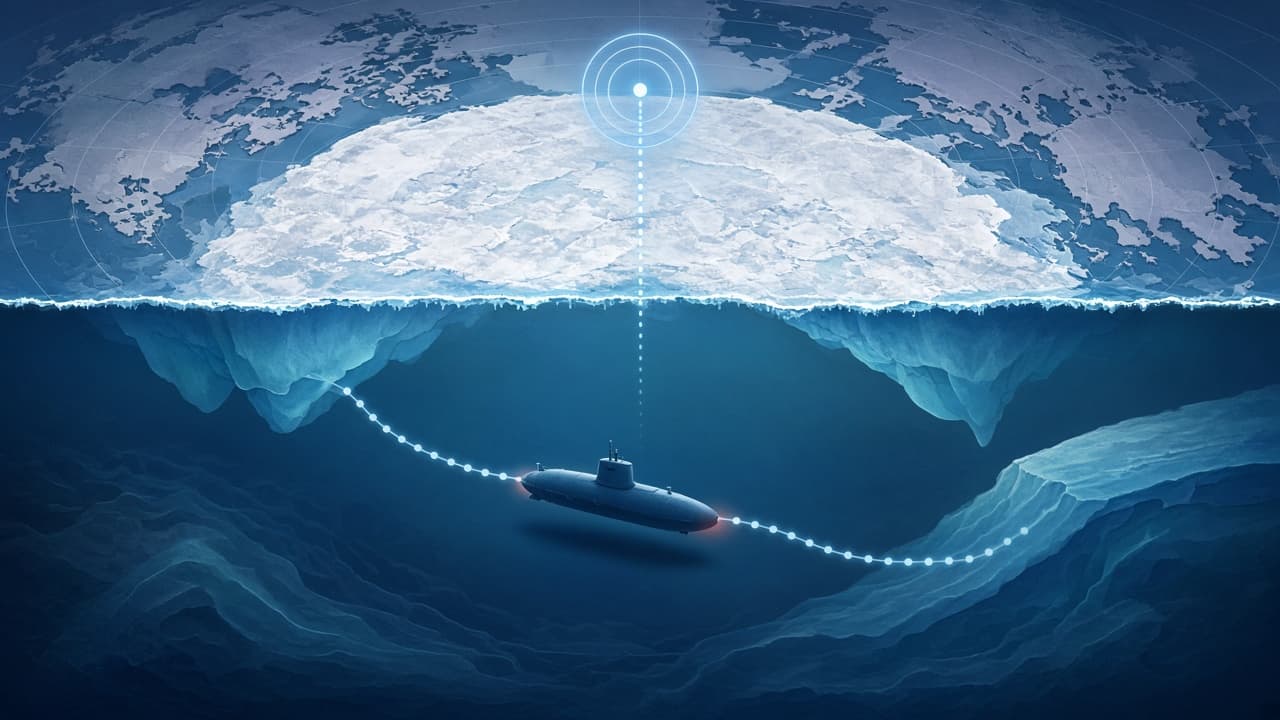
The successful run began on 23 July 1958, when Nautilus left Pearl Harbor with 116 people aboard, including four civilian scientists. Rather than force the shallow Chukchi again, Anderson worked east along the north coast of Alaska to the Barrow Sea Valley, a submarine canyon off Point Barrow that drops into the deep Arctic basin. On 1 August the boat dived into that trough and kept going. The ice overhead varied from about three to fifteen meters thick, and the crew ran at roughly 150 meters depth in water thousands of meters deep. Ninety degrees north came on 3 August. Nautilus did not stop or circle. It passed under the Pole and continued toward Greenland, surfacing in open water northeast of Spitsbergen after ninety-six hours and 1,590 nautical miles beneath the ice. Anderson radioed four words to Washington: Nautilus 90 North.
The public reaction was immediate and stage-managed. Anderson was lifted off by helicopter near Iceland and flown to Washington, where Eisenhower gave him the Legion of Merit at the White House and awarded the crew a Presidential Unit Citation, the first ever given in peacetime. The message to Moscow was not subtle. A submarine that can cross the Arctic basin submerged can also position itself off an enemy coast without being seen, and within two years the Navy would be putting ballistic missiles into that kind of hull. The Polaris missile submarine, and the whole logic of deterrence hiding under water, follows directly from the engineering Nautilus proved.
The science mattered too, and it lasted longer than the headline. Upward-looking sonar traces gathered on that voyage and on later Arctic runs became a baseline record of ice thickness that researchers still use when comparing the Arctic of the late 1950s with satellite measurements today. Submarine sonar data declassified decades later helped show how much the ice pack has thinned. A Cold War stunt turned into one of the earliest systematic datasets on the Arctic ice cover.
Nautilus itself served until 1980, having steamed more than 500,000 nautical miles and made over 2,500 dives. It is now a museum ship at the Submarine Force Museum in Groton, Connecticut, where visitors can walk through the control room and the crew spaces. The reactor compartment is sealed, but the layout makes the trade obvious: a long steel tube where the hardest constraint was never the ocean outside, it was what the machinery inside could do without fresh air.
Eagle Frame's takeaway: 3 August 1958 is the day nuclear power removed the last practical reason a submarine had to come up for air, and a ship crossed the top of the world without anybody seeing it. Know the reactor and steam loop, know the Barrow Sea Valley dive and know that the ice data from that voyage now helps measure how much the Arctic has changed.