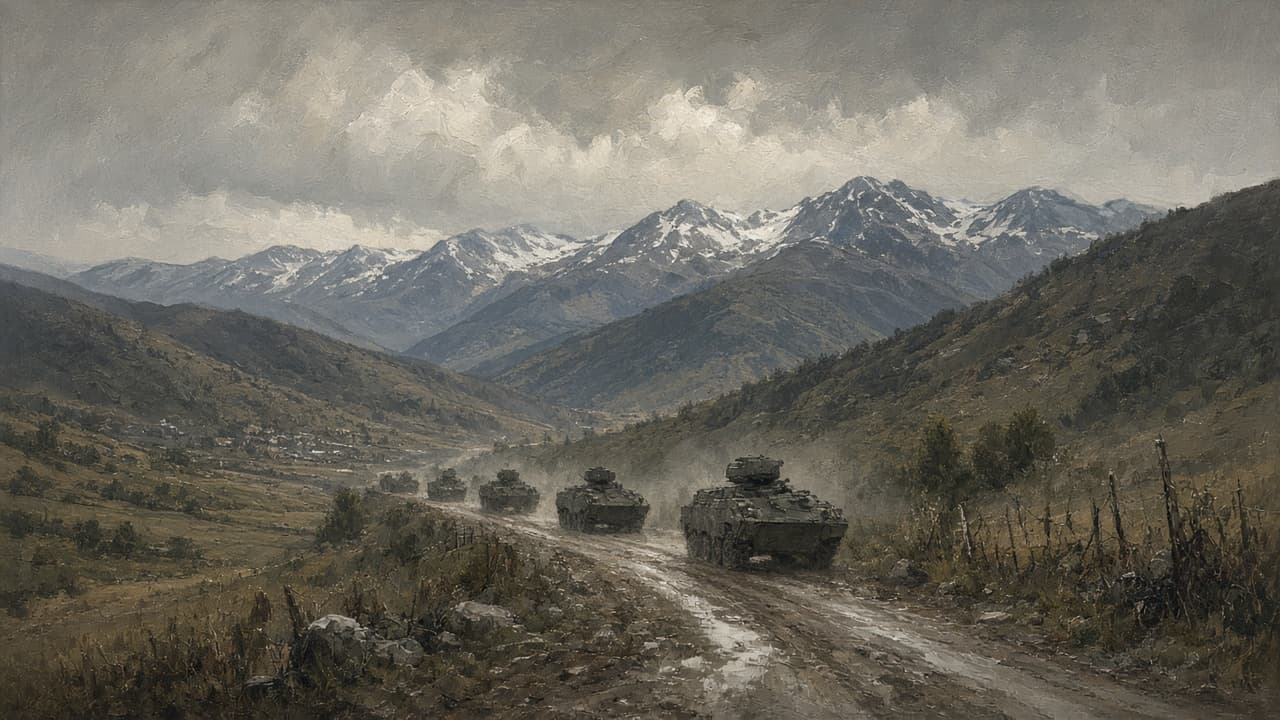
On this day: the Russo-Georgian War erupts
On the night of 7 August 2008, weeks of shelling around South Ossetia turned into open war. Georgian forces assaulted Tskhinvali, Russian columns came through the mountains, and five days later Georgia had lost control of two territories for good.
On the evening of 7 August 2008, President Mikheil Saakashvili of Georgia went on television and announced a unilateral ceasefire around South Ossetia, a breakaway region in the north of his country where shelling had been escalating for weeks. A few hours later, shortly before midnight, Georgian artillery and rocket launchers opened a heavy barrage on Tskhinvali, the region's main town, and Georgian troops moved in. Within hours Russian armor was rolling south through the Roki tunnel under the Caucasus range. By 12 August the fighting was over, and the map of the South Caucasus had been redrawn in a way that has not been reversed.
The dispute was old enough to have accumulated its own machinery. South Ossetia had fought a war against Georgian government forces in 1991 and 1992 as the Soviet Union came apart, and the ceasefire signed at Sochi in June 1992 left it in an unusual condition. It was internationally recognized as Georgian territory, governed in practice by its own authorities in Tskhinvali, and policed by a Joint Peacekeeping Force that contained Russian, Georgian and Ossetian battalions all at once. Abkhazia, on the Black Sea coast, sat in a similar frozen state after a bloodier war in 1992 and 1993 that displaced most of its ethnic Georgian population. Neither conflict was settled. Both were parked.
Two things unfroze them. Saakashvili came to power in the Rose Revolution of late 2003 promising to restore Georgian control over both territories and to take the country into NATO and the European Union. Russia, under Vladimir Putin and then the new president Dmitry Medvedev, had spent the same years handing out Russian passports in South Ossetia and Abkhazia, subsidising their budgets and staffing their security services. When NATO's Bucharest summit in April 2008 declined to give Georgia and Ukraine a Membership Action Plan but declared that both would become members eventually, it produced the worst of both outcomes. Georgia had a promise without protection.
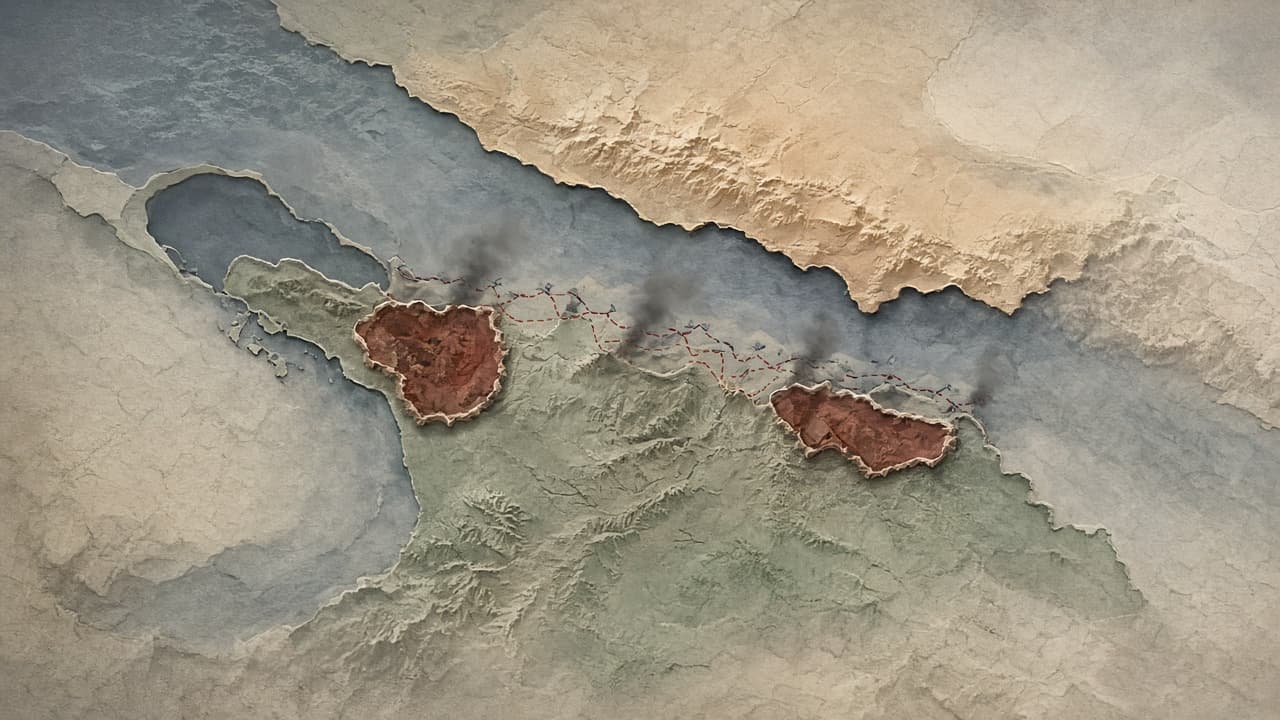
The summer of 2008 read like a countdown to anyone watching closely. There were bombings, sniper exchanges, detained officers and drone shoot-downs through June and July. Russia ran a large military exercise called Kavkaz 2008 in the North Caucasus in July and did not send all the participating units home. Ossetian authorities began evacuating children to North Ossetia in early August. Mortar and artillery fire across the contact line intensified on 1 August and again on 6 August. Both governments later insisted the other side started shooting first that week, and both had reason to want the other blamed for the first shot.
Once the Georgian assault began, the response was fast and far larger than the enclave required. Elements of the Russian 58th Army pushed through Roki and into Tskhinvali, where they fought Georgian units in the streets on 8 and 9 August. The Russian air force struck targets across Georgia proper, including the town of Gori, the port of Poti, the Vaziani airbase and infrastructure near the capital. A second front opened in the west when Abkhaz forces, backed by Russian troops, cleared Georgian positions from the upper Kodori valley. A Russian naval detachment operated off the Georgian coast. Georgia, whose best-trained brigade was in Iraq and had to be flown home, was outmatched within 48 hours.
It also became the first conflict where a shooting war ran alongside a sustained wave of cyberattacks. Georgian government, bank and news websites were flooded and defaced from the opening days, which made it difficult for Tbilisi to publish its own account of events while the fighting was live. Russia denied state involvement and the technical attribution remains disputed, but the sequencing was noted by every defense ministry in Europe and appears in NATO planning documents afterwards.
Diplomacy ended it quickly because France was holding the rotating presidency of the European Union and President Nicolas Sarkozy flew to Moscow and Tbilisi in person. The six-point plan he brokered, agreed on 12 August and signed over the following days, stopped the fighting, required both sides to pull back to pre-conflict positions and provided for international discussion of the territories status. Russian forces withdrew from the areas around Gori and Poti over the following weeks, but not from South Ossetia and Abkhazia. On 26 August 2008 Russia formally recognized both as independent states, a step only a handful of other governments have ever matched.
The human cost was smaller than the political cost and still substantial. Estimates compiled afterwards put the total dead at roughly 850, including Georgian and Russian soldiers, Ossetian fighters and several hundred civilians on both sides of the line. Around 192,000 people were displaced during the fighting. Most returned, but about 20,000 ethnic Georgians who had lived in South Ossetian villages such as those in the Liakhvi valley were not allowed back, and their houses were burned. Human Rights Watch and other monitors documented indiscriminate fire by Georgian forces in Tskhinvali, Russian use of cluster munitions, and looting and arson by Ossetian irregulars.
An independent European Union inquiry led by the Swiss diplomat Heidi Tagliavini published its findings in September 2009 and satisfied nobody, which is usually a sign of a careful report. It concluded that the open hostilities began with the Georgian shelling of Tskhinvali and that this was not justified under international law, and it also found that the attack followed months of provocation, that Russia's response went well beyond the defense of its peacekeepers and that the invasion of Georgian territory beyond South Ossetia was unlawful. It criticised Russia's passport policy in the enclaves and the recognition that followed the war.
The precedent turned out to be the real result. Russia showed that it would use force outside its borders in the former Soviet space, that Western governments would object loudly and impose little cost, and that recognising a breakaway territory could be used as a tool of policy. Georgia lost about a fifth of its claimed territory and gained an argument for NATO membership it has still not been granted. Russian bases remain in Tskhinvali and Sukhumi, and the administrative boundary has been steadily fortified with fences and signs in a process locals call borderization. Analysts who described 2008 as the first European war of the 21st century were reaching for a phrase. What they were describing became the pattern for Crimea in 2014 and for the full invasion of Ukraine in 2022.
Eagle Frame's takeaway: 7 August 2008 is a lesson in how a frozen conflict thaws. A local artillery exchange, a government that believed help was coming and a neighbour with troops already exercising nearby produced a five-day war that permanently moved a border, and the international response set the price for doing it again.