On this day: the Scopes Trial reaches its verdict
On 21 July 1925, a jury in Dayton, Tennessee, took nine minutes to convict John T. Scopes of teaching evolution in a state school. The $100 fine was later thrown out on a technicality, and the argument the trial staged has never really ended.
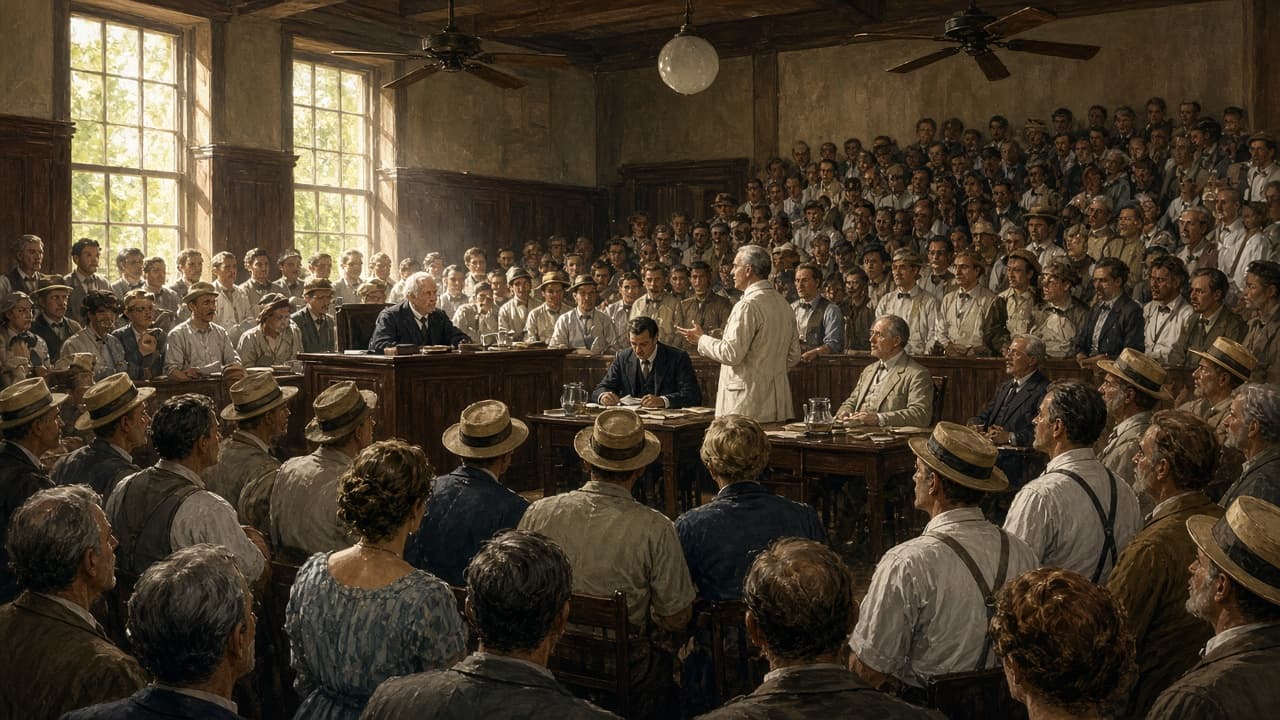
On 21 July 1925, after eight days of proceedings in Dayton, Tennessee, the jury in the case of The State of Tennessee v. John Thomas Scopes retired, deliberated for about nine minutes and returned a guilty verdict. Judge John Raulston set the fine at $100, the statutory minimum. The defence had asked the jury to convict. That is the detail that explains the whole event: the trial was never intended to acquit anybody.
The law at issue was the Butler Act, passed by the Tennessee legislature in March 1925. It made it unlawful in any state-funded school "to teach any theory that denies the story of the Divine Creation of man as taught in the Bible, and to teach instead that man has descended from a lower order of animals." The bill's sponsor, a farmer and legislator named John Washington Butler, later said he had not expected it to be enforced. The governor signed it while doubting it would be.
The American Civil Liberties Union placed advertisements in Tennessee newspapers offering to fund a test case for any teacher willing to be prosecuted. In Dayton, a small town whose economy had been shrinking, a group of local businessmen meeting in Robinson's drugstore saw an opportunity to put the town on the map. They approached John Scopes, a 24-year-old general science teacher and football coach who had substituted in a biology class. He agreed. He was never even certain he had taught the chapter in question.
Two national figures then turned a staged prosecution into a spectacle. William Jennings Bryan, three times a Democratic presidential nominee, former secretary of state and the most famous populist orator in America, joined the prosecution. Clarence Darrow, the country's best-known defence lawyer, volunteered for the defence. Bryan's opposition to evolution was tied to his politics: he associated it with social Darwinism, with the eugenics then being taught in American textbooks and with the argument that the strong should not be restrained.
The textbook Scopes used, George William Hunter's A Civic Biology, makes Bryan's concern less abstract than it sounds. It presented human races in a hierarchy and advocated eugenic measures against families it described as parasitic. That content was mainstream in American science education in 1925 and it is part of the historical record of the trial, even though it plays no part in the popular retelling.
The coverage was unprecedented. More than two hundred reporters came to a town of about 1,800 people. It was the first American trial broadcast live on radio, carried by WGN in Chicago. H. L. Mencken of the Baltimore Sun sent dispatches that mocked the town and its residents in language that shaped how the rest of the country understood the case and coined the nickname Monkey Trial. Telegraph wires were run into the courthouse and vendors sold toy monkeys on the street.
Legally the defence was boxed in from the start. Judge Raulston ruled that the question before the court was narrow: had Scopes taught evolution in violation of the statute? Whether the statute was good law or bad science was not admissible. That ruling excluded the defence's expert scientific witnesses, who had travelled to Dayton and whose testimony was entered only as written statements for the appeal record.
So Darrow tried something else. On 20 July, with proceedings moved onto the courthouse lawn because of the heat and the crowd, he called Bryan himself to the stand as an expert on the Bible. Bryan agreed, over the prosecution's objections. For about two hours Darrow questioned him on Jonah and the whale, Joshua stopping the sun and the age of the Earth. Bryan conceded that the six days of creation might not have been 24-hour days, which was a real concession to his own supporters, and the exchange grew angry on both sides. The judge struck the testimony the next morning.
With the scientific evidence excluded and the constitutional argument reserved for appeal, Darrow asked the jury to find his client guilty so the case could be taken upward. It worked procedurally and then failed on a technicality. The Tennessee Supreme Court in 1927 upheld the Butler Act as constitutional but overturned Scopes's conviction because the judge, rather than the jury, had set the fine. With no conviction there was no case to appeal to the United States Supreme Court, which is exactly what the state wanted.
Bryan died in Dayton on 26 July 1925, five days after the verdict, in his sleep after a heavy meal. He had been diabetic and exhausted. His death fixed the popular image of a man broken on the witness stand, which is a considerable simplification. Scopes took a scholarship to study geology and spent his career as a petroleum engineer, away from the argument entirely. He returned to Dayton once, in 1960, for the premiere of the film Inherit the Wind.
That play and film, written in 1955 as an allegory about McCarthyism, is where most people's picture of the trial comes from, and it is not a documentary. It invents a hostile town, a jailed defendant and a romance. The actual Scopes was never jailed, was on friendly terms with the prosecution and had been recruited rather than persecuted. Historians have spent decades separating the two versions.
The legal thread continued. The Butler Act stayed on the Tennessee statute book until 1967. In 1968 the United States Supreme Court struck down a similar Arkansas law in Epperson v. Arkansas on First Amendment grounds. Later rulings blocked equal-time laws for creation science in 1987 and, in a federal court in Pennsylvania in 2005, intelligent design in public school science classes. Each decision addressed a rebranded version of the same question.
Eagle Frame's takeaway: 21 July 1925 produced a guilty verdict that the defence had requested, a $100 fine that was later voided and a constitutional appeal that never happened. The trial settled nothing in law. What it did was stage the argument in public, on the radio, in front of the whole country, and that argument about who decides what goes in a science classroom has kept returning under new names for a century.