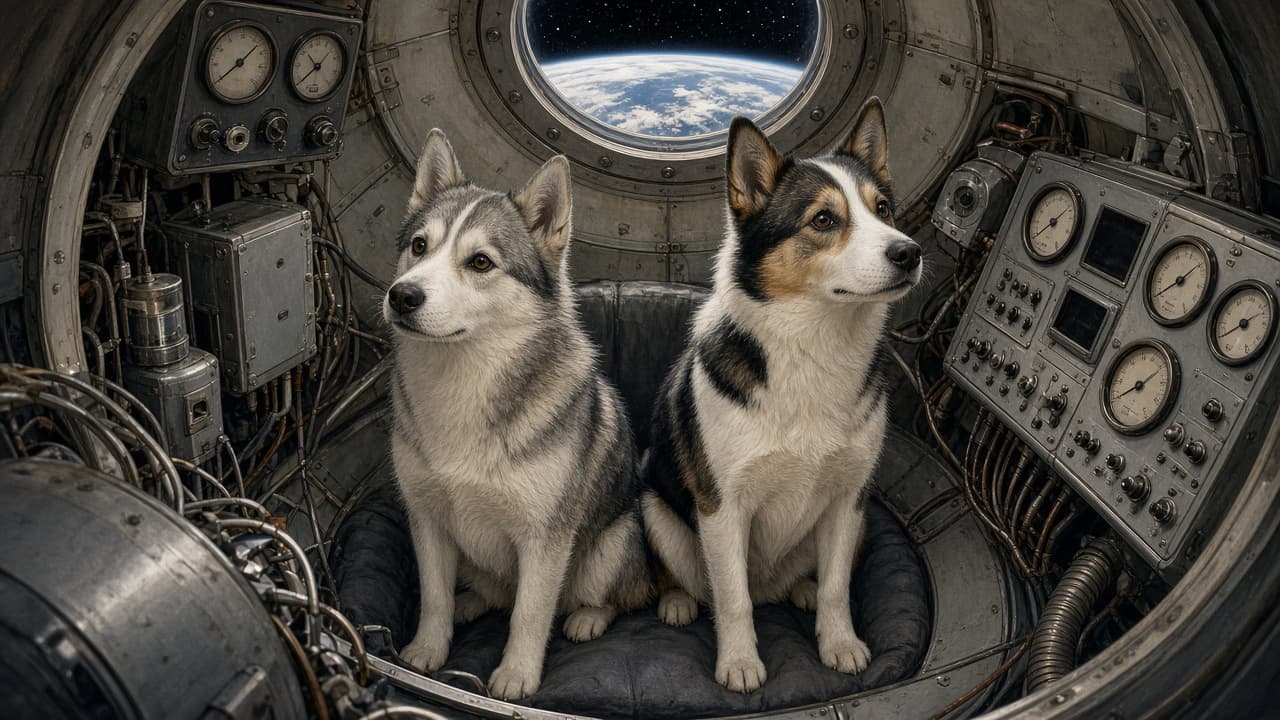
On this day: Sputnik 5 returns dogs from orbit
On 19 August 1960, the Soviet spacecraft Sputnik 5 returned safely to Earth with dogs Belka and Strelka aboard. The mission proved that living creatures could survive orbital flight and reentry.
On 19 August 1960, the Soviet Union recovered the spacecraft known as Sputnik 5 after it returned from orbit with two dogs alive inside. Belka and Strelka had spent roughly a day in space. Their safe landing was front-page news in a world still racing to master human spaceflight. The mission was not only propaganda. It tested the life-support and reentry hardware that would later carry cosmonaut Yuri Gagarin.
What is orbital spaceflight, in plain language? A rocket accelerates a payload so fast that it falls around Earth instead of into the ground. Gravity still pulls, but the forward speed keeps the craft circling. Living inside that environment means supplying air, temperature control, food, water and protection from radiation and vacuum. For animals and humans, the hardest part is often not going up but coming back: deceleration, heat and shock when the capsule hits the atmosphere.
Sputnik 5's cabin was a pressurized life-support box: air regeneration, food, waste handling and sensors monitoring heart rate and breathing for Belka and Strelka. Engineers had to keep temperature and carbon dioxide in safe bands while the craft circled Earth for roughly a day. Telemetry watched for distress that would kill a later cosmonaut just as surely. The cutaway lesson is that animal flights were systems tests for human crews. Every hose and canister answered a human problem in miniature. Success meant the dogs not only survived orbit but returned coherent enough for veterinary study.
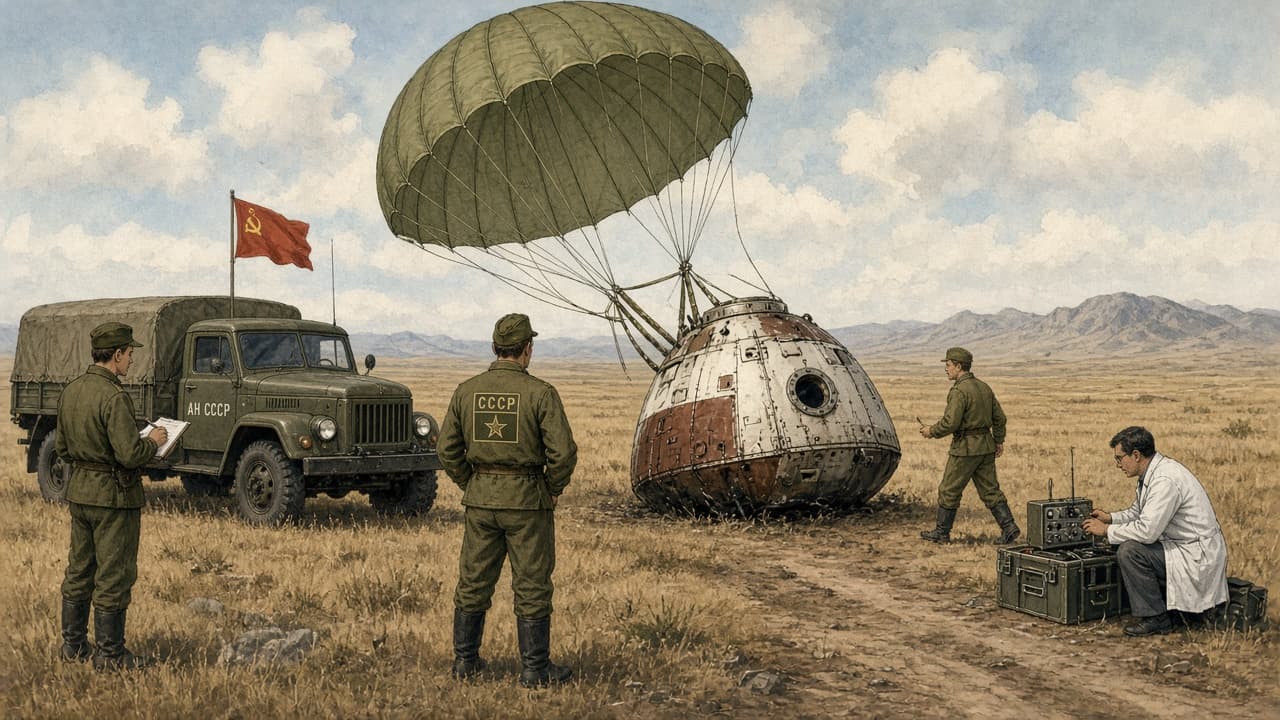
Recovery on the steppe completed the loop. After retrofire, the capsule punched through atmosphere behind a heat shield, then used parachutes to slow for ground impact. Teams raced across grassland to open hatches and retrieve the animals alive before heat or cold stressed them further. That landing choreography (tracking, helicopters, medical checks) became standard for crewed returns. The August 1960 success gave Soviet planners confidence to move toward Yuri Gagarin's flight. Readers should see the parachute scene as engineering proof, not only a soft animal story.
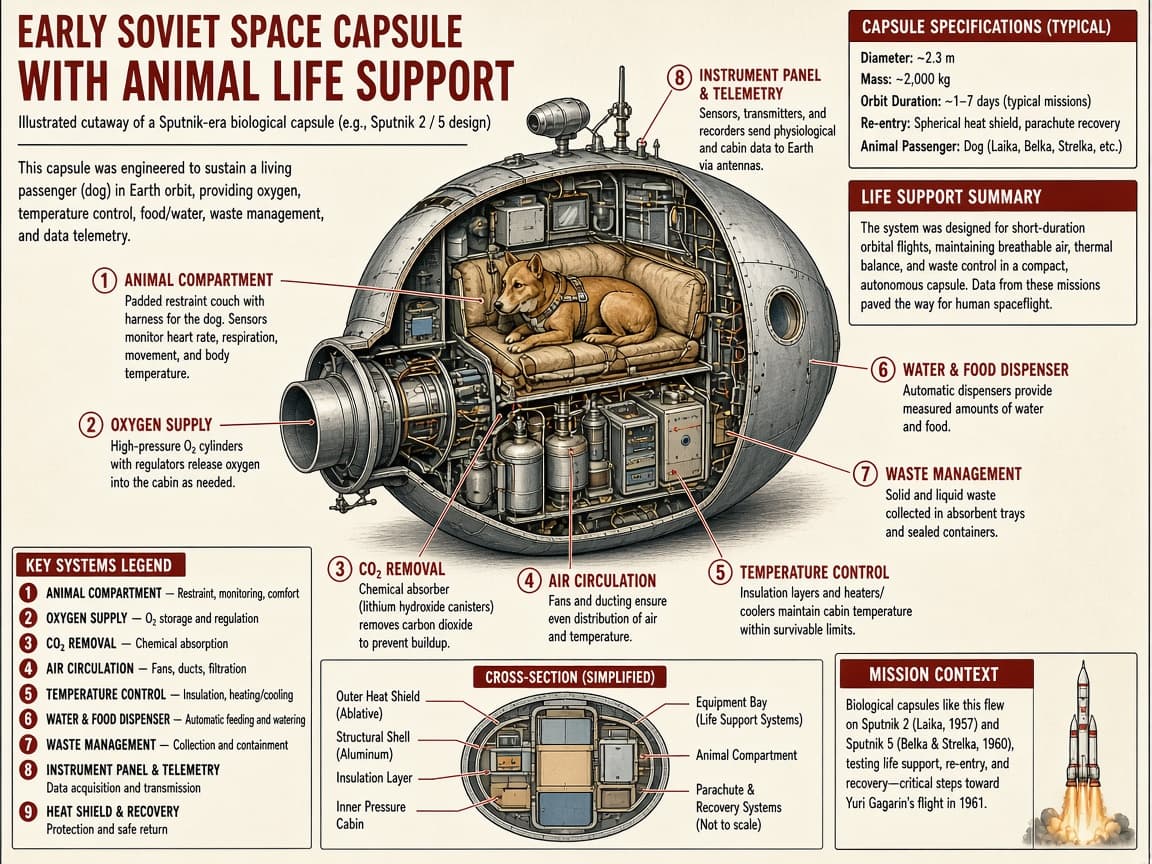
Sputnik 5 carried a pressurized cabin with life-support systems designed for biological passengers. Soviet engineers had already flown dogs on suborbital hops and on earlier Sputnik missions with mixed results. Laika, aboard Sputnik 2 in 1957, died during that flight, a fact the program later acknowledged. Belka and Strelka's mission aimed higher: full orbit, longer duration and a recoverable capsule that could survive reentry and a parachute landing.
The launch stack used a modified R-7 ballistic missile, the same family of booster that had placed the first Sputnik satellite in orbit in 1957. On 19 August the capsule descended under parachute and was located by recovery teams. Veterinarians examined the dogs. Both were alive. Television footage of their wagging tails reassured a public that wondered whether space was survivable at all. Strelka later had puppies; one was given to Jacqueline Kennedy, a Cold War gesture as strange as it was soft.
Mechanically, reentry works like this: the capsule slows by hitting the upper atmosphere at high speed. Friction heats the outer shell. Ablative or insulated heat shields protect the cabin. Parachutes deploy at lower altitude. Impact forces must stay within limits a body can tolerate. Sensors recorded temperature, pressure and acceleration so engineers could refine the next design. Each successful dog flight reduced guesswork before putting a human in the seat.
The mission also carried other biological specimens (including mice and insects) and returned them for study. Scientists wanted data on how weightlessness and radiation affected cells and organs. That research fed both space medicine and the prestige contest between Moscow and Washington. When NASA later launched Mercury astronauts, Soviet successes with dogs were part of the background pressure.
Cold War context shaped how the story was told. Soviet media celebrated socialist science. American commentators weighed whether the USSR still led the space race after earlier setbacks. Neither side's press emphasized animal ethics questions that later generations would raise more sharply. For historians, Belka and Strelka sit in a chain from wartime rocket development through Sputnik's beep to Gagarin's 1961 flight and Apollo's Moon landing.
Modern space stations keep humans aloft for months with recycling air and water. The basic problems Sputnik 5 tested (sealed cabins, thermal control, safe return) remain central. Tourist suborbital hops and Mars plans still depend on the same physics Belka and Strelka proved survivable in 1960. The dogs' names mean Squirrel and Little Arrow in Russian. Schoolchildren in the Soviet Union learned them like nursery rhyme characters.
Telemetry from the flight recorded heart rates, breathing and cabin pressure through launch, orbit and landing. Veterinarians compared the dogs' condition with ground controls. Those datasets fed capsule redesigns before human candidates strapped in. Every later splashdown, from Mercury to SpaceX, rests partly on animal flights that answered whether bodies could survive the numbers on the engineer's chart. Soviet press celebrated the dogs as national heroes while American planners accelerated Mercury schedules. The space race was not only rockets. It was also biology proving that hearts and lungs could survive launch stress. Belka and Strelka's wagging tails on film were soft propaganda with hard engineering behind them.
Eagle Frame's takeaway: 19 August 1960 is when Sputnik 5 brought Belka and Strelka back from orbit alive. Know the life-support cabin, know the reentry heat-and-parachute sequence and know why that dog flight mattered before Gagarin became the first human in space.