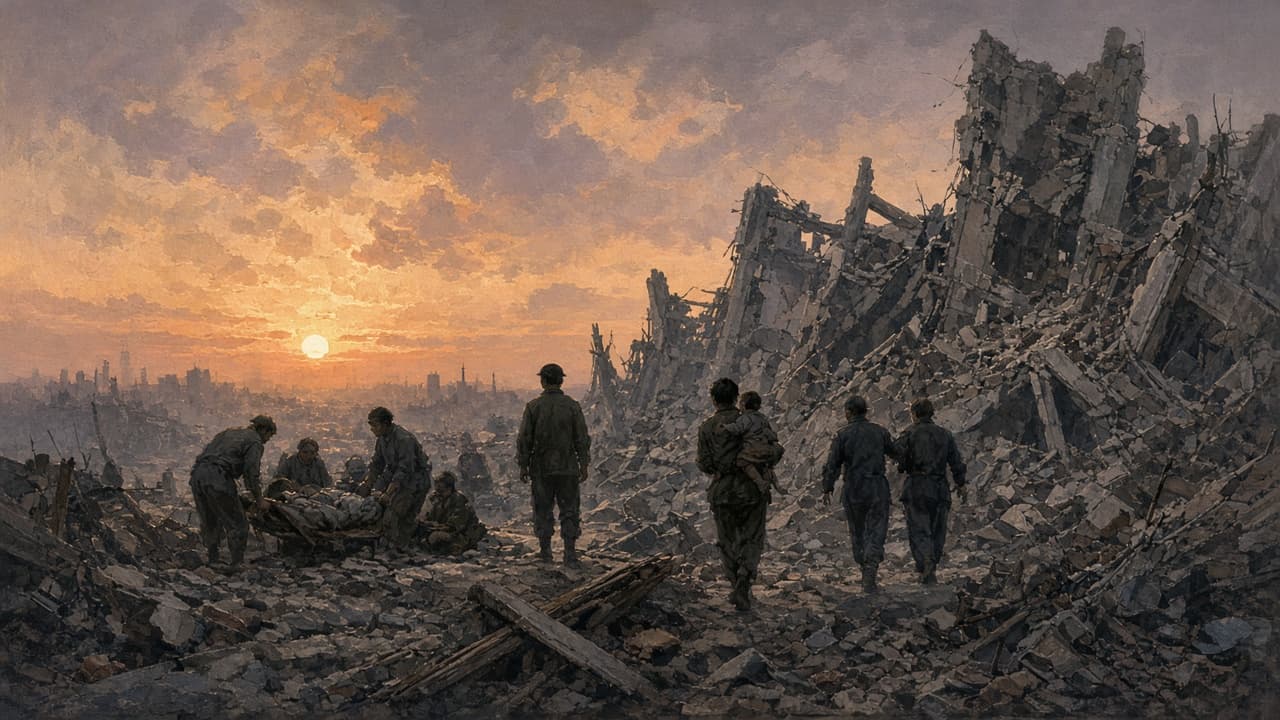
On this day: the Tangshan earthquake strikes
On 28 July 1976, a magnitude 7.8 earthquake destroyed the Chinese industrial city of Tangshan while its residents slept. The official death toll is 242,769, and it remains one of the deadliest earthquakes of the twentieth century.
At 3:42 in the morning on 28 July 1976, the ground under Tangshan moved. The shock measured about magnitude 7.8 and its focus was shallow, roughly 12 to 15 kilometres below the surface, almost directly beneath a coal and steel city of around a million people. Most of them were asleep in single-storey and low-rise brick homes. The main shaking lasted well under a minute. When it stopped, the great majority of buildings in the city centre were down. China's official death toll is 242,769, with about 164,000 severely injured. Some independent estimates run higher.
It is worth explaining what an earthquake actually is before describing this one. The outer shell of the Earth is broken into rigid plates that grind slowly past and into each other. Inside and along the edges of those plates, rock is under constant strain. Faults are the fracture surfaces where rock finally slips. Strain builds for decades or centuries because friction locks the two sides together. When friction gives way, the stored energy releases as seismic waves that travel outward through the ground.
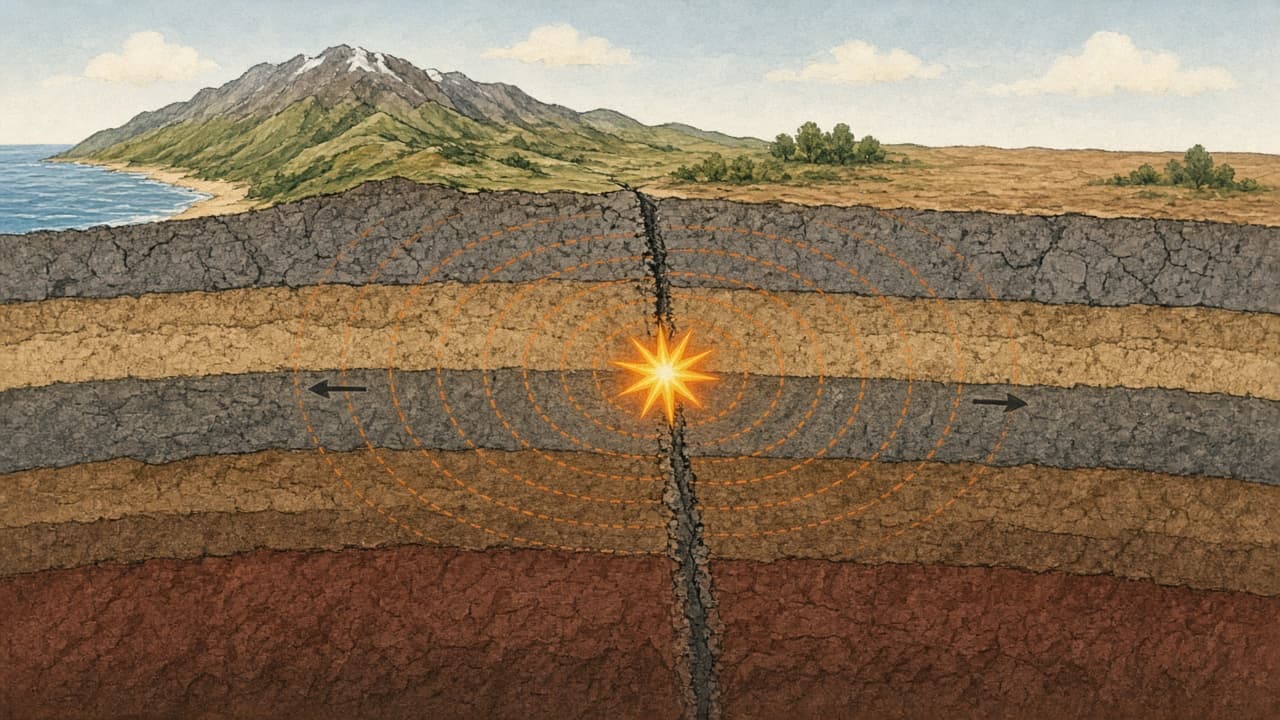
The Tangshan quake happened on a strike-slip fault, which means the two blocks of rock slid mostly sideways past each other rather than one riding over the other. That fault sits within the North China plain, away from the famous plate boundaries, which is one reason the risk had been underrated. Intraplate earthquakes are rarer than boundary quakes, but the crust there is old, cold and rigid, so the waves travel efficiently and shake a wide area hard.
Two features made this quake unusually lethal. The first is depth. A shallow focus puts the strongest shaking directly under the city instead of spreading it out. The second is timing and construction. Tangshan was built largely of unreinforced brick and masonry with heavy roofs, a style that performs badly in horizontal shaking. Brick walls have almost no tensile strength. When the ground moves sideways, walls crack, lose their bond with the floor above and the roof comes straight down. At 3:42 in the morning, the people under those roofs were in bed.
Seismologists describe ground shaking in two ways that readers often mix up. Magnitude measures the energy released at the source and there is one number per earthquake. Intensity measures how hard the ground shook at a given place, so it varies across a map and depends on distance, depth and soil. Tangshan recorded intensity at the top of the Chinese scale in the city centre. Soft or saturated soils can also liquefy, behaving briefly like a dense fluid, which tips buildings that otherwise would have stood.
The disaster did not end at 3:43. A magnitude 7.1 aftershock hit the same afternoon, around 18:45, killing rescuers and survivors who had gone back into damaged buildings. Water, power, rail and telephone lines were cut. Roads into the city were blocked by rubble and by damaged bridges. Coal mines under the city flooded or lost their hoists, though a remarkable number of underground miners survived because the tunnels moved with the rock instead of collapsing like surface walls. Shaking was felt in Beijing, about 150 kilometres west, where older buildings were damaged.
The rescue was enormous and almost entirely domestic. More than 100,000 soldiers of the People's Liberation Army were sent in, mostly digging by hand with limited heavy equipment. China under Mao Zedong declined offers of foreign aid and kept the scale of the loss out of international reporting for years. The official death toll was not published until 1979. That silence has become part of the event's history and a standard reference point in later arguments about disaster transparency.
1976 was already a year of political strain in China. Premier Zhou Enlai died in January, Marshal Zhu De in July, and Mao Zedong died on 9 September, less than seven weeks after the quake. In a political culture that still carried the old idea that natural catastrophe signals a dynasty in trouble, the coincidence was impossible to miss. The Gang of Four fell in October. Historians are careful not to make the earthquake a cause of the political turn, but it sat inside that year of endings.
Tangshan was rebuilt on the same ground with different rules. Chinese building codes were revised, seismic zoning maps were redrawn and the reconstructed city used reinforced concrete frames and tied masonry designed to hold together when shaken. The engineering lesson is consistent worldwide: the shaking rarely kills people directly, buildings do. Reinforcement that lets a structure flex, ties between walls and floors and anchored roofs are what turn a lethal quake into a survivable one. Countries that invested in codes after their own disasters, including Japan and Chile, show the difference in later death tolls.
There is also a false lesson to avoid. Chinese scientists had successfully issued a warning before the Haicheng earthquake in February 1975, based on foreshocks, groundwater changes and animal behaviour, and an evacuation saved many lives. Tangshan gave almost no such precursors. The pair of events is now taught as the limit of short-term prediction. Seismologists can map hazard over decades and give seconds of warning once shaking starts, but they cannot reliably tell a city to leave next Tuesday.
Eagle Frame's takeaway: 28 July 1976 is the day a shallow strike-slip rupture under a sleeping industrial city produced one of the deadliest quakes on record. The physics is not exotic: locked rock, sudden slip, sideways shaking. The death toll came from brick walls with nothing holding them together. Building codes, not prediction, are what save the next city.