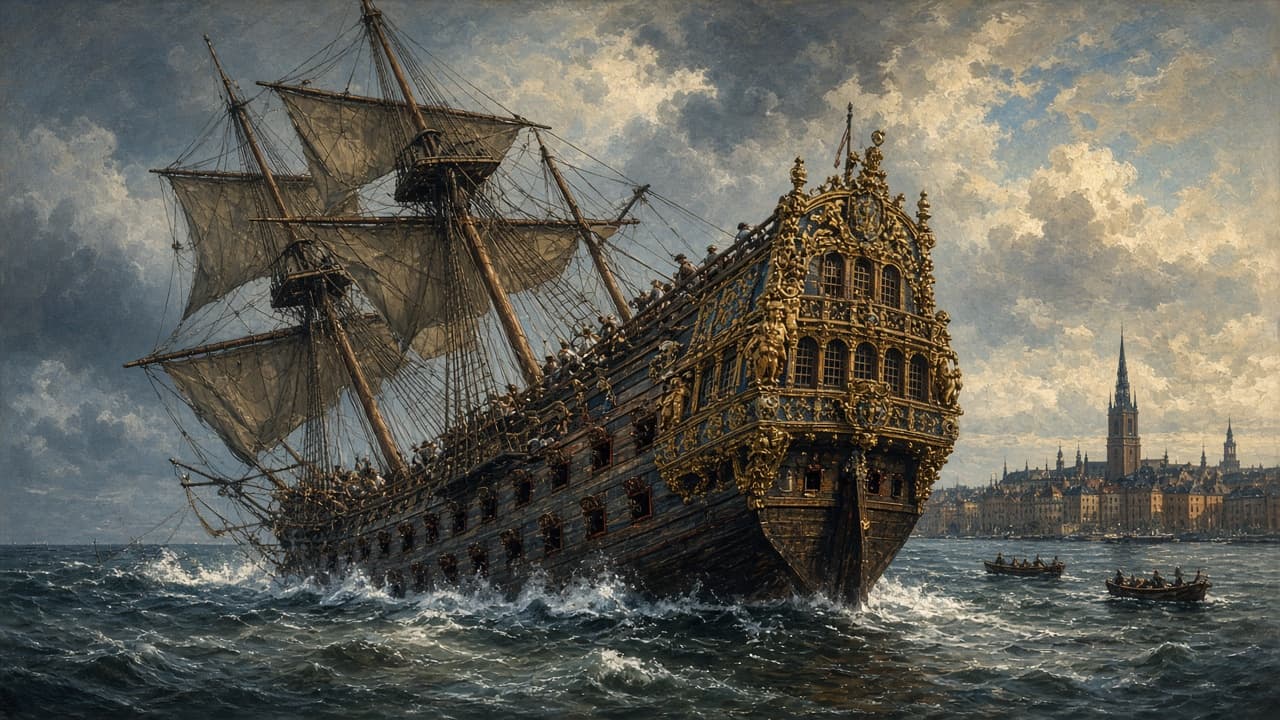
On this day: the warship Vasa sinks on its maiden voyage
On 10 August 1628, the Swedish warship Vasa capsized in Stockholm harbor minutes after leaving the dock. Top-heavy design and a light breeze doomed the voyage; the ship later became a museum treasure.
On 10 August 1628, the Swedish warship Vasa sailed from Stockholm on her maiden voyage and sank within minutes. A gust heeled the ship so far that water poured through open gunports. She settled in the harbor's mud in full view of a shocked crowd. King Gustavus Adolphus had ordered a powerful new vessel for wars in the Baltic. What he got was a floating lesson in naval architecture: beauty and firepower without enough stability.
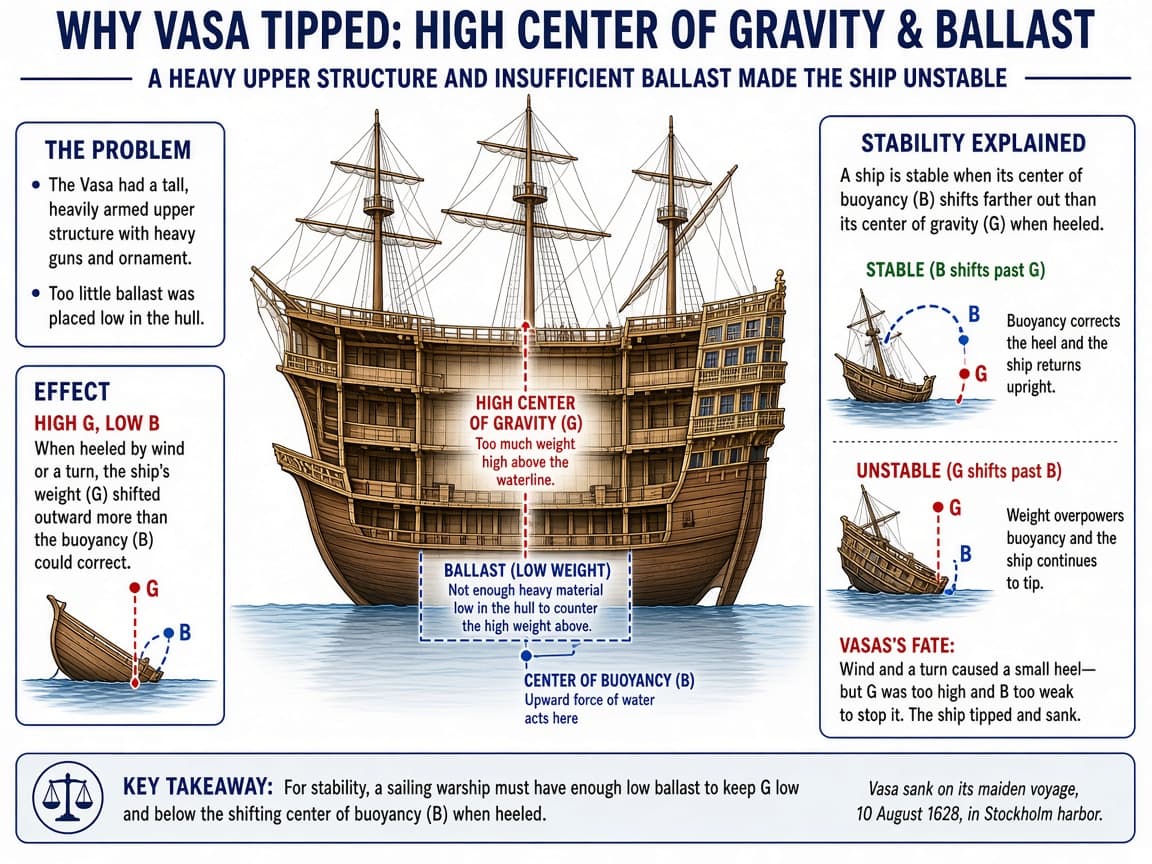
What is stability, in plain language? A ship floating upright has its center of gravity and the buoyant push of water arranged so that when the hull tips, underwater shape creates a righting force that helps it return. If weight sits too high or if the hull's underwater volume is wrong for that weight, tipping can grow instead of correct. Gun decks stacked with heavy bronze cannon raise the center of gravity. Open lower gunports close to the waterline invite flooding once the heel angle is large. Vasa had those risks baked into her lines.
Stability failure on Vasa can be pictured as a seesaw inside the hull. Guns, upper timbers and ornament sat high. Ballast and submerged volume sat lower. When a breeze pressed the sails, the ship heeled. Because the center of gravity sat too high relative to the hull's ability to push back upright, the heel grew instead of correcting. Open lower gunports then scooped water. That sequence is why naval architects still draw cross-sections with labeled centers: they are teaching the same physics that dumped a royal warship in a harbor.
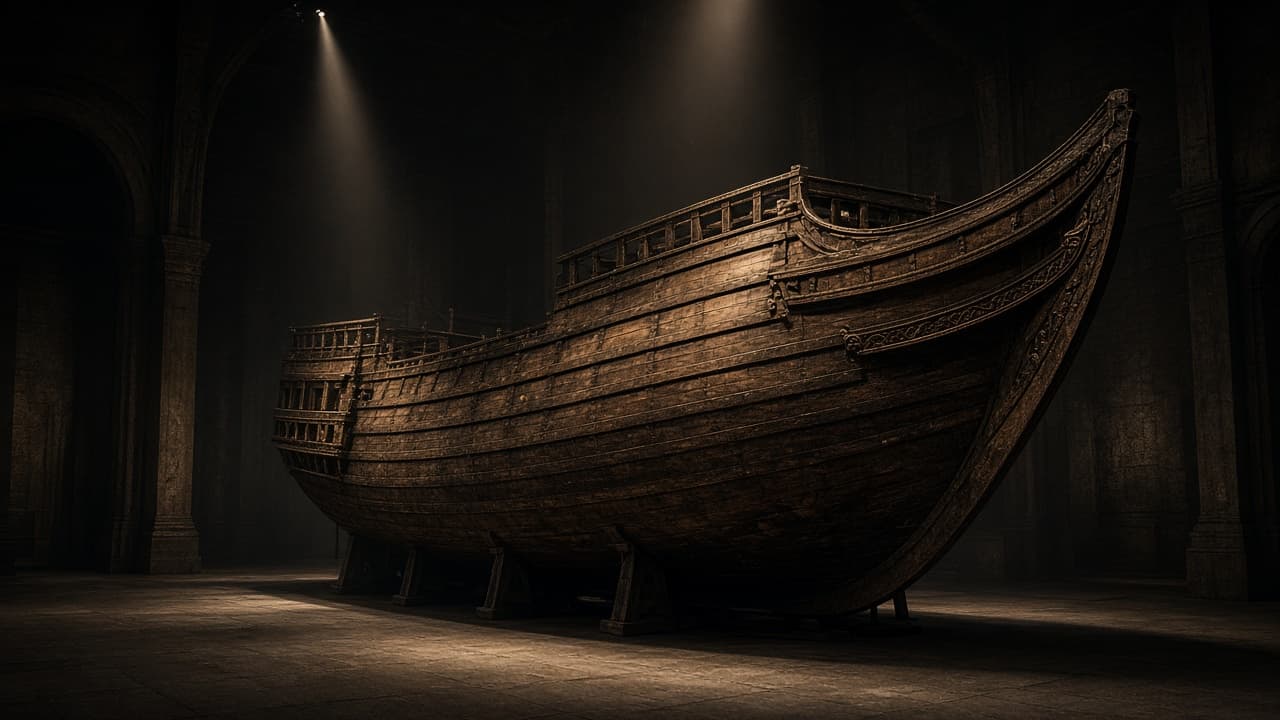
The recovered hull in Stockholm's Vasa Museum is more than a tourist silhouette. Cold Baltic water limited wood-boring worms, so carvings, tools and personal gear survived for centuries. Conservators replaced seawater with polyethylene glycol and now manage humidity so the timber does not shrink into ruin. Visitors walking the dark hall see a seventeenth-century weapons platform frozen mid-career. The museum converts a public embarrassment into a teaching collection on shipbuilding pressure, incomplete testing and the cost of ignoring stability for spectacle.
Contemporary accounts and later archaeology agree on the outline. Shipwrights built Vasa under pressure to impress. Design changes during construction added a second gun deck and more armament. A stability test (men running side to side on deck) reportedly showed dangerous rolling, yet launching went ahead. On the voyage day, sails were set in a light wind. After a short distance the ship leaned, recovered slightly, then leaned again as water rushed in. Dozens of people died. The pride of Sweden's fleet never fired a wartime shot.
An inquest followed. Blame swirled among builders, officers and the king's own demands for a formidable ship. Seventeenth-century engineering lacked the mathematical stability calculations modern naval architects use. Builders worked from experience, rules of thumb and the sovereign's impatience. Vasa's failure became evidence written in oak and bronze: political urgency can outrun physical limits.
Salvage in the 1600s recovered some valuable bronze cannon. The hull stayed underwater for centuries, preserved by the cold, brackish Baltic that limited the shipworms that destroy wrecks in saltier seas. In 1961, after years of planning, Sweden raised Vasa largely intact. Conservation teams sprayed polyethylene glycol for decades to replace water in the wood and prevent collapse as she dried. The Vasa Museum in Stockholm now draws visitors to walk beside a nearly complete seventeenth-century warship.
The museum is not only spectacle. It is a dataset. Sculptures, tools, personal belongings and hull joinery show how warships were built and how sailors lived. Researchers study clothing, food remains and the carved propaganda of royal power on the stern. A disaster became an archive because mud and chemistry paused decay long enough for modern science to arrive.
Engineers still cite Vasa when they teach risk. Adding capability (more guns, more decks, more ornament) without rebalancing the system invites failure modes that a light breeze can trigger. The same pattern appears in software, bridges and spacecraft: requirements creep without a new stability check. Vasa makes the metaphor concrete because you can stand beside the actual failed ship.
For Sweden's historical memory, 10 August 1628 is embarrassment turned into expertise. The kingdom that lost a flagship in its own harbor later led the world in recovering and conserving it. Tourists photograph the masts. Students sketch the heel angle. Both are reading the same physics lesson the crowd learned the hard way when gunports met the sea.
Modern naval architects use computer models to test stability before launch. In 1628 those models were full-size ships and the test was public. When Vasa heeled on her maiden sail, the righting moment failed because too much weight sat above the waterline and not enough ballast sat low. Gunports cut into the hull near the surface turned a recoverable lean into flooding. The lesson traveled across navies: every added deck of cannon is a stability calculation, not only a firepower boast. Stockholm's museum lets visitors see the actual failure instead of only reading about it in a textbook margin.
Eagle Frame's takeaway: 10 August 1628 is when Vasa proved that a warship can look invincible and still be unstable. Know the high guns, know the open ports and know why the raised hull in Stockholm still teaches engineering humility.