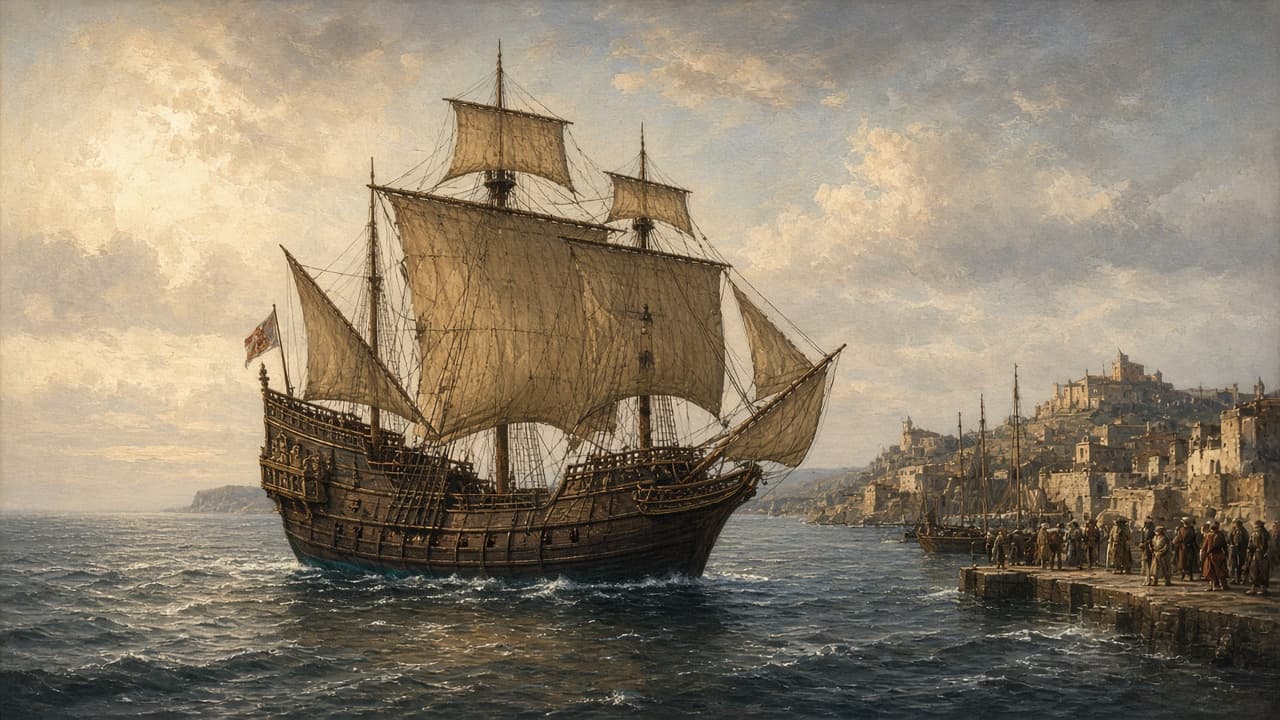
On this day: Victoria completes the first circumnavigation
On 6 September 1522, the Spanish ship Victoria returned to Spain under Juan Sebastian Elcano, completing the first recorded circumnavigation of the Earth. Ferdinand Magellan had died in the Philippines the year before.
On 6 September 1522, the battered Spanish ship Victoria sailed into Sanlucar de Barrameda on the Atlantic coast of Spain. Eighteen men were still alive on board under the command of Juan Sebastian Elcano. They had left Spain in 1519 as part of a fleet led by Ferdinand Magellan. Three years later Victoria was the only ship to complete the loop. The return closed the first recorded circumnavigation of the Earth: a voyage that went west from Europe, crossed oceans Magellan's generation was still mapping and came home from the east with proof that the oceans connected.
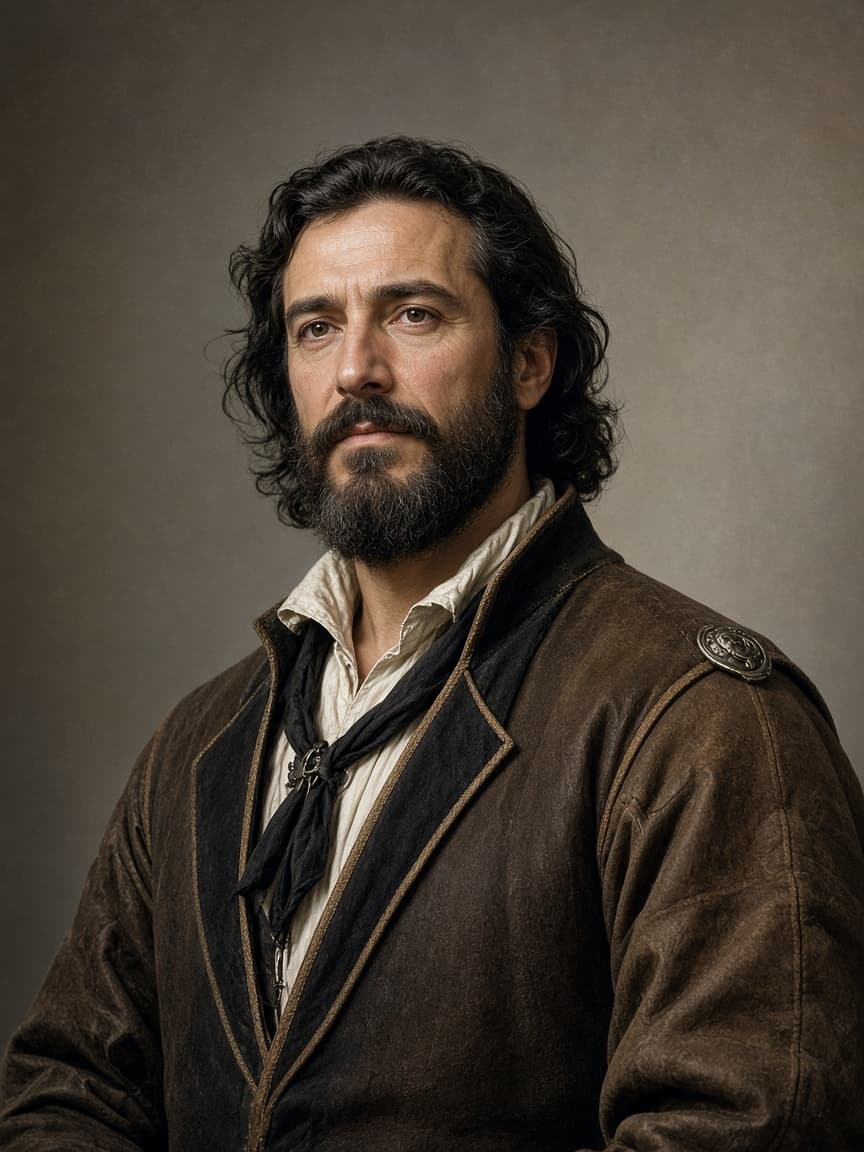
Circumnavigation means sailing or traveling all the way around the world and returning to the starting region by a continuous route that encloses the globe. On a sphere, any closed path that goes around rather than backtracking on the same line can count. In the age of sail the practical test was brutal: leave a European port, keep going by sea across unknown waters and arrive home from the opposite direction with a logbook that showed you had not simply reversed course. Victoria's crew met that test. Their success was navigational, commercial and political at once, because Spain and Portugal were competing for routes to the spice islands under papal lines of demarcation.
Magellan himself did not live to see Spain again. A Portuguese navigator sailing for the Spanish crown, he commanded five ships when the fleet departed from Seville and Sanlucar in 1519. He found a passage through the southern tip of South America, later called the Strait of Magellan. He entered the ocean he named Pacific because it looked calm after the passage. Crossing that ocean took far longer than expected. Food and water ran low. Scurvy killed men who had survived storms. In April 1521 Magellan was killed in a fight on Mactan in the Philippines while intervening in a local conflict. Leadership of the remaining expedition passed through several hands before Elcano took Victoria westward toward Africa and home. Portraits of Magellan are common in later art. The man who finished the circle was Elcano.
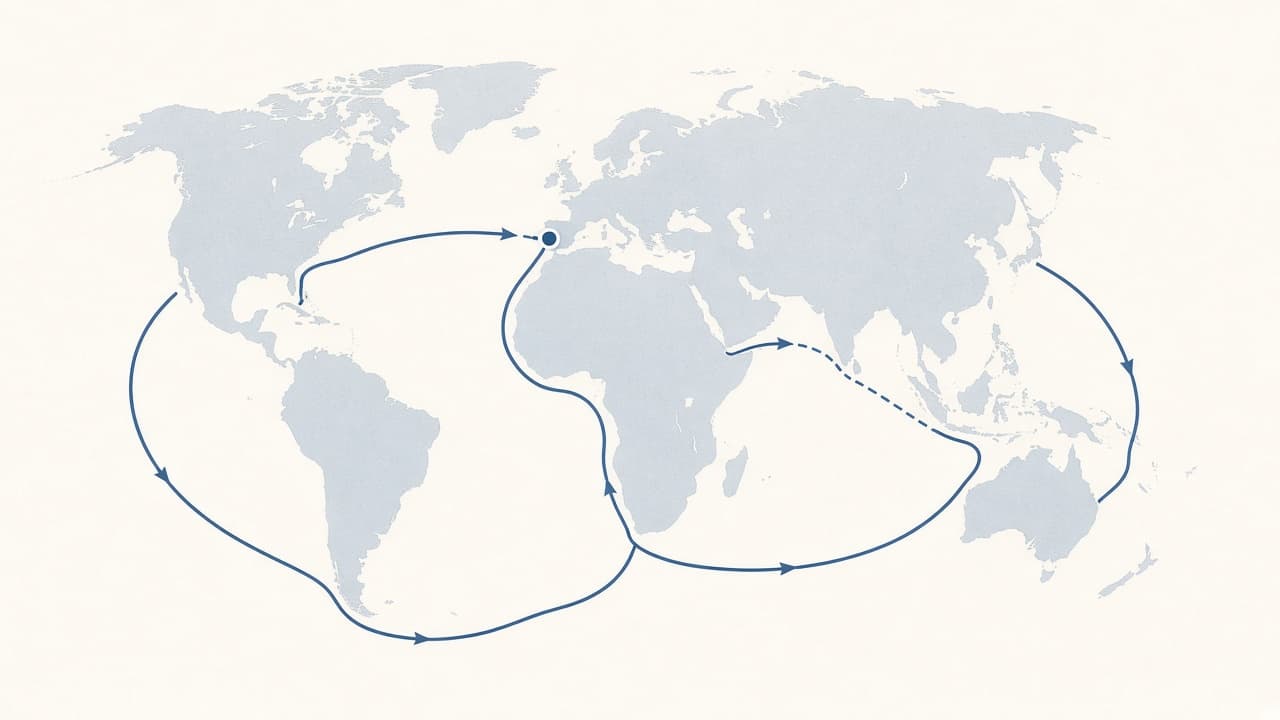
Elcano was born around 1476 in Getaria in the Basque Country. He was an experienced seaman by the time he joined Magellan's fleet. After Magellan's death and further losses among the officers, he became captain of Victoria for the most dangerous commercial leg of the journey: loading spices in the Moluccas and then deciding whether to try for home by crossing Portuguese-dominated waters. A second surviving ship, Trinidad, attempted a Pacific return and failed. Victoria went west into the Indian Ocean, around the Cape of Good Hope and north along Africa, hiding from Portuguese patrols when it could.
The geography lesson inside the voyage is easy to miss if you only remember the word first. European maps in 1519 still treated the Americas as a barrier whose southern end was uncertain and the Pacific as an unknown width. Magellan proved a navigable strait existed and that Asia lay across a vast ocean to the west of America. Elcano's return proved that a ship could keep going until European waters reappeared. Together those facts collapsed older habits of thinking about the oceans as separate bowls. The world ocean was one system, even if monsoon winds, scurvy and hunger made using it lethal.
Numbers tell the cost. The fleet had left with about 240 to 270 men depending on the source. Victoria returned with 18 European survivors, plus a few islanders taken on along the way according to some accounts. Other ships had been wrecked, seized or turned back. Cargo that did come home included cloves and other spices valuable enough to help justify the expedition's expense to the Spanish crown. Profit and knowledge traveled together. So did claims of sovereignty that would shape later colonial conflict in Southeast Asia.
It is fair to name both men without turning the story into a simple hero contest. Magellan organized the expedition, forced the passage into the Pacific and died mid-voyage. Elcano finished the circle and filed the return that made circumnavigation a recorded European fact. Later national storytelling in Spain and Portugal sometimes argued over credit. The logbooks and the arrival date at Sanlucar are clearer than the myths: without Magellan the route west would not have opened when it did; without Elcano Victoria would not have closed the loop in 1522.
What the voyage did not do is discover that the Earth is round. Educated Europeans already worked from a spherical model. What changed was empirical proof of oceanic continuity and a usable if terrible route for spice trade competition. Indigenous peoples across the Pacific and Asia already lived on the shores the fleet touched. Circumnavigation here means a European ship completing a global circuit under European sponsorship, not the first human understanding of a wide world.
After 1522 other voyages repeated and refined long ocean passages. English, Dutch and later navigators built on Pacific and Indian Ocean knowledge that Magellan's fleet had bought at terrible cost. The Magellan-Elcano route remained famous because it was first in the written European record and because it tied navigation to empire. Modern sailors still treat the strait and the Pacific crossing as landmarks in the history of seamanship. Museums in Spain and Portugal keep the rivalry alive in exhibits, while textbooks compress three years of hunger and improvisation into a single sentence about sailing around the world. The better sentence names both captains and teaches what circumnavigation actually means on a globe.
Eagle Frame's takeaway: 6 September 1522 is the day Victoria came home and turned circumnavigation from a plan into a completed voyage. Magellan opened the westbound path and died in the Philippines; Elcano commanded the return. The map lesson is simple and large. The oceans connect. A ship that keeps going can close a circle around the Earth.